
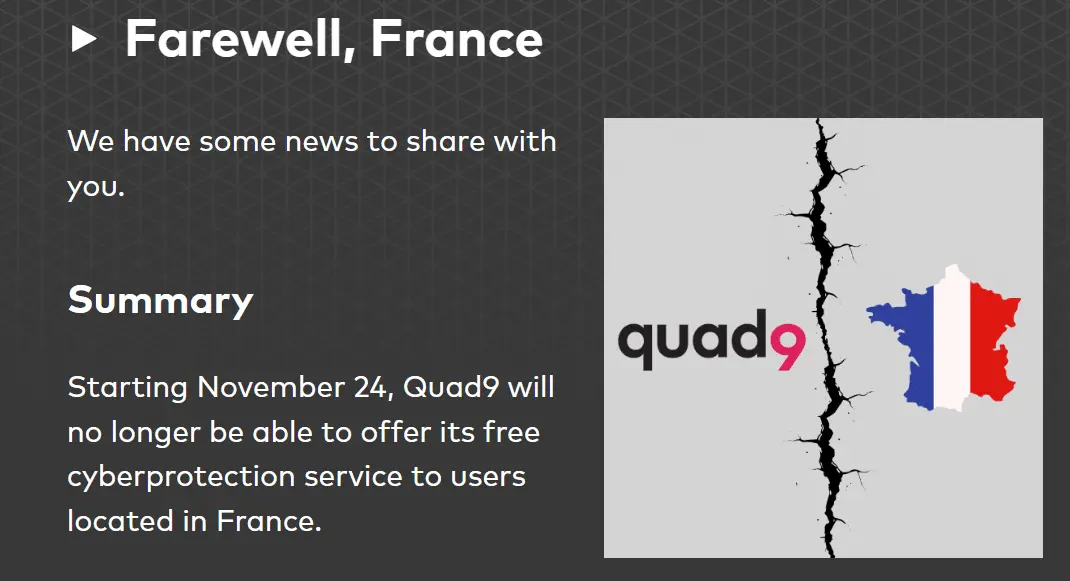
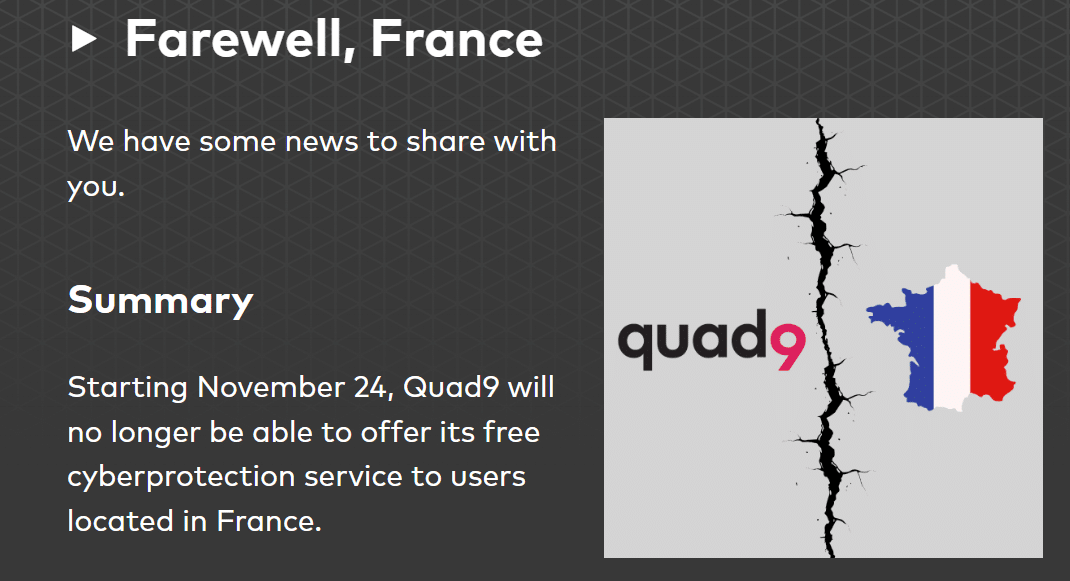
Swiss non-profit DNS resolver Quad9 has announced it is pulling out of France entirely after a Paris court ordered financial penalties over the organization’s refusal to block domains broadcasting unauthorized tennis streams. Starting November 24, Quad9 will officially stop serving users in France, making it the second major public DNS resolver to abandon the country over escalating website-blocking mandates.
The decision arrives in the wake of a legal battle initiated by sports broadcaster beIN Sports, which targeted Quad9 for failing to comply with a May court order requiring the blocking of pirate domains. While beIN initially demanded exorbitant daily penalties reaching up to €580,000 for non-compliance, the Paris court ultimately ruled on a lower penalty structure, setting the fine at €1,000 per day. Although significantly reduced from the broadcaster’s original request, the penalty still presented an untenable financial burden for the privacy-focused foundation, particularly when compounded by roughly 20 other pending blocking cases across the country.
Earlier this month, representatives for Quad9 informed reporters that the foundation was actively weighing its future in France, explicitly leaving open the possibility of a complete market withdrawal. Yesterday’s ruling cemented that trajectory, prompting the Swiss-based organization to publish a definitive "Au revoir, France" statement confirming that it will no longer offer recursive DNS resolution services to internet users within French borders as of November 24.

€1,000 a Day and the Burden of Compliance
The Paris Judicial Court ordered Quad9 to implement a blocking directive initially issued in May, which has since expanded to encompass 58 distinct domain names. Failure to comply would trigger a penalty of €1,000 per day. While beIN had pushed for a rate of €10,000 per day for every individual domain that remained accessible through Quad9’s network, the court consolidated the figure into a single daily penalty of €1,000 running until the blocking measures expire on November 14. Quad9 calculated that this period alone accumulates to approximately €24,000 in direct fines, excluding the foundation’s mounting legal expenses.
In its legal reasoning, the court emphasized Quad9’s own admissions. According to the judicial panel, the foundation was obligated to make reasonable efforts to restrict access to the designated domain names but deliberately chose to take zero action. This approach contrasted sharply with the outcomes of similar recent legal challenges involving other network intermediaries.
Earlier this month, the same Paris court rejected penalty requests filed by beIN against Cloudflare and several prominent virtual private network (VPN) providers. Those entities had successfully implemented blocks on at least a portion of the targeted domains, a measure the court deemed a sufficient manifestation of reasonable effort. A similar outcome occurred in September when Canal+ lost a parallel penalty bid against Cloudflare regarding its 1.1.1.1 resolver. Quad9, conversely, maintained a strict policy of non-compliance, confirming in court submissions that it had not blocked a single domain on the list.

Leaving France on Principle
For Quad9, the dispute extends far beyond monetary fines or legal expenditure. The foundation operates under the core philosophy that recursive DNS resolution should remain a neutral public utility, fundamentally untouched by commercial or judicial alterations.
In a formal statement addressing the controversy, Quad9 articulated its stance on data integrity, explaining that the organization categorically refuses to alter or misrepresent DNS responses in a manner contrary to user expectations. The foundation further noted a technical barrier inherent to its infrastructure: because its free service operates globally without requiring user registration, there is no reliable method to isolate and apply filtering exclusively to users physically located in France.
While complying with the court order would technically require blocking the specified domains for all users worldwide—thereby satisfying French jurisdiction by casting a global net—Quad9 flatly rejected the notion of enforcing a local French court mandate upon internet users across the globe.
When evaluating how it will technically cease service for French users, Quad9 admitted that all available methods are imperfect. Furthermore, the foundation argues that regional DNS-level blocking is largely ineffective as an anti-piracy tool. Determined users can easily bypass the restrictions by switching to any of the thousands of alternative open DNS resolvers available online. Describing the futility of the measure, the foundation compared the mandate to holding a single piece of newspaper in front of a stadium crowd to block their view of a concert.
Mounting Legal Pressure and Future Outlook
The catalyst for Quad9’s departure was not isolated to the immediate conflict with beIN Sports. The foundation faces approximately 20 other pending court cases in France centered around similar site-blocking demands. Executives concluded that even if individual penalties appear manageable in isolation, the cumulative weight of ongoing and future litigation would ultimately bankrupt the non-profit entity.
"Quad9 cannot survive the accumulation of penalties yet to be assessed in 20 other pending cases, nor those of future cases similar to the one brought by beIN," the foundation stated, underscoring the impossibility of maintaining operations under such regulatory exposure.

Quad9 is not the pioneer of this retreat. In 2024, OpenDNS similarly suspended its services in France following a piracy-blocking order brought by broadcaster Canal+.
Beyond operational survival, Quad9’s leadership views the broader trend of judicial blocking mandates as a dangerous precedent for digital rights and infrastructure. The foundation warns that legal mechanisms ostensibly established to protect specific commercial content rights can easily expand in scope. In the words of the organization, once the tools of censorship are constructed, they are rarely deployed sparingly or justly.
While an appeal remains pending and the foundation has vowed to continue its broader fight against court-ordered DNS restrictions, its immediate chapter in France is drawing to a close. French users relying on the service have until November 24 to transition to alternative DNS providers before Quad9 formally exits the jurisdiction.

Leave a Reply