
The legal battle between international sports broadcasters and public DNS resolvers in France has reached a critical juncture. Swiss non-profit foundation Quad9 now finds itself facing potentially catastrophic financial penalties after choosing to defy a French court order requiring the blocking of pirate sports streaming domains. While other major DNS providers have either complied or abruptly pulled out of the French market, Quad9 has maintained its position, arguing that recursive resolvers are structurally unsuited to police online copyright infringement and warning that the enforcement mechanisms threaten the security and stability of the global internet.
Since 2024, French courts have repeatedly issued multi-intermediary piracy blocking orders targeting unauthorized sports streaming sites, particularly during major football and tennis tournaments. These judicial mandates place the burden of enforcement not just on traditional internet service providers, but directly upon public Domain Name System (DNS) resolvers—the fundamental infrastructure that translates human-readable web addresses into machine-readable IP addresses.
The response from the DNS industry has been fractured. While some providers immediately implemented the requested restrictions, others took more drastic measures. OpenDNS, for instance, chose to suspend its service in France entirely following the very first blocking order, opting out of the jurisdiction rather than complying with the court’s demands.
Quad9, however, chose to remain active in France while simultaneously vowing to fight the mandates. The foundation initially stated that to comply with the narrow geographic restrictions demanded by the court, it would technically be forced to block the targeted sites for all users worldwide, creating a ripple effect across its global user base. As the legal wrangling continued, the scope of the orders expanded significantly.
beIN Returns for Penalties
The current escalation stems from a May ruling by the Paris Judicial Court. The court required Google, Whalebone—the operator of DNS4EU—and Quad9 to block pirate streams of Women’s Tennis Association (WTA) matches for users physically located in France. The legal action was initiated by broadcaster beIN Sports and initially encompassed six distinct domains. According to statements from Quad9, subsequent updates to the order added 52 more domains, pushing the total number of blocked targets to 58.
Despite these legal requirements, Quad9 has informed TorrentFreak that it is not blocking any of the 58 domains, and in fact, never has. This non-compliance is a deliberate, conscious decision by the foundation’s leadership, though one that carries an immense financial risk.
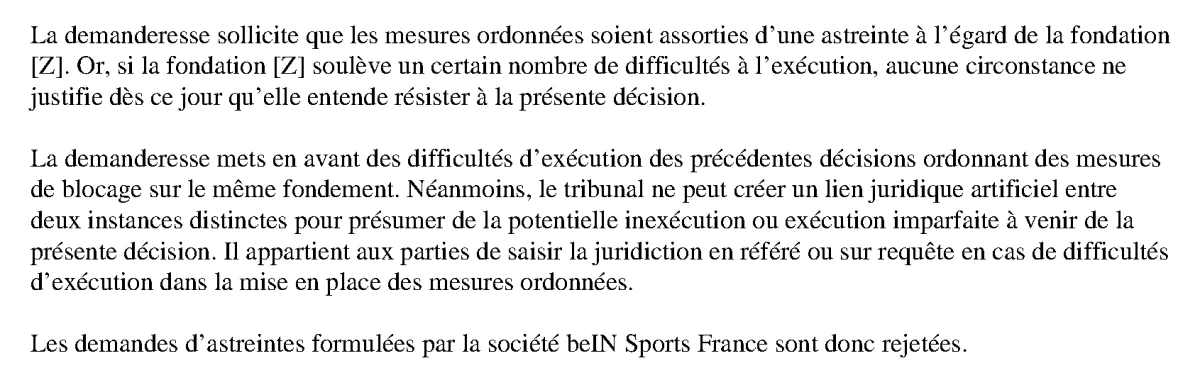
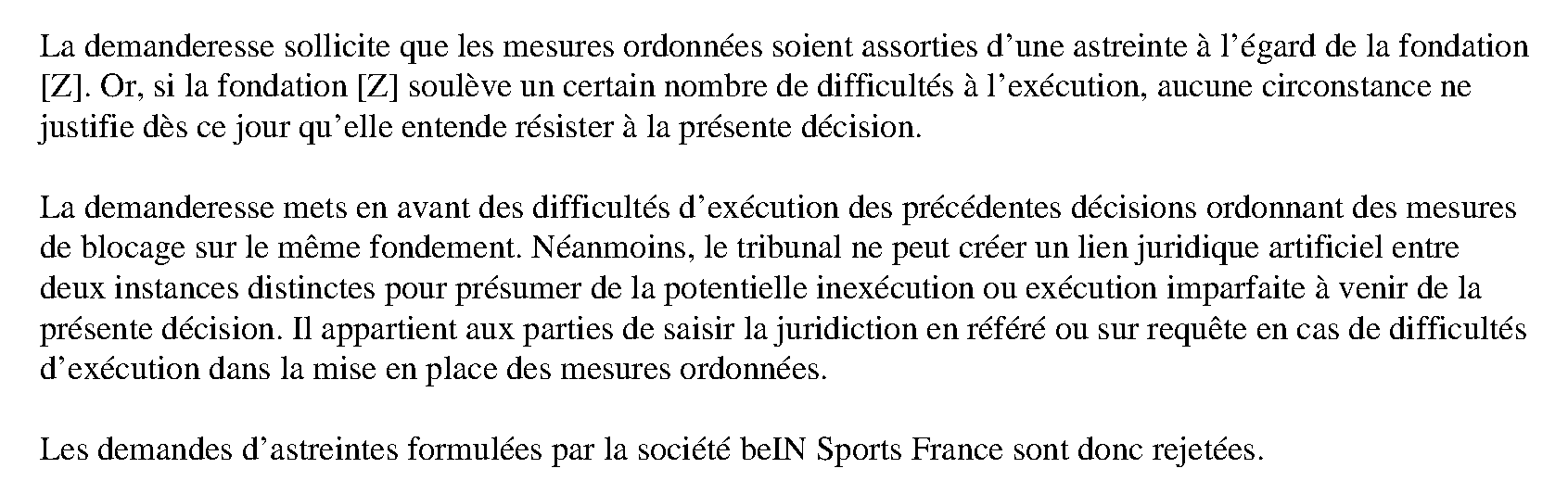
From the very beginning of the proceedings, beIN Sports sought to secure financial penalties against Quad9 to ensure strict enforcement. When initially requesting the blocking order, the broadcaster asked the Paris court to impose a penalty of 2,000 euros per day for every single domain that Quad9 failed to block. Notably, Quad9 was singled out individually for this penalty request, while the other DNS resolvers named in the suit did not face the same immediate threat.
At the time, the court declined beIN’s request for daily fines. The judges explained that there was no sufficient indication at that early stage that the foundation definitively intended to resist the order. However, the court left the door open for further action, noting that if operational problems or non-compliance arose later, the aggrieved parties could return to court to seek enforcement.

That is precisely what beIN Sports has now done. Quad9 revealed that the broadcaster has returned to the Paris Judicial Court to demand substantial financial penalties. According to Quad9, beIN is now seeking 10,000 euros per domain, per day of non-compliance. Across the 58 domains currently listed in the order, this aggregates to a staggering 580,000 euros per day—a rate that would accumulate into millions of euros in fines every single week.
The legal arguments were heard before the Paris court last Thursday, and a formal judicial decision is anticipated within three weeks. If the court rules in favor of beIN Sports, the penalties would apply retroactively from the moment the original order was issued, presenting an existential financial threat to the non-profit Swiss foundation.
The DNS Blocking Problem
Behind Quad9’s refusal to comply lies a deeply rooted technical and architectural dilemma. Technically, the foundation acknowledges that it has the operational capability to block the disputed domain names and thereby evade immediate financial pressure from rights holders. However, Quad9 maintains that it cannot cleanly and reliably limit those blocks strictly to users located within France, which is the precise geographic scope mandated by the court order.
As a privacy-focused public resolver, Quad9 does not collect or store user IP addresses or personal browsing data. Consequently, to enforce a geographically restricted block, the foundation would be forced to rely entirely on third-party geolocation databases that attempt to map IP addresses to physical locations. Quad9 argues that these databases are inherently imperfect, often suffering from gaps, inaccuracies, and outdated information.
"There is no legally useful way for us to define a French user," Quad9 representatives explained.
The foundation is intimately familiar with the legal perils of imperfect geolocation. In Germany, a high-profile legal battle initiated by Sony Music saw the courts initially rule that Quad9’s attempts to limit a pirate site block strictly to German users were insufficient. Although Quad9 ultimately won that specific case on appeal in late 2023, the underlying technical finding regarding the unreliability of geographic boundary enforcement was never formally overturned.
Convincing the Paris court of these technical limitations has proven equally challenging. In its May ruling, the court explicitly noted that the defendants had failed to adequately demonstrate that restricting the blocks exclusively to French territory would be financially prohibitive or technically impossible.
Alternatively, Quad9 possesses the technical capability to block the domain names globally, a measure it previously threatened in 2024 and temporarily implemented in Germany in 2023 under the direct threat of 10,000-euro daily fines. When asked why it has chosen not to apply a global block in the French case, the foundation clarified that the German action was strictly a temporary measure utilized while the litigation was ongoing. Quad9 emphasizes that every legal jurisdiction presents unique conditions and that it approaches each case on its own distinct terms.
"Chúng tôi vẫn hoàn toàn tin tưởng vào lập luận cốt lõi của mình: Trình phân giải đệ quy DNS là nơi sai lầm để chống lại vấn đề vi phạm bản quyền trực tuyến, và sẽ dẫn đến kết quả tồi tệ hơn đáng kể cho công dân Pháp," Quad9 stated, emphasizing its core conviction.
Concerns regarding the disproportionate impact of these orders extend well beyond Quad9. Earlier this year, a comprehensive report published by the Internet Society warned that smaller, mission-driven DNS operators bear the heaviest burden when jurisdictions mandate complex blocking infrastructures.
"Large, well-resourced operators may be able to absorb the compliance costs, but smaller and non-profit operators risk being excluded from the market if they cannot afford the staffing and compliance infrastructure demanded by jurisdiction-specific blocking orders," the Internet Society report cautioned.
Leaving France?
Should the Paris court rule in favor of beIN Sports and grant the request for multi-million euro penalties, Quad9 will be forced to take decisive action to protect its organizational survival. The foundation outlines three primary pathways should the financial pressure become untenable.
The first option is to attempt a geographically restricted block targeting only users perceived to be in France. However, given the foundation’s stance on the inaccuracy of IP geolocation databases, this approach would likely remain imperfect and continue to expose the non-profit to severe legal and financial liabilities.
The second option involves implementing a blanket, global block on the disputed domains. Quad9 notes that this approach would effectively allow a French judicial ruling to unilaterally dictate internet access standards across the entire world, a prospect the foundation views as an overreach of national jurisdiction.
The final option is to follow the precedent set by OpenDNS and completely cease serving users believed to reside in France, effectively pulling out of the French market to avoid compliance entirely. The accuracy and operational feasibility of such a withdrawal remain uncertain.
Quad9 reports that these drastic options have not yet been formally deliberated by its Foundation Council. The organization stresses that it must remain a law-abiding entity without compromising its continued existence. Furthermore, the foundation is bound by Swiss law to uphold its foundational principles of privacy, security, and internet stability, applying those standards consistently and predictably across its entire global user community.
‘Recklessly Dangerous’
The urgency of the situation is amplified by broader legislative trends within France. In July, the French Parliament adopted a new law designed to streamline and expand the nation’s anti-piracy framework. The legislation permits the automated, real-time addition of new domain names during live sports broadcasts, with regulatory authority ARCOM reviewing the blocked domains after the fact rather than requiring prior judicial approval.
Quad9 views this expansion of automated blocking powers as a dangerous escalation atop an already deeply flawed legal mandate.
"An unfettered, unencumbered and delegated power given to an unspecified list of commercial parties to block any content they desire seems to us recklessly dangerous, un-necessary, and counter-productive," the foundation warned.
The organization argues that aggressive domain-level interference ultimately backfires by driving ordinary internet users toward less secure, alternative systems operating in unknown jurisdictions. Furthermore, the sheer volume of real-time updates required by live sports broadcasting makes meaningful vetting practically impossible.
"Dynamic injection of false answers weaponizes the DNS against end users," Quad9 added. "This blocking method will be proven to be ineffective, wasteful, and will not achieve the goal of removing the content which remains as reachable as ever."
For now, the immediate fate of Quad9’s operations in France rests with the Paris Judicial Court. A formal decision regarding beIN Sports’ penalty request is expected to be handed down later this month, after which Quad9 is anticipated to announce its official response to the ruling. Representatives for beIN Sports declined to comment on the ongoing legal procedure.

Leave a Reply