

The vibrant community behind Opensource.com is hard at work on something entirely new. Visitors to the platform may have noticed a distinct quietness settling over the site lately. That silence, however, is not a sign of wind-down, but rather the hush before a new chapter. There is a new project actively in the works behind the scenes, and while specific operational details and feature rollouts remain under wraps for the moment, there is already plenty to discuss regarding the philosophy, the history, and the future of the network. What better way to begin unpacking this upcoming transition than by looking at the broader architecture of the internet itself?
The Internet and Top-Level Domains
To understand where the Opensource.com community is heading, it helps to examine where the digital world came from. As most internet users know, the internet is fundamentally a network. By definition, a network is simply a group of interconnected connections. In fact, the term "internet" is a portmanteau derived from "interconnected" and "network."
In its earliest conceptual and operational stages, the modern internet consisted primarily of two distinct pillars: a military network designed for resilient communications and an academic network meant for research sharing. As digital technology advanced and public fascination grew, the network expanded rapidly far beyond those two original institutional groups. With that explosive growth, it quickly became apparent that different structural designations were desperately needed. Systems administrators and network architects required a reliable way to differentiate between a commercial entity operating for profit, a charitable organization serving the public good, a university educating students, or a governmental department serving citizens.

These crucial designations ultimately became known as top-level domains, commonly abbreviated as TLDs. Today, internet users can choose from a vast and sometimes bewildering array of available extensions, ranging from industry-specific suffixes to regional codes. However, for a long time, the digital landscape was defined by only a handful of original TLDs. Those foundational designations remain deeply popular and universally recognized to this day. Most internet users intuitively understand that when they navigate to an address ending in .com, they are visiting a commercial site, whereas visiting a .org address generally signifies a non-profit organization dedicated to a specific mission or public interest.
Open Source is a Network
Just as the global internet relies on interconnected digital infrastructure, the open source movement relies on an equally vital network of a different kind. Open source can manifest in many diverse forms. It can be commercial, driving enterprise software and global cloud infrastructure; it can be non-profit, supporting public-interest tools and open standards; it can be academic, powering scientific research and educational software; and it can be cultural, preserving shared knowledge and creative works.
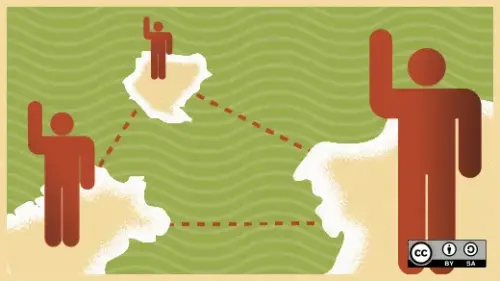
Regardless of the specific form it takes, open source is always, at its core, a network. Sometimes that network is composed of interconnected computers sharing code repositories, distributing Linux distributions, or hosting decentralized services. More importantly, however, it is a network of people. Whether open source contributors, maintainers, and enthusiasts are gathering together in person at a massive international conference, meeting informally at a local pub, or collaborating continuously in an online chat room, open source is fundamentally a community of living, breathing human beings.

For the past twelve years, the website Opensource.com has been proudly supported by a commercial entity, providing a dedicated digital home for stories, tutorials, and essays about the open source way. Yet, the individuals—representing both the readers and the writers, the everyday contributors and the veteran maintainers—who make up the heartbeat of the Opensource.com community are not commercial entities. They are people.
That distinction between corporate backing and human-driven community is at the heart of the current transition. In just one month, Opensource.com is going to resolve that long-standing dynamic, ushering in a fresh approach that aligns more closely with the people who built its community. Stay tuned for the upcoming announcement.

Leave a Reply