Traditional operating systems were originally architected to manage fundamental computing resources, orchestrating CPU scheduling, memory allocation, storage subsystems, networking, and application execution within tightly bounded parameters. However, the rapid proliferation of Agentic AI is introducing a profound layer of operational complexity, necessitating that modern enterprise infrastructure expand its mandate to support the entire lifecycle of intelligent, autonomous software agents.
This shifting paradigm requires underlying systems to seamlessly manage agent deployment, granular task scheduling, strict execution isolation, dynamic context management, memory retrieval, specialized tool invocation, comprehensive observability, and resilient system recovery. Addressing these emerging architectural demands, the openEuler open-source community is actively evolving its operating system capabilities to support the development, deployment, execution, coordination, and optimization of intelligent agents across diverse, heterogeneous computing environments.
These transformative concepts and technological directions are taking center stage at the ongoing Agentic Infra OS Conference and openEuler Summit 2026. Industry leaders, systems architects, and developers are convening to discuss how enterprise infrastructure must adapt as artificial intelligence transitions from conversational models to deeply autonomous operational workflows.
AI Agents Need More Than Computing Power
Artificial intelligence agents are rapidly moving beyond basic conversational interactions to execute complex code, invoke external tools, interface directly with enterprise applications, and coordinate multi-step workflows without constant human intervention. As these demanding workloads scale across production environments, traditional infrastructure faces an unprecedented set of operational challenges. Modern systems must now deliver secure execution boundaries, rapid environment provisioning, efficient context reuse, persistent memory mechanisms, and elastic resource management capabilities.
Legacy infrastructure architectures simply were not designed around these dynamic operational requirements. Consequently, the next major evolution of the operating system must look far beyond conventional process management and hardware resource allocation to fully support the complex lifecycle of agent execution.
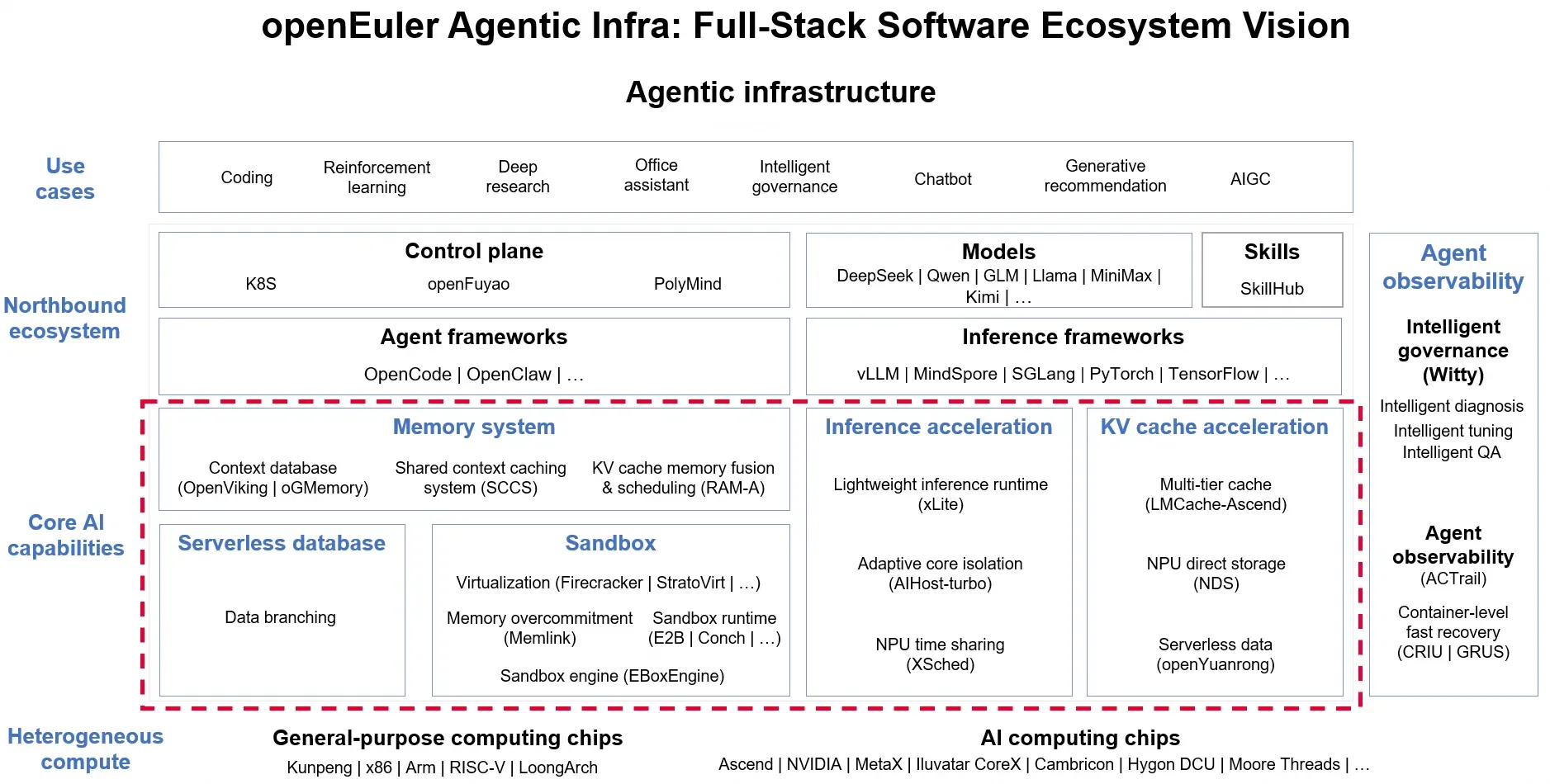
This core philosophy drives openEuler’s vision for an agentic operating system: building an open, secure, and highly efficient software stack that bridges low-level operating system capabilities with advanced agent runtimes, artificial intelligence frameworks, specialized data services, and heterogeneous computing resources.
To achieve this, the infrastructure is engineered to operate seamlessly across diverse hardware architectures. This includes general-purpose processors spanning x86, Arm, RISC-V, and LoongArch, alongside specialized artificial intelligence accelerators sourced from multiple hardware vendors. This heterogeneous approach is critical for enterprise deployments, which rarely rely on a single hardware architecture or unified accelerator platform.
The underlying architecture is fundamentally centered around two major layers. The Agent Kernel provides foundational, system-level capabilities, while the Agent Service layer exposes reusable services such as secure sandboxing, advanced memory management, session orchestration, and a centralized Tool Gateway. Surrounding this robust foundation, complementary infrastructure technologies—including distributed caching and serverless data services—work in concert to support the performance, scalability, and intensive data requirements inherent to modern agent workloads.

Rather than cramming every conceivable capability directly inside the monolithic operating system kernel, this architectural approach strategically combines deep system-level optimizations with reusable infrastructure services and a thriving open ecosystem. Five technical pillars form the backbone of this comprehensive framework.
Five Pillars of Agentic Infrastructure
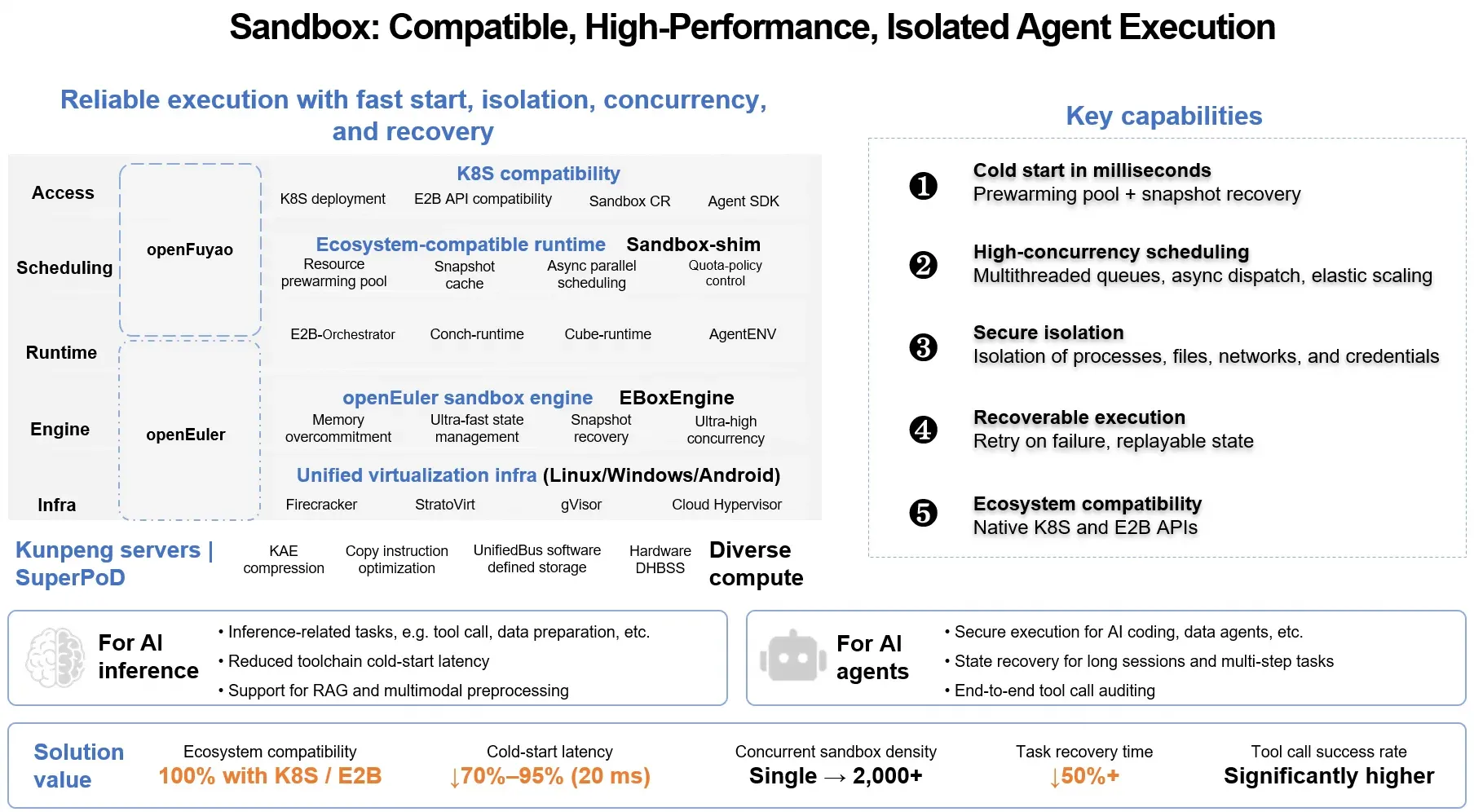
The first critical pillar focuses on secure, scalable agent execution through advanced sandboxing. Autonomous agents require heavily isolated environments to safely execute dynamically generated code, invoke external tools, and interact with complex external systems. These ephemeral environments must initialize with minimal latency, scale gracefully to handle high concurrency, and recover reliably whenever underlying tasks are interrupted or fail.
openEuler addresses these rigorous demands by synthesizing lightweight virtualization technologies, snapshot-based recovery mechanisms, resource prewarming strategies, and high-density scheduling algorithms. Technologies such as StratoVirt and the Conch runtime collaborate to rapidly instantiate and manage secure sandbox environments, while robust orchestration capabilities underpin large-scale deployments.
According to performance evaluations conducted by openEuler, sandbox startup latency can be driven as low as twenty milliseconds, achieving a high density of more than two thousand sandboxes per node. In separate large-scale concurrency stress tests, the platform successfully launched one hundred thousand sandboxes within ten seconds. These empirical results clearly demonstrate the viability of fast provisioning and high-density agent execution at enterprise scale.
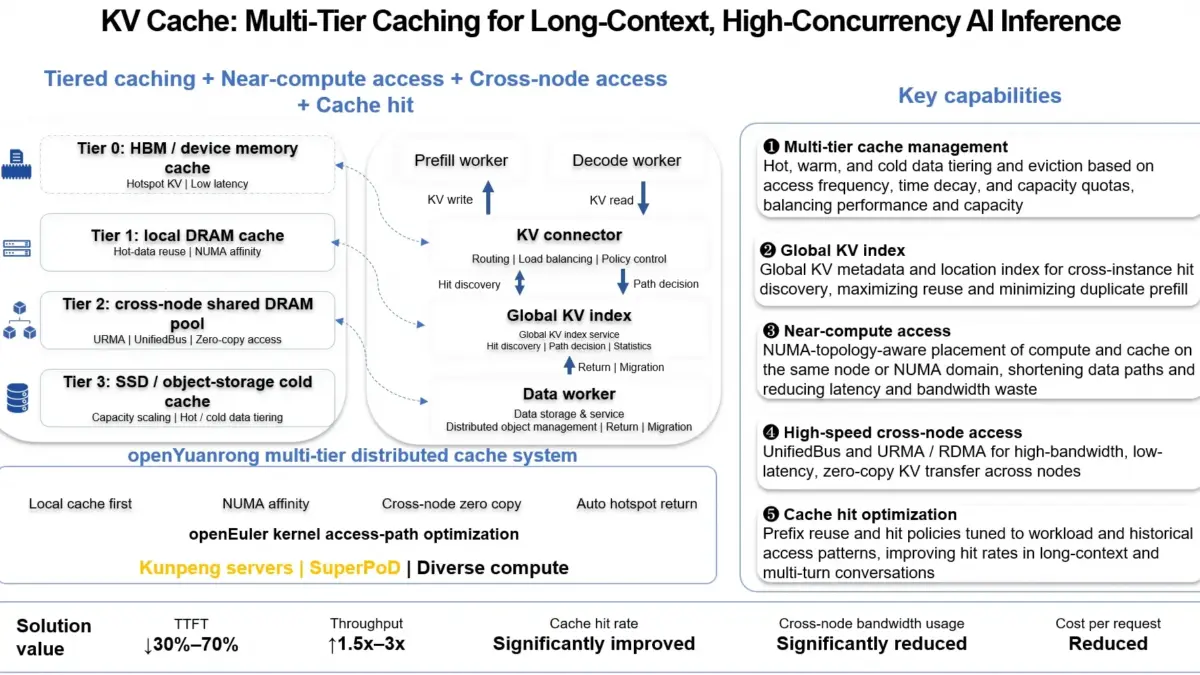
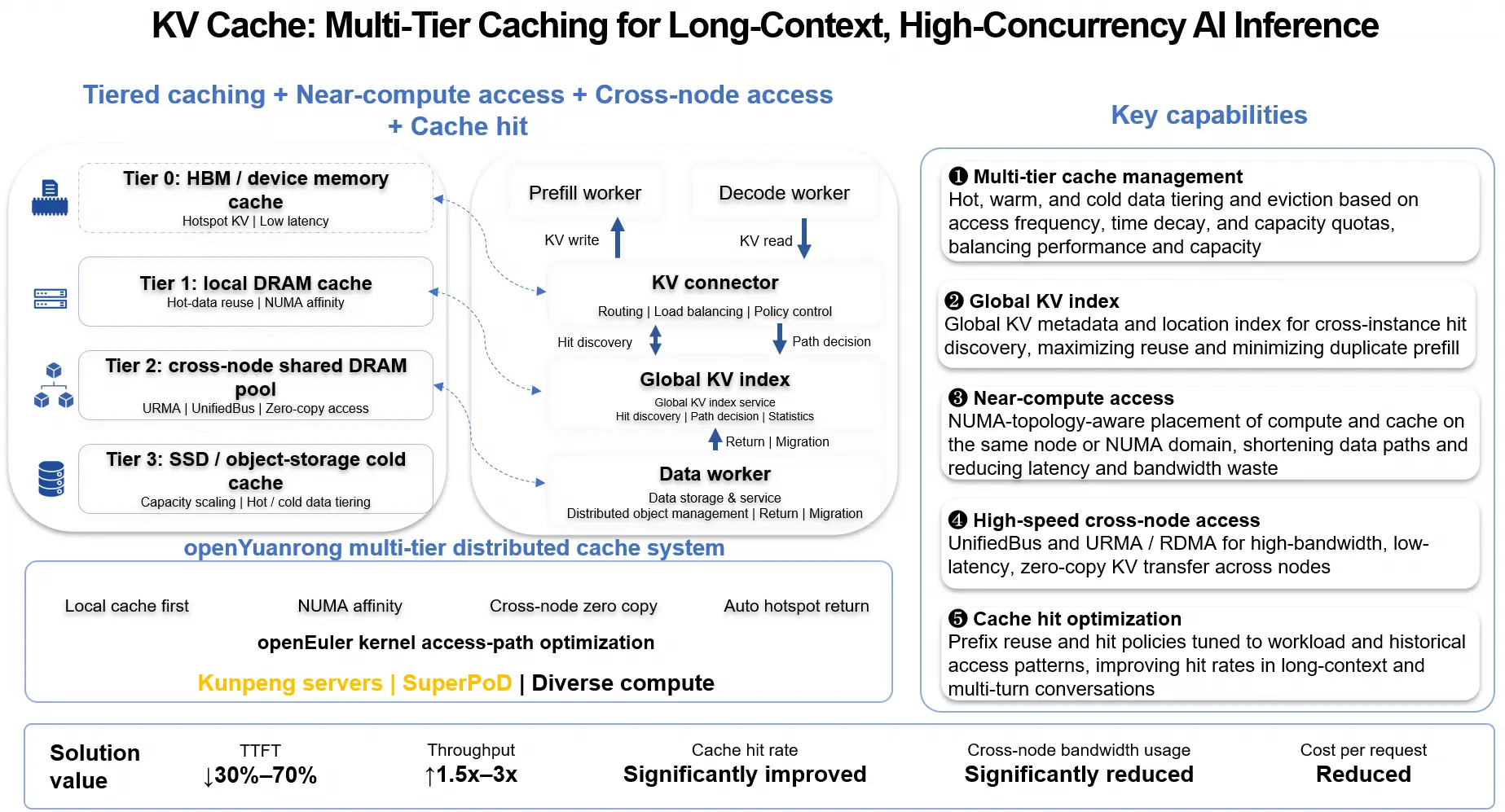
The second pillar addresses inference optimization through advanced KV cache management. In multi-turn agent workflows, repeated inference cycles frequently involve substantial overlaps in conversational and operational context. Recomputing or repeatedly transferring identical attention states wastes scarce accelerator memory and artificially increases the time to first token.
The openEuler KV cache approach integrates multi-tier caching architectures, global indexing mechanisms, NUMA-aware resource placement, and high-speed cross-node data transfer protocols. Utilizing advanced technologies including LMCache and openYuanrong, KV cache data can be efficiently reused across disparate instances and accessed closer to the underlying compute resources.
Agent-aware scheduling elevates this optimization further. By intelligently mapping agent context directly to specific KV cache chunks, the system can accurately predict reuse patterns and proactively coordinate prefetching and cache eviction strategies. The resulting performance gains are significant, with inference throughput increasing by one and a half to three times, while the time to first token drops by thirty to seventy percent in targeted scenarios.
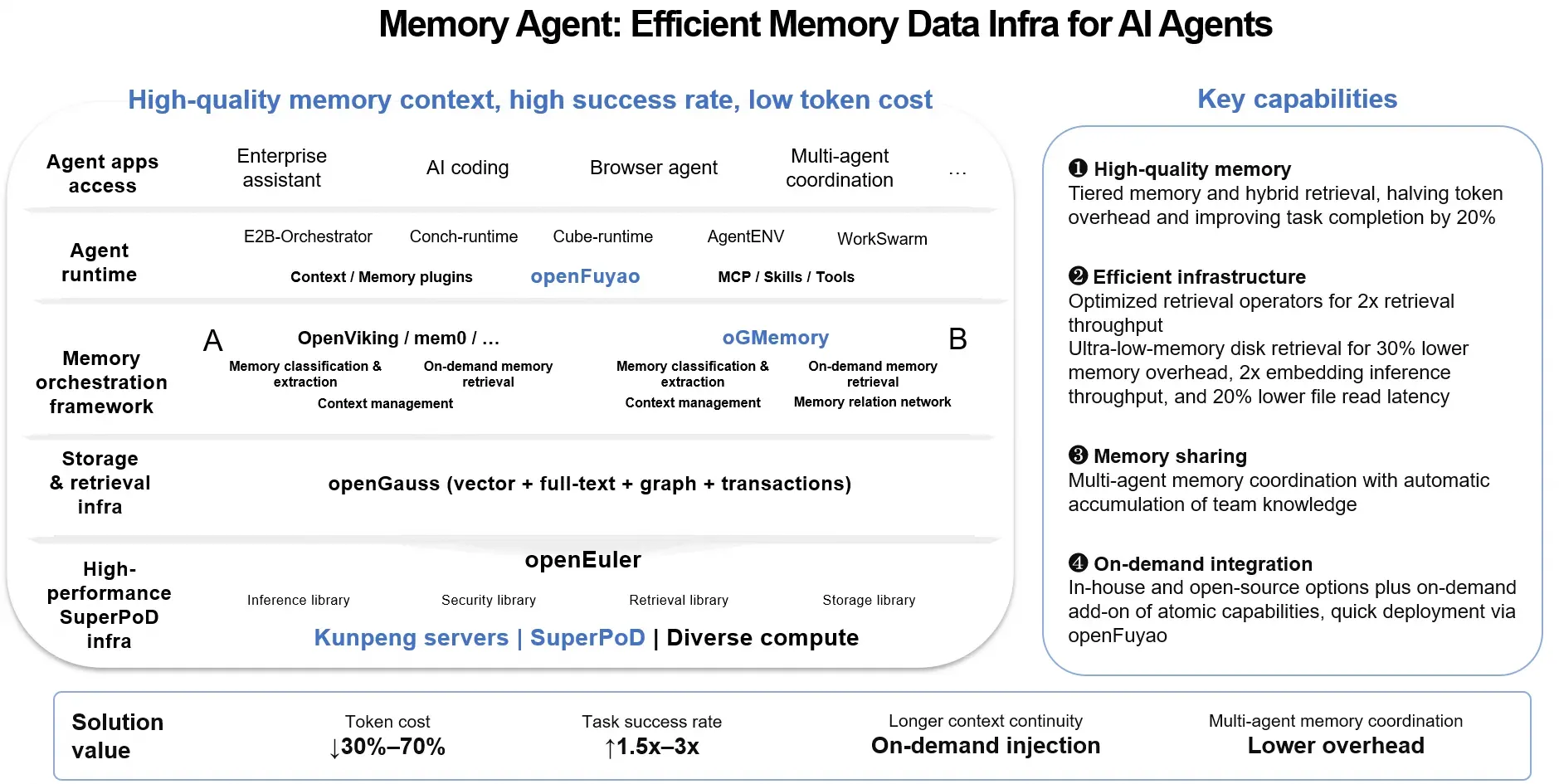
The third pillar introduces the Memory Agent, designed to provide agents with persistent contextual awareness. While KV caches accelerate real-time inference by reusing previously computed states, agent memory addresses the distinct challenge of helping software agents retain, consolidate, and retrieve valuable knowledge across extended turns, disparate tasks, and multiple user sessions.
The openEuler memory infrastructure combines sophisticated memory extraction and orchestration frameworks with hybrid retrieval and storage capabilities. Solutions incorporating OpenViking, oGMemory, and openGauss provide robust structured context management, vector and full-text retrieval, and seamless knowledge sharing across collaborative agent swarms.
This capability empowers agents to selectively retrieve only relevant information when needed, eliminating the inefficiency of repeatedly processing lengthy historical transcripts. It additionally facilitates shared knowledge accumulation within complex multi-agent workflows. By retrieving strictly targeted context, the system can reduce token-related operational costs by thirty to seventy percent while boosting task success rates by one and a half to three times in specialized benchmarks.
The fourth pillar centers on serverless database capabilities, enabling elastic data services tailored specifically for AI agents. Beyond the core Agent Kernel and Agent Service layers, supporting data infrastructure plays an indispensable role in agentic workflows. Serverless database features provide the elastic, branchable data environments required by modern agents that routinely create, modify, compare, and roll back relational data across dynamic operational sequences.
Built upon openGauss, this approach pairs elastic compute provisioning with copy-on-write storage architecture and native database branching capabilities. Multiple agent instances can safely share a unified baseline dataset while maintaining completely independent changes. Advanced features including point-in-time recovery, branch comparison, and automated merging further support flexible, non-linear data workflows.
The resulting data foundation allows database environments to be provisioned, modified, and recovered dynamically as agentic tasks evolve. The solution is engineered for rapid, elastic provisioning, featuring millisecond-level instance startup and second-level database branch creation and rollback, thereby granting agents the ability to manage isolated data environments with minimal overhead.
The fifth and final pillar emphasizes an open, heterogeneous ecosystem. True agentic infrastructure cannot afford to remain tethered to a single proprietary model, framework, or hardware platform. It must seamlessly bridge diverse software and hardware components while keeping their underlying resources manageable and accessible.
The openEuler ecosystem brings together an extensive array of agent frameworks, inference engines, orchestration platforms, memory management systems, and heterogeneous processors and hardware accelerators. Through ongoing collaboration with prominent open-source projects and technologies—including Kubernetes, openFuyao, vLLM, MindSpore, and openGauss—the initiative aims to reliably support varied agent workloads across fragmented computing environments.
The ultimate objective extends far beyond basic software compatibility. It is designed to deliver a consistent, reliable infrastructure foundation upon which developers and global ecosystem partners can confidently build, deploy, and scale sophisticated agentic applications.
From an Operating System to an Agentic Infrastructure Foundation
The fundamental transition toward Agentic AI represents much more than a routine shift in application software development; it is actively reshaping the core infrastructure requirements of modern enterprise computing. As software agents assume higher degrees of autonomy, underlying infrastructure must support far more than basic model inference. It must guarantee secure execution environments, efficient data movement, persistent memory retention, elastic data services, and reliable coordination across increasingly intricate workloads.
The agentic infrastructure initiative spearheaded by openEuler directly tackles these requirements through five interconnected technology domains: an open infrastructure vision, high-performance sandbox execution, distributed KV cache acceleration, persistent agent memory, and serverless database services. Each component addresses a distinct operational bottleneck inherent to modern agent deployment and execution. Together, they establish a cohesive framework designed to make autonomous agent capabilities significantly more scalable, reusable, and manageable across heterogeneous environments.
Ultimately, these developments signal a broader, transformative evolution in the foundational role of the operating system. As artificial intelligence agents grow increasingly autonomous and workloads become exponentially more dynamic, computing infrastructure must move beyond mere resource allocation to actively empower agents to execute securely, operate efficiently, retain contextual memory, and scale reliably across the enterprise.