
For years, the conventional wisdom surrounding the evolution of onchain foreign exchange (FX) has envisioned a top-down transformation. Under this traditional framework, major global banks tokenize sovereign currencies, institutional financial giants migrate their day-to-day foreign exchange operations onto public or private blockchain rails, and institutional-grade liquidity follows as a natural byproduct.
The ultimate destination of this projected trajectory is an onchain FX ecosystem that eventually grows large enough to mirror its traditional, multi-trillion-dollar counterpart. However, according to an insightful analysis by Michael Egorov, the founder of Curve Finance and Yield Basis, that is not necessarily how the market will develop.
Growing evidence suggests that onchain foreign exchange is instead tracking an entirely opposite trajectory. Rather than cascading downward from the commanding heights of global banking institutions, onchain FX is actively developing from the bottom up, driven by tangible, everyday utility and grassroots demand.
This emerging landscape is powered by specialized regional stablecoins—such as the Brazilian Digital token (BRZ) or Monerium’s euro-backed EURe—which can be swiftly redeemed onchain and seamlessly moved between digital wallets and traditional bank accounts. These assets generate healthy, organic trading activity as decentralized finance (DeFi) users actively swap them across decentralized exchange (DEX) liquidity pools.
Markets of this nature are developing in real time around a deeply practical human and commercial need: the ability to move value directly and efficiently between digital currencies and local fiat systems without enduring the friction of legacy infrastructure.
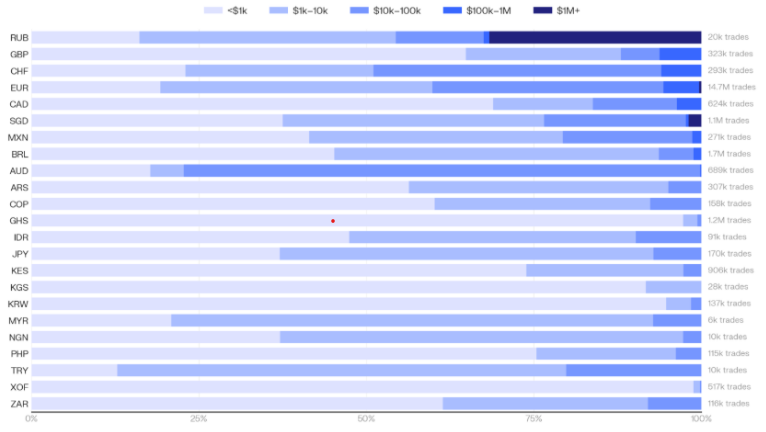
While this sector remains in its early stages of maturation, the underlying use cases and economic demand are undeniably real. Data compiled by crypto market maker Keyrock illustrates that the vast majority of onchain stablecoin trades tied to emerging market currencies cluster comfortably within the $1,000 to $10,000 range. While these figures represent modest sums when compared against traditional institutional trade volumes, that realization misses the broader point.
The distribution of these transaction sizes demonstrates how the market is organically building outward in the direction of onchain FX to satisfy practical payment and remittance needs, rather than merely catering to large-scale speculative traders or institutional desks.
‘Small’ Is Not the Same as ‘Usable’
Individuals and modern businesses alike require reliable mechanisms to move their capital across currency borders. Crucially, they are demonstrating little patience for waiting on major traditional finance (TradFi) institutions to painstakingly migrate their sluggish legacy FX operations onto modern blockchain infrastructure.

Within traditional financial circles, a pervasive assumption persists that a currency market must command massive, deep pools of liquidity before it can achieve genuine utility. In daily practice within the digital asset economy, however, that premise does not entirely hold true.
If genuine economic demand exists from a user who needs to exchange United States dollars into euros, Swiss francs, or another regional currency, even a comparatively smaller liquidity pool can successfully process those transactions and fulfill a vital economic purpose. Onchain foreign exchange does not need to achieve massive global scale before it becomes useful to the end consumer. Instead, it is primed to grow precisely because real people are actively utilizing it to solve immediate financial friction.
This organic growth pattern mirrors the historical trajectory of stablecoins themselves. They originated as a relatively niche, crypto-native instrument designed primarily for traders looking to park capital during market downturns. Yet, contemporary financial systems recognize them as foundational components of a much broader, highly resilient global financial infrastructure.
Recent data shared by blockchain analytics firm Chainalysis highlights this rapid expansion, revealing that global cross-border stablecoin activity surged to exceed $220 billion by mid-2026. This milestone represents an impressive expansion of nearly 80% over the course of a single year, offering empirical proof that underlying global demand and economic activity are on a relentless upward trajectory. There is no structural reason why onchain foreign exchange cannot follow a remarkably similar developmental path.
The User Does Not Care How Big the Market Is
When examining the core mechanics of this technological shift, the most practical considerations tend to take center stage. Onchain FX admittedly lacks the capacity to compete with the sheer scale of the entire global traditional foreign exchange market in the near term; bridging that gap remains years away. A far more compelling and immediate question concerns the specific friction points it can resolve for a user or enterprise that already maintains capital onchain.
In the current ecosystem, a participant can exchange a USD-pegged stablecoin into a euro-backed alternative directly onchain, utilizing those funds for cross-border settlements with minimal friction. Executing transactions via this digital route frequently proves significantly faster and more cost-effective than navigating a classic international wire transfer through traditional correspondent banking networks.
The identical underlying logic applies directly to the broader onchain FX sector. Modern financial technology platforms and crypto-backed card issuers do not need to successfully replicate the entire multi-trillion-dollar institutional market to deliver value. Their primary operational requirement is the ability to move their customers’ funds efficiently and cost-effectively between different currency denominations.
When a consumer attempts to purchase goods or services denominated in a foreign currency using legacy rails, the conversion process invariably introduces hidden costs. These transactions typically route through payment giants like Visa or Mastercard, which routinely levy processing fees hovering around 1% of the transaction value.
Onchain exchanges present a markedly superior alternative for these operations. When user funds already reside natively on blockchain rails, swapping dollar stablecoins for euro stablecoins can be executed directly, bypassing a labyrinth of intermediaries. This peer-to-peer or pool-based approach reduces both execution time and overall expenditure.
Commercial banks will likely retain their critical roles as primary entry and exit funnels where digital tokens must safely interface with the traditional physical economy. Issuing and redeeming local fiat currencies, maintaining traditional bank accounts, and handling rigorous regulatory compliance are domains where traditional banking institutions will naturally take the lead.
However, once capital successfully transitions onto the blockchain, a vast majority of the traditional in-between intermediary steps can be safely eliminated to achieve unprecedented operational efficiency. From the perspective of an everyday user who simply wishes to execute a financial transfer with minimal complication, this dynamic represents a profound and highly positive upgrade to global commerce. In this context, the absolute size of the broader underlying FX market becomes largely irrelevant.
Demand Is Only Half the Problem
Despite the powerful tailwinds of organic user adoption, significant structural hurdles remain. Real, sustained demand is an absolute prerequisite for success, but it does not magically solve the complex engineering and economic challenge of maintaining adequate liquidity. The primary obstacle is not merely deploying a euro-to-dollar or franc-to-dollar trading pool; the true test lies in making those decentralized pools economically sustainable for the participants providing the capital.
Traditional market-making firms may find it commercially unappealing to allocate capital and provide liquidity for emerging, smaller-scale foreign exchange markets. If the aggregate transaction volume is insufficient to justify the operational overhead and capital costs, institutional market makers will simply look elsewhere.
This is precisely where automated market makers (AMMs) introduce a transformative structural advantage. Software-driven liquidity models can continuously quote prices and facilitate trades around the clock without requiring a dedicated human team of professional traders to manually manage every individual transaction.
Consider the dynamics between two prominent dollar stablecoins, such as USDC and Tether. From the perspective of a traditional, legacy financial exchange, executing a trade between two assets pegged to the exact same underlying fiat currency might appear tedious and unrewarding. Both instruments are designed to maintain a parity value of approximately one dollar, leaving minimal price volatility to speculate on.
Nevertheless, if genuine commercial demand persists among users needing to transition between different stablecoin issuers for operational reasons, an automated market maker can easily establish a specialized pool enabling direct swaps. Every individual trade routes a fractional fee to the decentralized liquidity providers backing the pool. When a sufficient aggregate volume of users requires the exact same conversion pathway, a viable, self-sustaining market can thrive—even if the asset pair appears mundane to traditional institutional market makers.
This style of adoption may not mirror the explosive, speculative manias frequently associated with early crypto token launches, but there is inherent economic value in steady, organic growth. Emerging financial markets frequently require nothing more than a dedicated core group of users grappling with a specific pain point that legacy financial infrastructure fails to resolve adequately. When those users generate enough economic activity to sustain the underlying market viability, structural liquidity can take root and expand outward from there.