When an authentic, high-stakes choice lands on your desk—such as a time-sensitive job offer requiring an immediate response, an expensive real estate investment stretching your finances to the limit, or a struggling side business you have artificially kept afloat for years—standard book recommendations rarely help. Traditional reading lists typically hand readers the exact same stack of titles in the identical order, starting with Daniel Kahneman before moving down a row of bestsellers that rarely address the specific mechanics of the problem at hand.
To bridge the gap between theoretical psychology and practical choice, a realistic evaluation of decision-making literature requires sorting titles by situational utility rather than sales volume. Rather than treating books as passive entertainment, critics suggest grading them by the actionable mental drills they provide, noting where their methodologies fall short, and identifying which famous volumes should be avoided when facing an urgent dilemma.
How the Literature Was Graded
Evaluating the best books for decision-making requires focusing primarily on the mechanics of practice and structured drills. Psychological research underscores the value of active methodologies over passive reading. Across four years of geopolitical forecasting tournaments sponsored by the United States intelligence community, researchers found that a training module lasting under an hour improved forecasters’ accuracy—measured by Brier score—by six to eleven percent against a control group, according to a study published in Judgment and Decision Making by Chang, Chen, Mellers, and Tetlock.
While under an hour of structured drills yields measurable improvements, the passive act of reading a book has rarely been proven to automatically enhance real-world judgment. Consequently, modern critiques score each literary work by the specific drill a reader can extract and apply immediately. A book that fails to provoke a concrete exercise functions more like a nature documentary about human cognition than a functional tool.
Seven Essential Titles for Practical Decisions
Several foundational works stand out for offering functional interventions rather than mere theoretical observations.
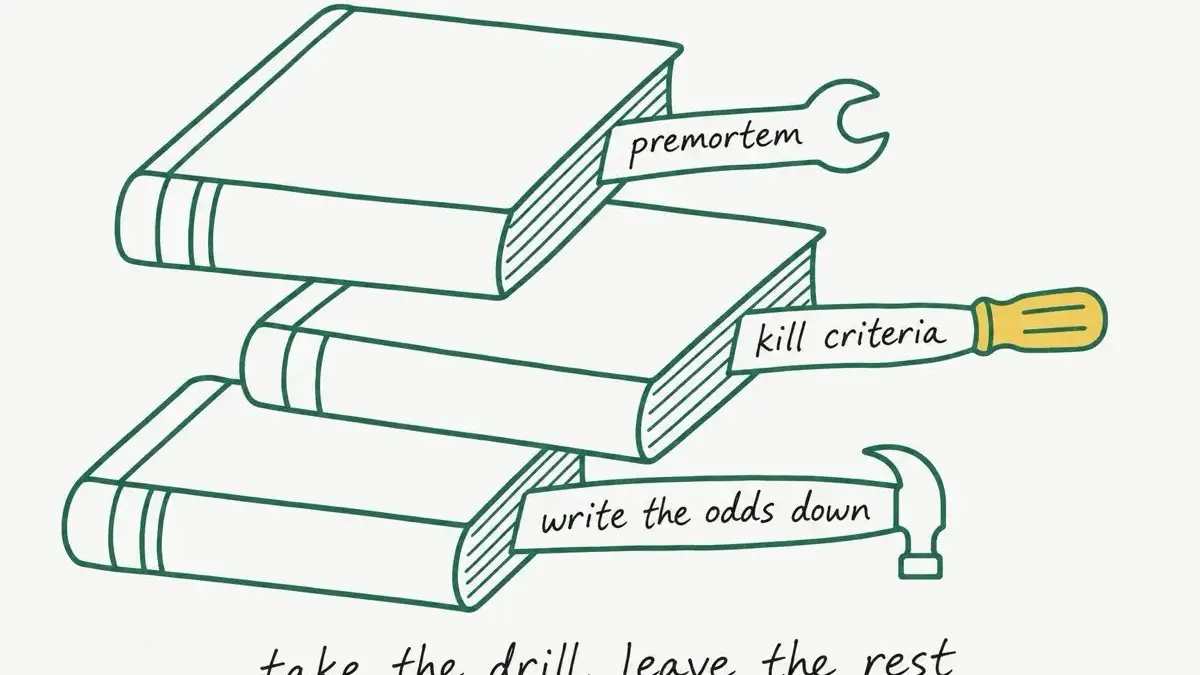
Chip and Dan Heath’s Decisive: How to Make Better Choices in Life and Work directly tackles the common trap of deciding within a narrow frame established by external forces. Instead of asking a binary question like whether to accept a specific job, the framework encourages expanding alternative possibilities. This narrowing tendency reflects broader organizational patterns; Paul Nutt’s profile of 78 decision case studies revealed that most institutional processes were solution-centered, beginning prematurely with a favored answer and suppressing innovation. The Heath brothers’ WRAP sequence is explicitly designed to counter this habit by widening options, testing assumptions, attaining emotional distance, and preparing for failure. The most critical step in this sequence is running a premortem—assuming a decision has failed and working backward to diagnose the causes. Gary Klein notes that prospective hindsight raises an individual’s ability to identify future failure points by roughly thirty percent. However, the book relies heavily on corporate examples and borrows distancing mechanisms like Suzy Welch’s 10/10/10 framework.
For situations involving persistence rather than selection, Annie Duke’s Quit: The Power of Knowing When to Walk Away addresses the challenging discipline of stopping unproductive paths. Duke suggests establishing concrete exit conditions while maintaining emotional equilibrium, such as closing a business if it fails to hit specific monthly revenue targets by a set date. These predefined boundaries prevent self-negotiation when quitting otherwise feels psychologically akin to failure. Yet, the poker-based framework has limitations; while walking away from a game of cards only costs chips, abandoning a career or a relationship carries far wider personal and social costs that the text glosses over.
Duke’s companion work, Thinking in Bets: Making Smarter Decisions When You Don’t Have All the Facts, introduces the concept of avoiding "resulting"—the flawed habit of judging the quality of a decision purely by its eventual outcome. If a properly vetted venture folds due to unpredictable macroeconomic shifts, the initial choice was not necessarily incorrect. Separating the quality of the decision from external luck prevents distorted lessons from a difficult year.

For foundational cognitive theory, Daniel Kahneman’s Thinking, Fast and Slow remains the defining text on automatic versus deliberate mental systems, detailing cognitive biases such as anchoring, availability heuristics, loss aversion, and overconfidence. Nevertheless, the volume remains descriptive rather than prescriptive. Furthermore, some of its underlying research has faced scrutiny; Kahneman publicly acknowledged placing excessive faith in underpowered studies regarding social-priming chapters, though foundational concepts like prospect theory and the two-system framework remain influential.
Expanding on systemic errors, Kahneman, Sibony, and Sunstein’s Noise: A Flaw in Human Judgment differentiates cognitive bias from random scatter. While bias pushes judgments in a predictable direction, noise represents erratic variability—such as different underwriters pricing identical risks inconsistently. Its primary practical contribution is "decision hygiene," breaking complex evaluations into independent components assessed separately. However, its applications are largely institutional, offering limited utility for an individual choosing between personal housing options.
Among procedural guides, Smart Choices: A Practical Guide to Making Better Decisions by Hammond, Keeney, and Raiffa offers a structured, traditional method involving problem definition, objective setting, alternative generation, and tradeoff analysis. While methodologically sound, the text is dry, features aging examples, and naively assumes individuals can always articulate their true preferences accurately.
Finally, Philip Tetlock and Dan Gardner’s Superforecasting: The Art and Science of Prediction demonstrates that difficult choices usually conceal an underlying forecast. Tetlock’s successful forecasters excelled by quantifying beliefs, decomposing complex inquiries into smaller components, and updating probabilities incrementally as new evidence emerged. While effective, the tangible gains documented in forecasting tournaments stem primarily from active training modules rather than passive reading.
Titles to Approach with Caution
Certain celebrated titles offer engaging intellectual exploration without providing actionable procedural frameworks for urgent dilemmas.
Rolf Dobelli’s *
The Art of Thinking Clearly presents numerous cognitive biases in short, digestible chapters, functioning effectively as an intellectual glossary. However, simply identifying survivorship bias does not offer a methodology for resolving complex personal dilemmas. Similarly, Dan Ariely’s Predictably Irrational* provides a fascinating overview of behavioral economics, yet it lacks practical procedures to guide a professional facing competing career choices on a Tuesday afternoon. Additionally, broader controversies surrounding behavioral data integrity highlight the importance of independently verifying striking psychological findings before integrating them into organizational policy.
Ultimately, navigating complex choices effectively relies less on consuming entire libraries and more on executing targeted mental drills. Whether by widening available options, establishing rigorous exit criteria, or conducting a pre-mortem analysis, the utility of decision-making literature is measured strictly by the concrete actions it inspires before the deadline arrives.