

As every new Premier League football season gets underway, fans are routinely met with familiar warnings regarding the hidden economic and social costs of digital piracy. This year, the ritual has returned with fresh statistical backing, courtesy of a newly published industry-backed report attempting to quantify the scale of the illicit streaming economy in the United Kingdom.
BeStreamWise, a prominent anti-piracy campaign supported by major broadcasting and entertainment stakeholders including Sky, the Premier League, FACT, the BBC, and the UK Intellectual Property Office, released its latest research findings to highlight the persistence of unauthorized viewing. To provide a concrete economic assessment, the campaign commissioned the independent economic consultancy WPI Economics to investigate the fiscal impact of digital copyright infringement.
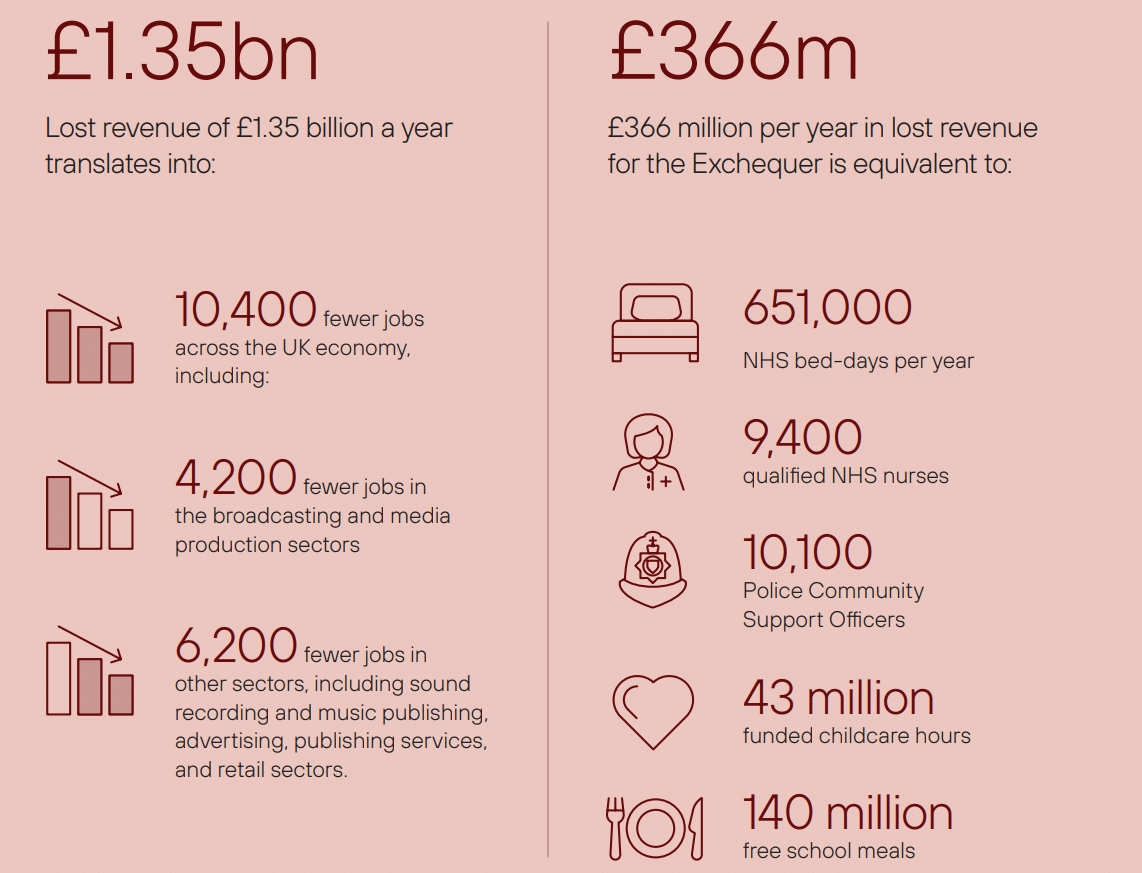
The resulting publication, titled “The Price of Piracy,” estimates that illegal streaming practices result in a staggering £1.35 billion in missed annual revenue for UK broadcasters and rightsholders. According to the report’s economic modeling, this multi-billion-pound shortfall translates directly into 10,400 lost jobs across the creative and broadcasting sectors, alongside £366 million in missing tax revenue that would otherwise flow into public coffers.
To contextualize the scale of these figures for the public, the report draws direct comparisons between the uncollected tax revenue and the funding of essential public infrastructure. The £366 million in missing taxes, the study asserts, is equivalent to the annual salaries of 9,400 qualified National Health Service (NHS) nurses, or enough financial resource to provide 140 million free school meals to children across the country.
A £1.35 Billion Poll Based on Hypothetical Scenarios

The foundation of the report’s billion-pound revenue estimate rests upon a consumer survey of 2,501 UK adults conducted earlier this year in February. Within this sampled demographic, nearly a third of respondents—specifically 31%—admitted to having utilized some form of illegal streaming service or unauthorized platform within the preceding three months. When statisticians extrapolate this percentage across the broader adult population of the United Kingdom, it yields an estimated figure of 16.8 million potential video pirates.
To bridge the gap between survey responses and the headline-grabbing £1.35 billion revenue loss figure, TorrentFreak reached out to BeStreamWise for clarification on the methodology. The campaign explained that the calculation is based on a theoretical scenario in which commercial piracy is completely eradicated and no longer available as an option to consumers.
During the February poll, respondents who acknowledged engaging in piracy were specifically asked which legal subscription services they would be willing to pay for if their preferred unauthorized channels disappeared. WPI Economics subsequently multiplied these stated intentions by the average retail cost of those legal services, before extrapolating the result across the entire national population.
The campaign emphasizes that the resulting financial tally only accounts for individuals who explicitly stated a willingness to pay for legal alternatives in this hypothetical closed-market scenario. Put differently, the £1.35 billion figure does not represent actual lost retail sales resulting from direct competition. Instead, it measures the projected subscription fees that self-identified pirates claim they would be willing to pay at full market price if piracy ceased to exist overnight, which is then mathematically converted into the tax revenues capable of funding thousands of public sector workers.
The Reality of Hypothetical Bias and Pirate Motivations
While the mathematical framework appears straightforward on paper, it carries significant economic caveats. Behavioral research has consistently demonstrated that consumers generally exhibit a well-documented tendency to state they would pay more for goods or services in hypothetical surveys than they actually do when faced with real-world financial choices—a phenomenon widely recognized by economists as hypothetical bias.

Although there are recognized statistical methods available to correct for this behavioral gap, a spokesperson for BeStreamWise confirmed that the WPI Economics study did not apply any discount factor to the survey data. The consumer responses were taken strictly at face value. While the absence of a downward correction is not entirely unprecedented in academic and industry research on digital copyright infringement, it ultimately means that the projected £1.35 billion figure should be viewed as an absolute ceiling rather than a guaranteed recovery for broadcasters.
In fact, data within the very same consumer poll highlights that financial savings remain the primary driving force behind unauthorized viewing habits. When asked to justify their behavior, 38% of surveyed pirates cited cost savings as the primary motivation, followed closely by convenience at 31%, and a general desire to avoid recurring subscription fees at 24%. Furthermore, over half of the respondents—52%—indicated that they were likely to continue engaging in piracy regardless of external interventions or warnings.
Social Media Emerges as the Primary Piracy Source
One of the most notable and unexpected revelations of the survey is the dominant role that mainstream social media platforms now play as the primary gateway for accessing unauthorized content. This broad classification encompasses all forms of video piracy, extending far beyond traditional dedicated streaming portals.
According to the research findings, a majority—specifically 54%—of active illegal streamers access unauthorized material directly through social media platforms. This compares sharply with just 26% who utilize purpose-built purchased devices and illicit IPTV subscription services, and 28% who stream or download files via unofficial websites. Meanwhile, more traditional unauthorized methods accounted for smaller shares, with 15% downloading content through peer-to-peer torrent networks or cloud-sharing services, and only 7% acquiring stolen logins or compromised passwords for legitimate subscription platforms.
The breadth of these findings is partly attributable to the study’s expansive definition of piracy. The survey categorized watching short clips via social media platforms as a distinct form of copyright infringement, alongside actions such as utilizing Virtual Private Networks (VPNs) to bypass geographic restrictions and access content exclusively broadcast in foreign territories.
Consequently, an individual casually viewing a single unauthorized video clip of a football goal or a television show on mainstream networks like X or Instagram is officially counted within the survey’s definition of an illegal streamer. The exact phrasing of the survey questions remains undisclosed, as BeStreamWise has not made the raw polling dataset publicly available for independent verification.
An “Oven-Ready” Policy Solution
Quantifying the financial dimensions of the piracy ecosystem represents only one facet of the newly published report. The document also concludes with specific policy recommendations aimed at mitigating the issue through coordinated institutional action.
The primary recommendation calls upon the UK Government to amplify existing public consumer awareness campaigns through its official communication channels, positioning the BeStreamWise initiative as the ideal vehicle for this effort. The report argues that these awareness campaigns should place a heavy emphasis on the estimated £270 million in direct financial harms that consumers routinely face through secondary risks associated with pirate sites, such as malware infections, financial fraud, and identity theft.
Describing the proposal as an “oven-ready” strategy, the report suggests that government endorsement would serve as a game-changing intervention to educate the public about cybersecurity vulnerabilities while simultaneously addressing the hundreds of millions of pounds lost by unwary streamers to cybercriminals.
A second recommendation advocates for the establishment of a voluntary cross-sector framework. Under this proposed model, online technology platforms, internet connectivity providers, and commercial content services would collaborate voluntarily under light government oversight to curtail the online distribution of stolen media.
Significantly, the report abstains from proposing sweeping new legislation or expanding mandatory website blocking powers. Instead, it contends that traditional enforcement mechanisms have fallen short primarily because ordinary consumers remain insufficiently educated regarding the legal and security risks inherent in unauthorized streaming.
While targeted public awareness campaigns and voluntary industry agreements may succeed in steering a portion of the viewing public toward legitimate channels, rights holders and broadcasters would be wise not to anticipate capturing a substantial share of the £1.35 billion in hypothetical subscription revenues anytime soon.
A complete copy of "The Price of Piracy" report, produced by WPI Economics for BeStreamWise, is accessible via public records.


Leave a Reply