
Over the past two decades, Illinois-based adult entertainment company FlavaWorks has established a formidable reputation as one of the most aggressive and relentless enforcers of intellectual property rights within the adult industry. The company has routinely utilized the U.S. federal court system to target both individual copyright infringers and private peer-to-peer distribution networks. Its aggressive litigation strategies have frequently set legal precedents regarding how digital piracy of adult content is handled in American courts.
Earlier this year, FlavaWorks filed a high-profile lawsuit targeting Gay-Torrents.org, a well-known private torrent tracker. That comprehensive legal action named the site’s operators, internal administrators, an associated Bulgarian shell company, and hundreds of individual members as defendants. The mounting pressure and financial exposure resulting from the lawsuit ultimately prompted the site’s operators to abruptly shut the platform down. However, the closure of the domain did not signal an end to the legal jeopardy surrounding the platform’s community.
The tracker’s former users remain firmly in the crosshairs of the adult producer’s ongoing legal campaign. A newly expanded complaint filed last week in an Illinois federal court targets a fresh batch of 75 members. This group consists of one explicitly named individual defendant alongside 74 "John Doe" defendants who are currently identified solely by their internal site usernames and user identification numbers. Notably, FlavaWorks has chosen to file this latest iteration of the legal battle as a Racketeer Influenced and Corrupt Organizations (RICO) case, marking a significant escalation in the scope and severity of the allegations.
RICO Complaint Against Torrent Users
The newly filed complaint characterizes Gay-Torrents.org not merely as a loose collective of file-sharers, but as an "association-in-fact enterprise" whose primary objective was to profit from the unauthorized distribution of copyrighted works. By invoking the federal racketeering statute alongside traditional copyright infringement allegations, FlavaWorks is arguing that the site’s members actively contributed to a coordinated racketeering operation over an extended period.

Within the framework of the complaint, members who actively uploaded and downloaded infringing content are described as "lower-rung participants." According to FlavaWorks, these individuals supplied the site’s vast infringing inventory while actively participating in the platform’s mandatory sharing-ratio system. Meanwhile, members who elected to pay for VIP access are categorized as "funders" of the enterprise, and these paying subscribers face an additional, highly serious allegation of wire fraud.
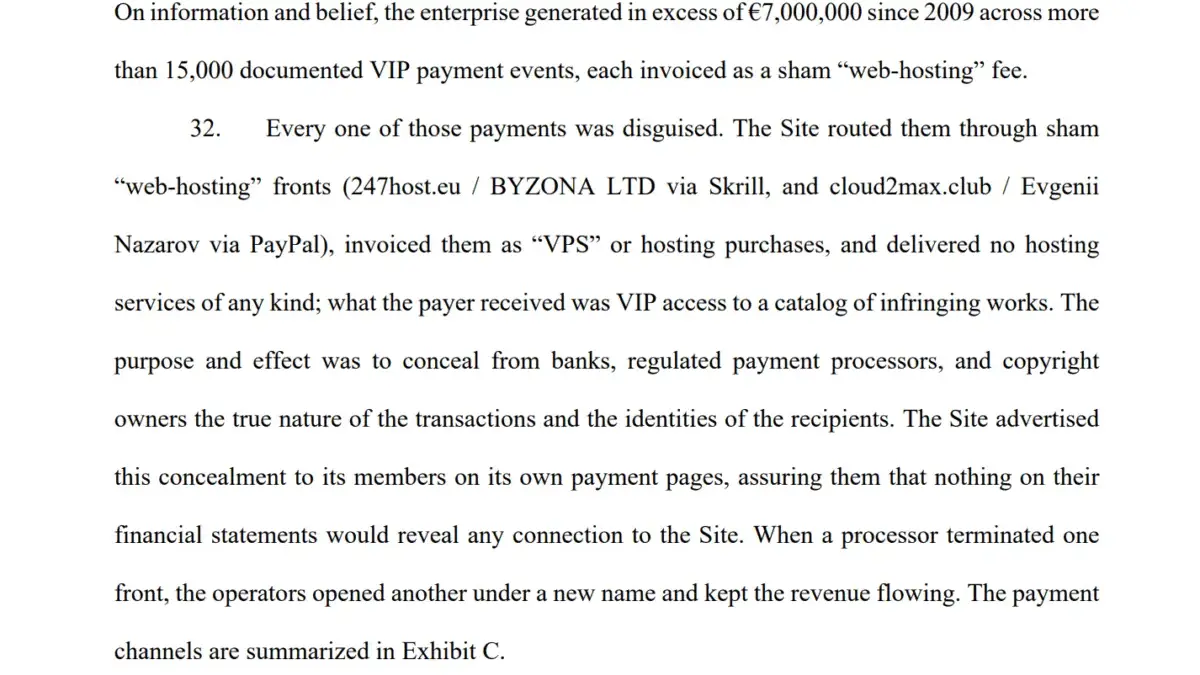
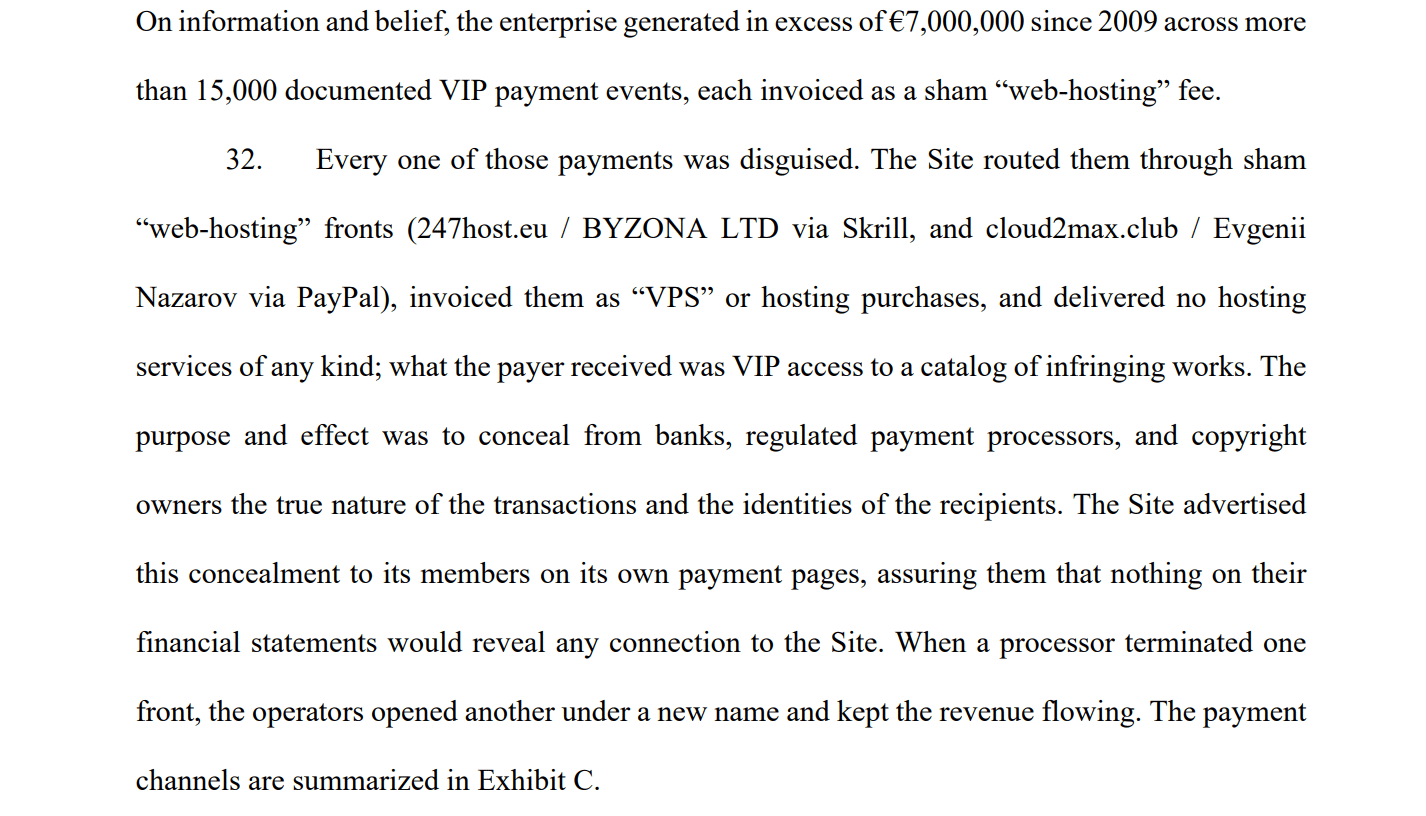
FlavaWorks argues in its legal filings that every single VIP payment processed by the platform constituted a fraudulent act designed to bypass financial scrutiny. According to the complaint, subscribers were directed to sham web-hosting fronts and instructed to purchase "VPS plans" that both parties allegedly knew did not actually exist. The primary purpose of these disguised transactions, the company contends, was to obscure the true nature of the payments from mainstream banks, credit card companies, and online payment processors.
The legal documents outline massive historical figures stemming from these operations. "On information and belief, the enterprise generated in excess of €7,000,000 since 2009 across more than 15,000 documented VIP payment events, each invoiced as a sham ‘web-hosting’ fee," the complaint reads. This multi-million-euro figure represents an estimation calculated by FlavaWorks, covering all revenue allegedly generated by the enterprise over a 17-year operating span. The same financial figures were heavily cited in the initial April lawsuit, where the company requested an asset-freezing order targeting the tracker’s alleged payment providers, including mainstream platforms like PayPal.
Unique Forensic Identifier
The sole named individual defendant in the new complaint is Jason A. S., a resident of Virginia. According to allegations detailed in the court documents, he was a paying subscriber to FlavaWorks’ legitimate, legal websites between March 2020 and July 2021. During that specific window of time, he allegedly downloaded more than 200 copyrighted works belonging to the company.
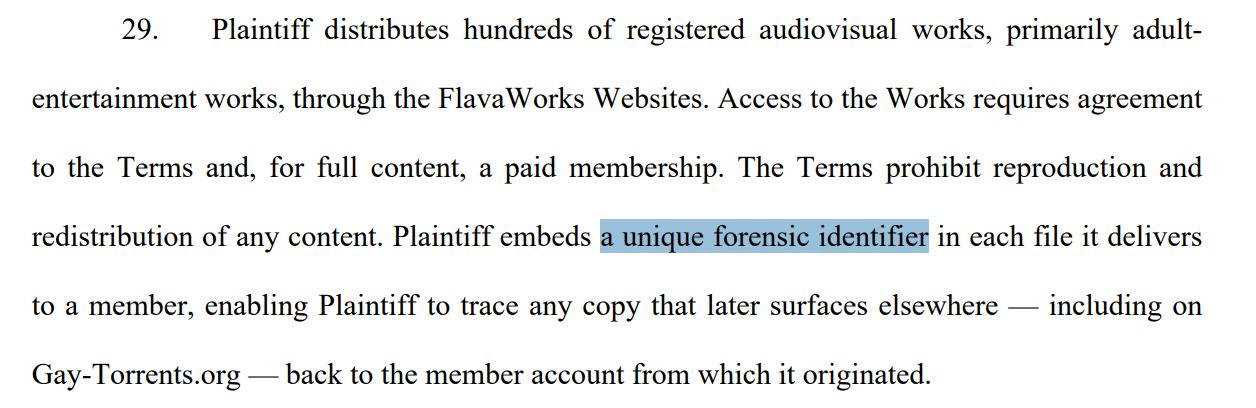
FlavaWorks relies heavily on a proprietary forensic watermarking system designed to embed a unique, trackable identifier into every digital file delivered to its authorized subscribers. When unauthorized copies of videos bearing his distinct digital identifier subsequently surfaced on Gay-Torrents.org, FlavaWorks investigators were able to trace the precise origin of the leaks back to his subscriber account.
These pirated copies were reportedly first detected by the company’s monitoring systems in 2022, prompting FlavaWorks to issue a formal cease-and-desist notice to the defendant at that time. Despite the warning, the man allegedly continued to utilize the illicit platform, and copies of the proprietary content reportedly kept circulating within the community up until 2025.
In addition to allegedly distributing unauthorized copies of the company’s intellectual property, Jason A. S. is accused of paying for a VIP membership on the tracker. This dual involvement makes him both an uploader and a funder under the complaint’s overarching RICO theory. Within the context of the litigation, he functions as the "anchor defendant," whose direct residency and legal connections to the state of Illinois provide the federal court with jurisdiction over the remaining anonymous defendants through specialized RICO provisions.
The Case for RICO
The initial lawsuit pursued by FlavaWorks also targeted platform members, but it relied primarily on standard copyright infringement and state-law claims. That conventional legal approach quickly ran into a common procedural obstacle: the amended complaint was eventually forced to drop hundreds of defendants because they lacked sufficient minimum contacts to fall under the jurisdiction of an Illinois court.
The application of the RICO statute effectively resolves this jurisdictional hurdle. The federal statute authorizes nationwide service of process, meaning that a plaintiff only needs to establish a single anchor defendant with direct ties to the forum state. Once that connection is established, all co-conspirator defendants residing anywhere within the United States can be legally joined to the same action.
Furthermore, utilizing RICO substantially raises the legal stakes for everyone involved. The statute provides for significantly higher damage awards and introduces strict conspiracy liability. Under this legal doctrine, a platform member who merely paid VIP subscription fees and never uploaded a single file could potentially still be held fully liable for the copyright infringements committed by the broader enterprise.
To ensure the viability of this complex RICO theory within the current procedural posture, the operators of Gay-Torrents.org have been kept out of the formal list of defendants. Instead, the complaint specifically identifies the site operators as non-party co-conspirators, streamlining the focus onto the user base.
74 Does & the Evidence Trail
The current complaint lists 74 "John Doe" defendants, each identified solely by their registered Gay-Torrents.org username and internal user identification number. FlavaWorks intends to uncover the true legal identities of these individuals through ongoing discovery and court-authorized subpoenas as the litigation moves forward.
Portions of the evidentiary trail relied upon by the company are relatively straightforward. Usernames and internal user IDs are generally visible to members participating within a private torrent community, and FlavaWorks investigators maintained active accounts on the site. The forensic identifier matches were generated by comparing unauthorized files downloaded directly from the tracker against the company’s internal subscriber and delivery databases. Additionally, evidence shows that a company investigator successfully purchased a VIP subscription on the platform to document the transaction flow.
Further financial evidence is expected to stem from external sources. The complaint notes that formal subpoenas were previously issued to Skrill and PayPal during the course of the initial lawsuit, yielding financial records that track which users funded their VIP memberships through those channels. However, how FlavaWorks managed to compile specific user download activity logs and other internal platform records remains less transparent, with the complaint referring broadly to "the Site’s own per-member records" without detailing precisely how those internal logs were acquired.
RICO Raises the Bar
The comprehensive RICO complaint formally accuses the defendants of direct and contributory copyright infringement, substantive RICO violations, and RICO conspiracy. The legal filing catalogs 85 distinct copyrighted works, opening the door to statutory damages of up to $150,000 per work on the traditional copyright infringement claims alone. The inclusion of RICO counts introduces the possibility of treble damages stacked on top of those figures.
At the same time, pursuing a RICO case introduces a considerably higher evidentiary bar for the plaintiff. Proving criminal copyright infringement allegations requires demonstrating clear willfulness and a motivation involving commercial advantage or financial financial gain. Beyond meeting that standard, FlavaWorks must establish a continuous pattern of racketeering activity, clearly define the specific role and involvement of every single defendant, and satisfy rigorous pleading standards.
The wire-fraud allegations similarly require detailed documentation outlining the precise mechanics of every contested transaction, including who was involved, what occurred, when it happened, and how the funds were transferred. Whether FlavaWorks will ultimately litigate these complex claims through to a full trial remains to be seen. Initiating a RICO lawsuit exerts immense pressure on the named and anonymous defendants alike, though successfully proving these multifaceted claims against individual users at trial remains a significantly more complex undertaking than pursuing standard copyright infringement litigation.
For the time being, however, FlavaWorks has already achieved its primary strategic objective by forcing the permanent shutdown of the pirated content tracker. In a practical sense, any favorable outcomes or financial recoveries secured through the RICO complaint will serve as an additional bonus for the company. For the former users caught in the legal web, however, the stakes have been dramatically elevated, and the long-term concerns are substantial.



Leave a Reply