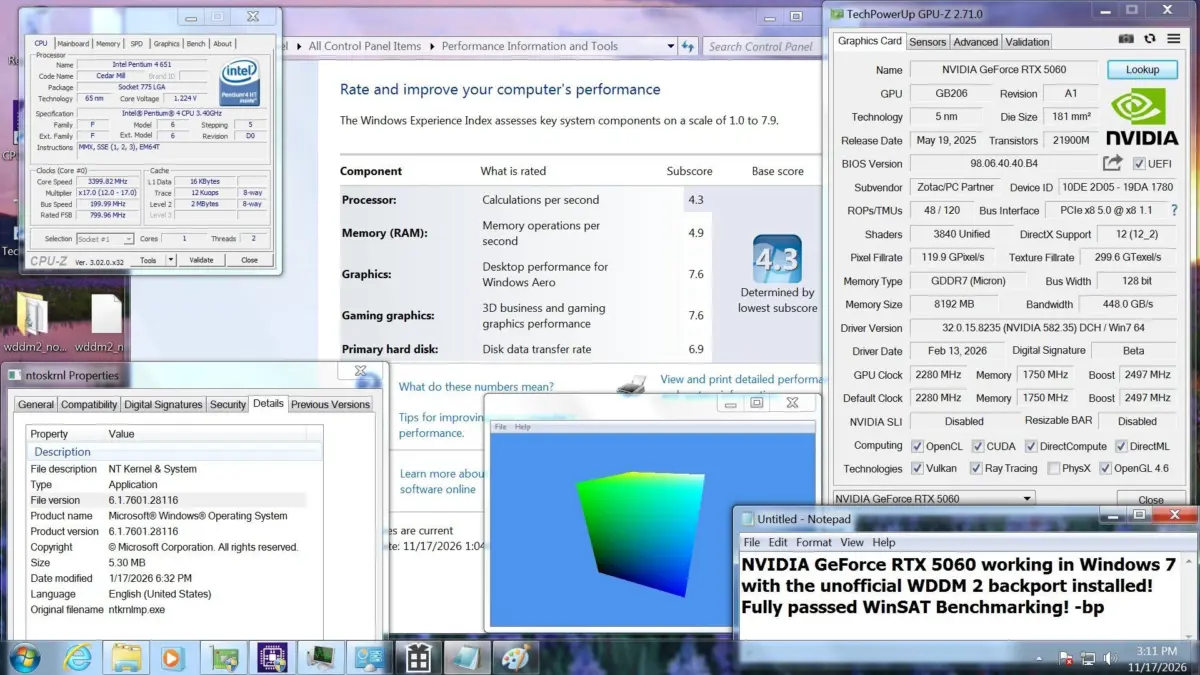
Even though Microsoft officially retired Windows 7 years ago, bringing an end to its routine security patches and mainstream support cycle, the operating system continues to hold a deeply nostalgic place in the hearts of PC enthusiasts, retro gamers, and software tinkerers. Rather than letting the beloved legacy platform fade entirely into obsolescence, a dedicated community of developers has found an ingenious way to bridge the gap between yesterday’s software and today’s cutting-edge hardware. A new grassroots project is currently making waves across the tech community by granting Windows 7 the unprecedented ability to support modern graphics cards from industry heavyweights such as Nvidia, AMD, and Intel, while simultaneously unlocking advanced graphics APIs including DirectX 12 and Vulkan 1.4 capabilities.
This ambitious undertaking is the handiwork of software enthusiasts EAZY BLACK, kryptik, and VisualEhrmanntraut, whose collaborative effort centers around a clever architectural workaround. At the core of their project is the successful backporting of the Windows Display Driver Model (WDDM) 2.2 from Windows 10 down to the older Windows 7 environment. To fully grasp the magnitude of this engineering feat, one must look back at the historical evolution of Microsoft’s display driver architecture. When Windows 7 originally debuted to widespread acclaim, it shipped natively with WDDM 1.1, a display driver model tailored for the hardware landscape of the late 2000s and early 2010s. Years later, as hardware capabilities expanded and graphics processing units grew exponentially more powerful, Microsoft introduced WDDM 2.0 alongside the launch of Windows 10 in 2015, subsequently refining it to WDDM 2.2 with the rollout of the Windows 10 Creators Update in 2017.
Because modern graphics hardware is engineered from the ground up to interface seamlessly with these newer display driver models, running a contemporary GPU on an un-modded installation of Windows 7 has historically presented a brick wall of incompatibility. Without modern WDDM drivers, users attempting to install current-generation graphics cards on Windows 7 would find themselves stranded without proper hardware acceleration, stuck using rudimentary basic display adapters, or entirely unable to install functional drivers. By successfully backporting WDDM 2.2, this community project effectively tricks modern hardware into communicating fluently with the aging operating system, opening the floodgates for users who want to run contemporary silicon on a legacy software environment.
Furthermore, the implications of this project extend far beyond basic display output, stretching directly into the realm of high-performance modern gaming and compute workloads. Historically, software compatibility for advanced graphics application programming interfaces on Windows 7 was severely restricted. While Microsoft did make a notable exception back in 2019 by releasing a limited, specialized version of DirectX 12 for Windows 7, that official implementation was narrow in scope. It was never intended as a general-purpose upgrade for consumers or everyday gamers; instead, Microsoft designed that limited release strictly as a tool to help developers port select high-profile games—such as Blizzard’s World of Warcraft—from Windows 10 back to the older operating system. General users looking for widespread, system-wide modern API support were left largely out in the cold.
With the advent of this new community-driven driver project, however, those limitations are being systematically dismantled. By introducing robust support for both DirectX 12 and the latest Vulkan 1.4 specifications to Windows 7, the developers are enabling the legacy operating system to interact with modern graphics pipelines in a way that was previously thought impossible by mainstream standards. This means that applications and games relying on contemporary rendering techniques, low-level hardware access, and efficient multi-threaded command buffers can theoretically execute within the Windows 7 ecosystem, pairing the classic user interface and lightweight system overhead of the 2009 operating system with the raw computational horsepower of modern graphics processing units.
The release of this project underscores a persistent, recurring theme within the broader personal computer ecosystem: the sheer tenacity of software enthusiasts who refuse to let functional technology disappear simply because its corporate creator has pulled the plug. While mainstream users and enterprise environments long ago transitioned to Windows 10 and subsequently Windows 11 due to critical security considerations, software vulnerabilities, and a complete lack of official vendor backing, the enthusiast community continues to push the boundaries of what legacy operating systems can achieve. Whether driven by nostalgia, a preference for the classic user experience of the Windows 7 era, or a purely academic fascination with low-level systems programming, projects like this demonstrate that the lifespan of an operating system is often determined just as much by the passion of its users as it is by corporate lifecycle policies.