
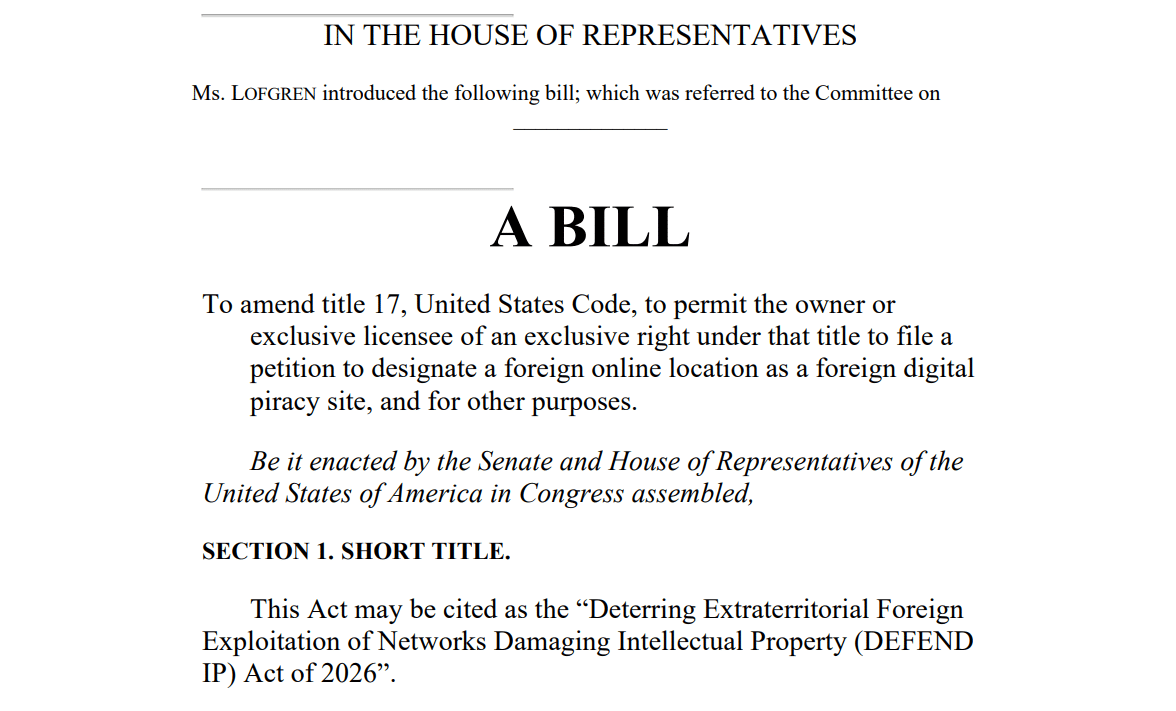
Lawmakers on Capitol Hill are ramping up legislative efforts to crack down on online piracy, introducing a unified bicameral proposal known as the DEFEND IP Act. Spearheaded by Senator Thom Tillis and Representative Zoe Lofgren, the newly unveiled bill merges previous legislative drafts into a single comprehensive measure. The rollout comes hot on the heels of a separate proposal introduced last week—the American Copyright Protection Act (ACPA)—which sparked intense debate across the tech sector by explicitly incorporating virtual private networks into its site-blocking framework.
The DEFEND IP Act, whose full title stands for the "Deterring Extraterritorial Foreign Exploitation of Networks Damaging Intellectual Property," represents a concerted push to bridge previous gaps between House and Senate approaches to foreign online copyright infringement. The measure brings together lawmakers from both sides of the aisle. Alongside Lofgren, the House effort is co-led by Representative Ben Cline, while Senators Chris Coons, Marsha Blackburn, and Adam Schiff have signed on as co-sponsors of the Senate counterpart.
According to supporters, the legislation aims to target overseas digital bad actors while maintaining protections for domestic internet users. "I am proud to work across the aisle on this smart, targeted approach to crack down on foreign piracy while protecting Americans’ free speech and access to a free and open internet," Representative Lofgren stated in the official announcement detailing the bill.
The Senate version of the legislation, designated as S. 5529, has been formally referred to the Senate Judiciary Committee for review. While the complete text of the Senate bill is pending publication on Congress.gov, Representative Lofgren’s office has made a copy of the House version publicly available, allowing legal experts, industry analysts, and advocacy groups to examine the statutory details up close.
VPNs Are Exempt
Much like the ACPA proposal introduced by Representative Darrell Issa, the DEFEND IP Act establishes a legal mechanism empowering copyright holders to secure court orders requiring technical intermediaries to block access to designated foreign pirate websites. However, a critical divergence between the two bills lies in the specific categories of intermediaries that fall within the crosshairs of the legislation.
The DEFEND IP Act casts its net over large-scale broadband service providers boasting at least 50,000 subscribers, as well as public Domain Name System (DNS) resolvers generating more than $100 million in annual revenue. Under this revenue threshold, major public infrastructure operators such as Google and Cloudflare would likely be included in the mandate.

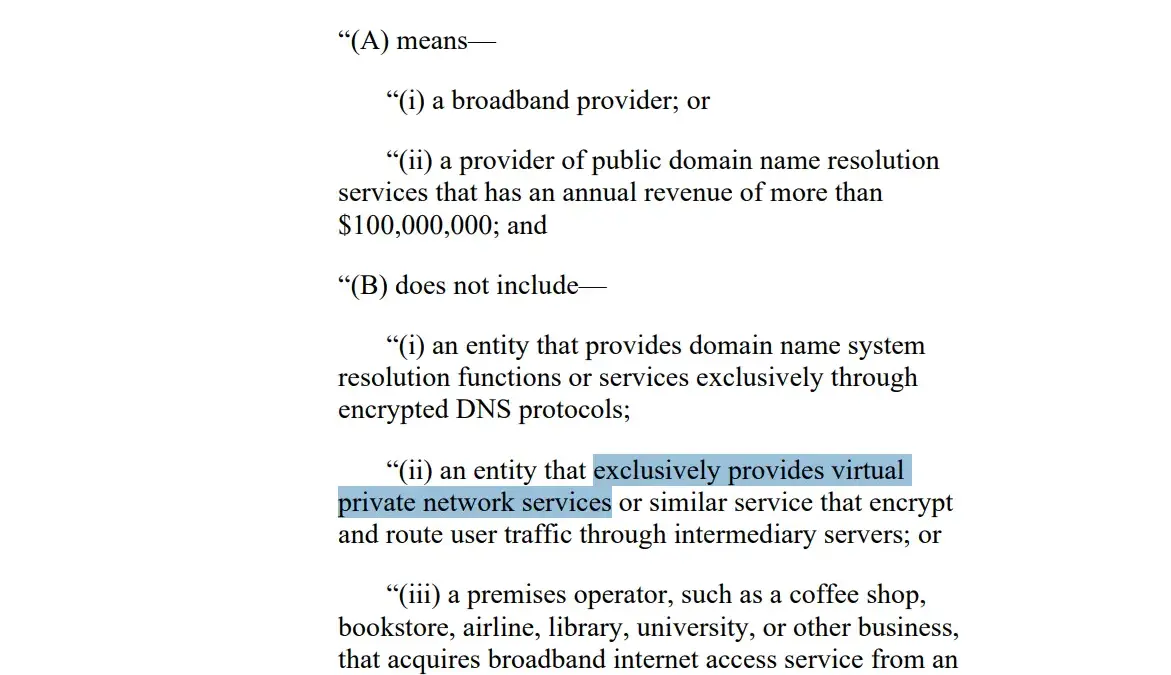
Crucially, however, virtual private network services are omitted from the targeted list of intermediaries. The statutory definition of a service provider within the bill explicitly excludes any entity that exclusively provides virtual private network services, or comparable mechanisms designed to encrypt and route user traffic through intermediary servers.
This exemption marks a stark contrast with the ACPA framework, which leaves the door open for VPN providers to receive blocking orders. Even so, the precise wording of the DEFEND IP Act introduces potential ambiguities. The statute utilizes the term "exclusively," which leaves room for legal interpretation regarding how the exemption applies to technology companies that bundle consumer VPN features alongside other commercial software or network services.
Public DNS resolvers face a similarly nuanced standard. They receive a parallel exemption under the bill, but only if they deliver their resolution services exclusively through encrypted DNS protocols, such as DNS over HTTPS. Because major public resolvers routinely handle a mix of encrypted and unencrypted traffic, industry watchers note that this represents a high bar, potentially requiring household-name providers to alter their infrastructure or apply blocking measures across their encrypted channels to remain compliant.
Designate First, Block Later
The procedural roadmap outlined in the DEFEND IP Act for executing a site-blocking order mirrors the two-tier framework established in competing legislative proposals. The process begins with a formal determination by a federal court, which must evaluate and classify a target platform as a "foreign digital piracy site."
To satisfy this legal standard, a website must meet specific statutory criteria: it must be primarily designed to facilitate copyright infringement, host no commercially significant purpose apart from piracy, or be intentionally marketed and promoted as a destination for pirated material. Operators of accused sites are granted a 20-day window to respond to allegations. Nevertheless, the statutory language allows a federal judge to bypass waiting periods and issue an ex-parte order if the initial evidentiary requirements are fully satisfied by the rightsholder.
Once a site has successfully received the formal designation, copyright holders can return to the presiding judge to petition for a formal blocking order directed at the covered network intermediaries. The court is tasked with evaluating whether the requested blocking mechanism is technically feasible and effective, or whether alternative, less burdensome remedies are available to achieve compliance.

Under the terms of the bill, issued blocking orders remain valid for a period of one year, with provisions allowing rightsholders to seek renewals if the underlying infringement persists. Furthermore, if a designated pirate site attempts to evade enforcement by shifting its operations to a fresh domain name or a new IP address, rightsholders are authorized to petition the court to update the existing order dynamically.
The legislation also addresses the monetization of live content by explicitly extending its scope to cover live-streaming transmissions, including major sporting events. This provision enables rightsholders to seek expedited court interventions when an unauthorized live transmission is anticipated to violate their intellectual property rights, allowing legal mechanisms to be triggered before a match or broadcast begins.
Hollywood Applauds, Public Knowledge Objects
To mitigate burdens on the telecommunications sector, the DEFEND IP Act includes several procedural safeguards for participating service providers. Court orders are prohibited from mandating specific technical methods for implementing a block, granting network operators the flexibility to determine how best to comply. Additionally, intermediaries receive statutory immunity from civil liability when they execute blocking orders in good faith, and the framework permits them to request that rightsholders cover a portion of the associated compliance costs.
The legislation also provides a remedy for websites swept up in the enforcement process by mistake, allowing operators to petition the court to modify or rescind an erroneous order. Unlike competing proposals such as the ACPA—which includes provisions for up to $250,000 in statutory compensation for collateral damage—the DEFEND IP Act does not incorporate a payout mechanism for entities harmed by mistaken enforcement.
Unsurprisingly, the unified bill has secured rapid endorsements from major Hollywood studios and creative industry organizations. More than a dozen prominent trade associations and unions have stepped forward to back the measure from its inception, including the Motion Picture Association, the Recording Industry Association of America, the Copyright Alliance, SAG-AFTRA, and the Directors Guild of America.
"By enacting this legislation, our country can deploy a highly effective tool to protect creators and consumers from overseas digital piracy, all while safeguarding free speech and preserving the open internet," said Charles Rivkin, Chairman and CEO of the Motion Picture Association, voicing strong support for the bipartisan text.
Conversely, digital rights and public interest organizations have mounted staunch opposition, viewing the bill as a continuation of long-standing concerns regarding internet censorship infrastructure. Public Knowledge, an advocacy group that previously spoke out against the ACPA, argues that both site-blocking bills share the same fundamental flaws.
"For the second time in as many weeks, rightsholders have convinced Congress to build out an expansive infrastructure for censorship rather than go after the root of the problem: operators of overseas piracy websites," Public Knowledge wrote in its formal analysis of the legislation, adding an explicit warning regarding infrastructure-level interventions: "Let us repeat: Applying blocking orders to global DNS resolvers causes global blocks."
The introduction of the DEFEND IP Act places two competing site-blocking initiatives into the congressional arena, echoing debates that have persisted in various forms since the controversial Stop Online Piracy Act was shelved over fourteen years ago.
Despite the high-profile backing from creative industries and the bipartisan sponsorship in both chambers, time is running out for the current legislative push. Both the ACPA and the DEFEND IP Act face an imminent expiration deadline when the current session of Congress concludes in January. Compounding the uncertainty, Representative Issa is retiring from the House, and Senator Tillis is not seeking reelection, meaning neither primary architect will be positioned to reintroduce their respective proposals next year. Whether either bill will navigate the legislative process further than its historical predecessors remains to be seen.


Leave a Reply