
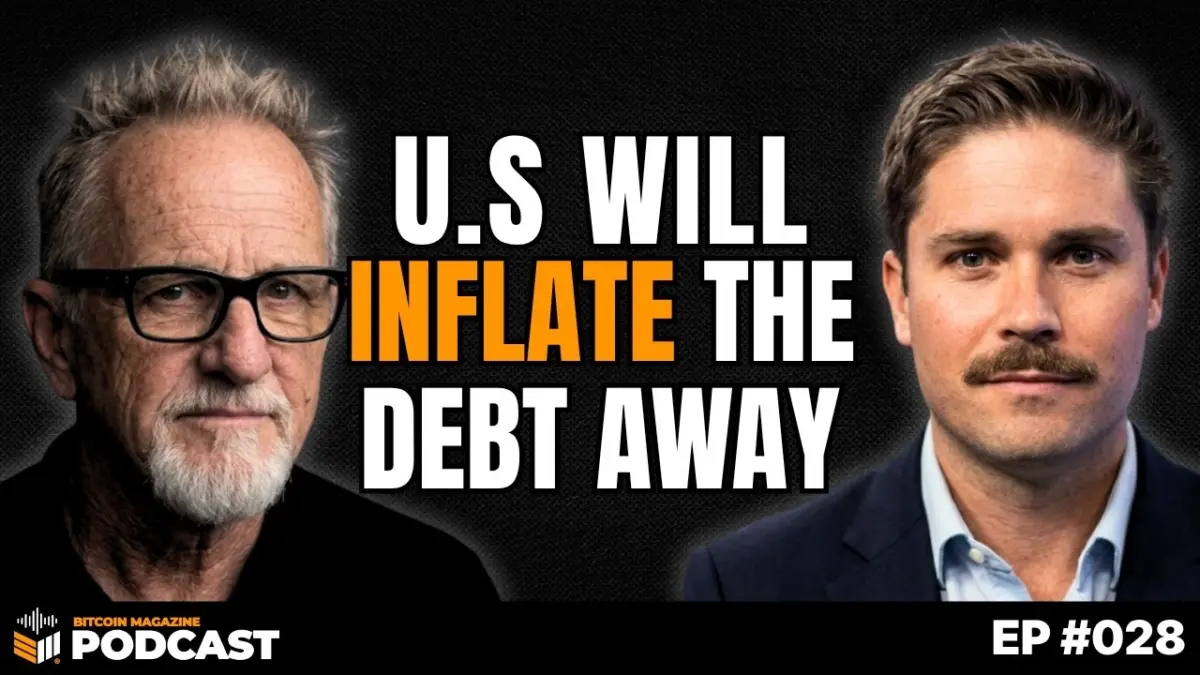
Decades of heavy manufacturing offshoring have left the United States critically dependent on foreign rivals for essential defense equipment, advanced robotics, and core artificial intelligence hardware, according to independent investor Craig Tindale. In a recent appearance on Bitcoin Magazine, hosted by Spencer Nichols, Tindale framed this reliance not merely as an economic misstep, but as an acute national security crisis that threatens the sovereign capabilities of the United States.
Drawing deep inspiration from the economic philosophies of America’s founding architect Alexander Hamilton and the stark warnings of former President Dwight Eisenhower regarding the military-industrial complex, Tindale argued that the United States has systematically hollowed out its industrial base. By outsourcing the production of critical metals, high-tech components, and manufacturing infrastructure, the nation has inadvertently placed its strategic future in the hands of geopolitical competitors.
The wide-ranging discussion, which spanned the complexities of modern financial repression, rising global sovereign yields, and the shifting dynamics of a multipolar world, ultimately centered on an urgent premise: national survival in the twenty-first century requires an immediate return to domestic industrial self-sufficiency and a reimagining of technology as a fundamental defense mandate.
The Roots of Dependence: From Hamilton’s Vision to Modern Offshoring
To understand the gravity of the current predicament, Tindale looks back to the foundational economic principles established by Alexander Hamilton, the nation’s first Treasury Secretary. Hamilton understood that political independence is hollow without economic and industrial independence. His vision for a newly formed American republic relied heavily on domestic manufacturing, protective tariffs, and state-supported industrial capacity to ensure the nation could sustain itself through crises without relying on foreign powers.
For generations, this framework guided American economic expansion, culminating in the post-World War II industrial juggernaut that Dwight Eisenhower famously relied upon to secure the nation. However, Eisenhower also issued a prophetic warning about the unchecked influence of the military-industrial complex and the long-term dangers of prioritizing short-term financial efficiencies over deep industrial resilience.
According to Tindale, American leadership largely ignored these warnings in the late twentieth and early twenty-first centuries. Driven by the pursuit of lower labor costs and maximized corporate profit margins, supply chains were systematically globalized. Factories were shuttered across the American heartland and rebuilt overseas, often within nations that harbor adversarial ambitions toward the West.
Today, this strategy has backfired profoundly. The U.S. can no longer reliably build its own heavy defense equipment, advanced industrial robots, or the specialized semiconductor hardware required to run modern artificial intelligence systems. Tindale points out that this vulnerability extends down to the raw materials level, noting that decades of offshoring have left the country beholden to foreign suppliers for the critical metals essential to both civilian technology and military hardware.
Financial Repression and the Realities of Rising Global Yields
The discussion between Tindale and host Spencer Nichols also delved into the complex macroeconomic forces enabling this fragile status quo, touching on financial repression in the age of superintelligence. As global powers navigate unprecedented debt burdens, Tindale explained why sovereign yields are rising everywhere and why nations, in the traditional sense, rarely go completely broke in the modern fiat era. Instead of defaulting openly, heavily indebted governments resort to financial repression—a set of policies that channel domestic savings into government debt at below-market interest rates.
Tindale analyzed how tools like Operation Twist and potential new accords between the U.S. Treasury and the Federal Reserve are utilized to manipulate yield curves and manage the astronomical cost of sovereign borrowing. However, these mechanisms are not without consequences. Tindale emphasized that domestic savers ultimately bear the cost of financial repression, absorbing the hidden tax of inflation and artificially suppressed returns on their capital while governments attempt to engineer economic stability from the top down.
This financial maneuvering occurs against the backdrop of a rapidly fragmenting multipolar world. As alternative financial networks, stablecoins, and legislative frameworks like the GENIUS Act emerge, nations are increasingly evaluating their exposure to traditional Western-dominated financial systems. Tindale highlighted Hong Kong’s gold vault and the renewed global appetite for hard assets as clear indicators that sovereign states are waking up to the risks of holding purely digital or paper-based claims, recognizing that true wealth ultimately resides in tangible, physical commodities.
Artificial Intelligence as a Defense Mandate and State Capitalism
Perhaps the most striking element of Tindale’s thesis is his perspective on artificial intelligence. While much of the mainstream technology sector views AI through the lens of commercial enterprise, consumer productivity, and software monetization, Tindale views the technology primarily through a geopolitical and military prism.
In a world defined by intensifying great power competition, Tindale describes AI as a high-stakes race to automate the world and construct an impenetrable defense network. In his view, artificial intelligence, advanced code, and automated systems represent the ultimate instruments of modern state capitalism. Nations that fail to control the underlying hardware, energy grids, and algorithmic infrastructure of advanced AI will find themselves entirely subjugated by those that do.
Because AI development is computationally intensive and relies heavily on cutting-edge hardware—much of which depends on an outsourced global supply chain—the race for superintelligence cannot be separated from the broader imperative of reindustrialization. Tindale argues that the United States must treat artificial intelligence development as a core national defense mandate, integrating software capabilities directly with domestic hardware manufacturing to ensure the nation can protect its borders, critical infrastructure, and digital networks from foreign infiltration or disruption.
Protecting Capital and Navigating the Fourth Turning
As the global order undergoes structural transformation, Tindale offered perspective on how investors and individuals can navigate an era defined by geopolitical friction, shifting monetary policies, and technological disruption. Drawing on generational theory, he likened the current global instability to a "Fourth Turning"—a period of profound crisis and institutional rebuilding that tests the resilience and self-sufficiency of nations and individuals alike.
To protect capital amidst financial repression and systemic volatility, Tindale advocates for a diversified approach rooted in hard assets. He points to traditional safe havens and foundational industrial commodities, including gold, silver, copper, and Bitcoin, as essential vehicles for wealth preservation in a fragmenting world. While gold and silver offer historical protection against currency debasement, industrial metals like copper remain tied to the physical economy and the very manufacturing renaissance Tindale argues is necessary for survival. Meanwhile, decentralized digital assets like Bitcoin provide an alternative mechanism for value storage outside the traditional banking apparatus.
Ultimately, Tindale’s analysis serves as a stark warning to policymakers and investors alike. The decades-long experiment of prioritizing globalized efficiency over national self-sufficiency has reached its limits. Rebuilding America’s industrial capacity, securing the domestic supply chain for critical technologies, and treating artificial intelligence as a frontline defense priority are no longer optional economic reforms—they are immediate prerequisites for national survival.



Leave a Reply