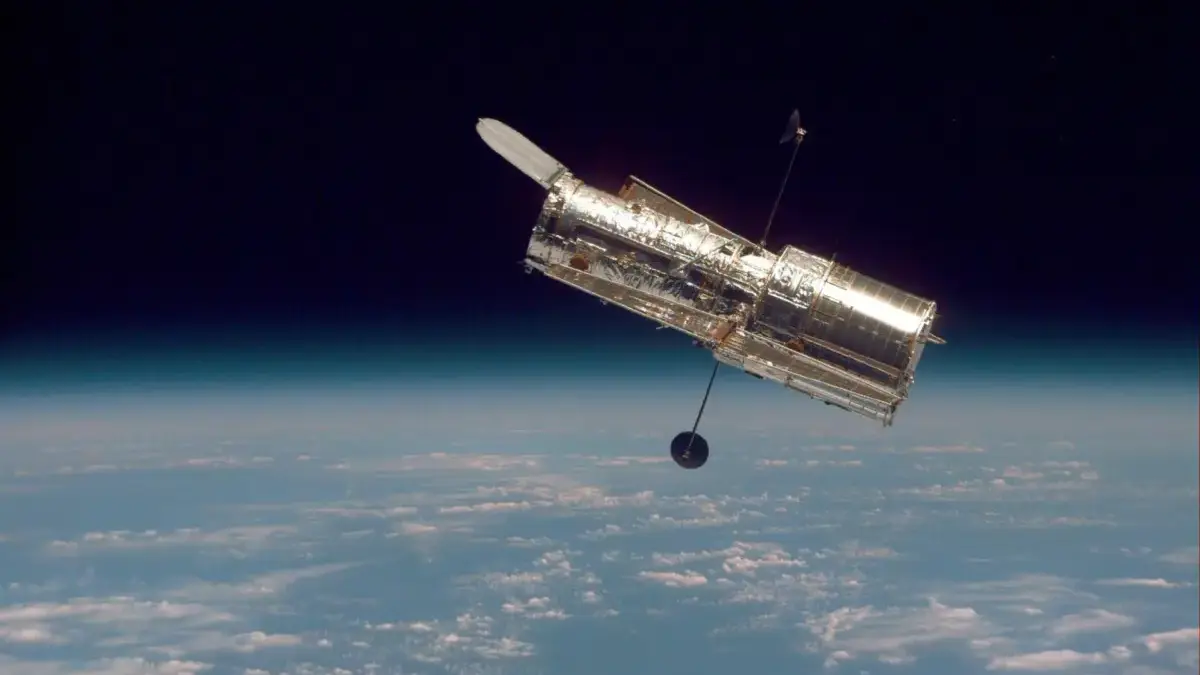
Gravity is a relentless and unforgiving force, slowly pulling the legendary Hubble Space Telescope closer to its ultimate demise with each passing day. While the iconic observatory is not in any immediate danger of burning up in the Earth’s atmosphere, its operational time is steadily running out. Unless its decaying orbit receives a crucial altitude boost, the Hubble Space Telescope will come crashing to Earth sometime in the 2030s. Faced with this looming atmospheric re-entry and the potential loss of one of humanity’s most productive scientific instruments, NASA is looking outward and turning to the private sector to see if commercial innovation can rescue the aging space telescope.
The challenge facing the space agency is rooted in the fundamental physics of low Earth orbit. Even at altitudes hundreds of kilometers above the surface, the Earth’s upper atmosphere exerts a faint, persistent drag on spacecraft. Over decades, this drag robs satellites of their orbital energy, causing them to gradually drift downward. For the Hubble Space Telescope, which was deployed into orbit back in April 1990 by the crew of the Space Shuttle Discovery, this slow orbital decay has been managed in the past through regular maintenance missions conducted by NASA astronauts. During the heyday of the Space Shuttle program, brave crews visited Hubble multiple times to repair faulty components, upgrade its scientific instruments, and reboost the telescope into a higher, more stable orbit.
However, following the retirement of the Space Shuttle fleet in 2011, NASA lost its primary means of directly servicing spacecraft in orbit. Without a dedicated human-crewed lift capability of that exact scale and specialized tooling, Hubble has been left to fend for itself. As the decades have worn on, the atmospheric drag has continued unabated. Without a dedicated reboost maneuver executed within the next decade or so, the telescope’s orbit will degrade to the point where it begins an uncontrolled and destructive re-entry through the Earth’s atmosphere.
Recognizing that Hubble still possesses immense scientific utility, NASA is taking proactive steps to explore whether commercial aerospace companies might be able to step in where the space shuttle left off. The agency has officially opened a formal Request for Information to gauge interest and gather proposals from private sector entities. The goal is to determine if innovative, cost-effective commercial services could successfully reach Hubble, attach to the telescope, and safely raise its orbit to extend its operational lifespan.

Addressing the potential of this commercial collaboration, NASA Administrator Jared Isaacman emphasized the enduring value of the mission in a public statement released on the agency’s official website. "Hubble still has important science ahead of it, and we should be looking at every reasonable opportunity to keep it delivering for as long as possible," Isaacman stated. He further underscored the responsibility the agency has toward both scientific discovery and fiscal stewardship. "If there are innovative and cost-effective ways to extend the life of an asset already on orbit, we owe it to the American taxpayer and the scientific community to explore them. Extending Hubble’s life would mean more discoveries, more science, and more opportunities to expand our understanding of the universe."
The initiative marks a significant shift in how NASA approaches the maintenance and longevity of its premier legacy space assets. In the past, extending the life of complex orbital observatories required fully government-funded, highly specialized human spaceflight missions. Today, the rapid maturation of the commercial space industry—driven by private companies developing advanced robotics, autonomous rendezvous and docking capabilities, and versatile cargo vehicles—has opened up entirely new possibilities. By turning to the private sector, NASA hopes to leverage these cutting-edge commercial technologies to accomplish a task that would have previously required an exclusive, multi-billion-dollar government program.
The Request for Information, which has been formally published on government contracting platforms, represents the initial data-gathering phase of this ambitious endeavor. NASA is using the solicitation to invite aerospace companies, technology developers, and commercial spaceflight providers to submit their ideas, technical concepts, and feasibility assessments for servicing the telescope. These submissions will help the agency understand what capabilities currently exist in the private market, what technologies might need further development, and what a potential commercial servicing mission might look like in practice.
The window for interested private sector partners to submit their insights is tightly bounded. NASA has announced that the Request for Information will remain officially open through November 30th, closing at 3 PM Eastern Time. Following the conclusion of this submission period, agency officials will review the responses, evaluate the technological feasibility of the proposed commercial concepts, and determine the next steps for potentially safeguarding the telescope.
As the early-to-mid 2030s deadline approaches, the future of the Hubble Space Telescope hangs in the balance. For over three decades, the observatory has fundamentally transformed our understanding of the cosmos, capturing breathtaking imagery and gathering critical data that has reshaped modern astrophysics. Whether private sector ingenuity can successfully intervene to give the venerable telescope a new lease on life remains to be seen, but NASA’s outreach to commercial partners ensures that every possible avenue is being explored before gravity claims one of science’s greatest achievements.