Global financial markets faced a turbulent week as macro-economic pressures, tech stock sell-offs, and crypto-specific security incidents collided. While Bitcoin staged an impressive weekend recovery after hitting a cycle low, broader traditional and digital asset markets wrestled with escalating fears, regulatory interventions, and ongoing infrastructure vulnerabilities.
Bitcoin’s 11% Rebound, Kraken Says Everything’s Fine Despite $17K Bitcoin Price
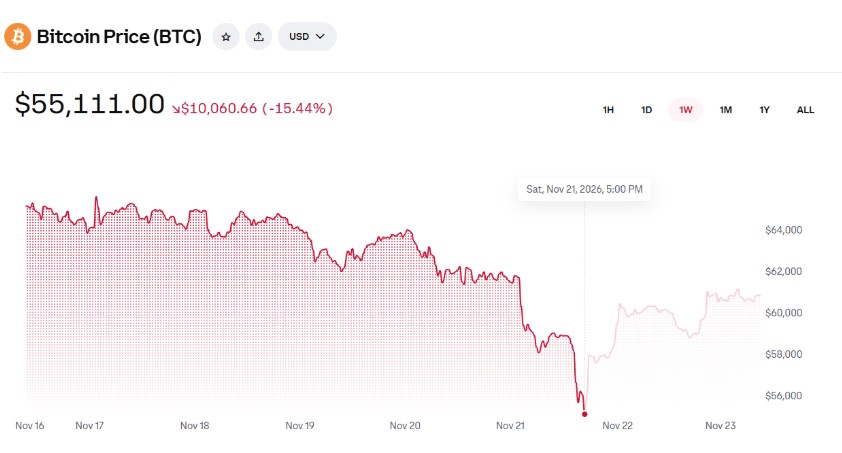
Bitcoin saw a sharp recovery over the weekend, climbing to $61,034 and marking an 11% rebound from its new cycle low around $55,110 recorded on Coinbase. However, traders and analysts remain split on whether this recovery will hold.
The recent crypto correction was not isolated, occurring amid growing concerns over the financial sustainability of the debt-financed artificial intelligence build-out. The tech-heavy Nasdaq fell another 5.3%, pushing dangerously close to a bear market after dropping nearly 20% from its October peak. Meanwhile, the S&P 500 tumbled 8.6%, marking its 12th worst weekly performance since 1952. Safe-haven assets were not spared either, as gold lost 4.3% in a single 24-hour window, compounding to a 21.6% decline since September and putting it on track for its worst three-month performance since June 2013.
At the time of reporting, Bitcoin’s price hovered near $60,750, though market observers warned of potential further downside. Many analysts drew parallels to previous four-year market cycles, which historically bottomed out following United States mid-term elections. Veteran trader Peter Brandt noted earlier in the week that every major bull market phase in Bitcoin’s history has ultimately concluded with a correction of at least 75% from its previous parabolic trend, raising questions about whether the current market cycle is following a similar path.

Meanwhile, a localized flash crash hit Kraken’s Canadian dollar markets, where the price of Bitcoin briefly plummeted to approximately US$17,000. Despite the spot price trading at a staggering 71% discount compared to USD markets, Kraken issued a statement assuring users that its systems were functioning normally. The exchange reported that every order was processed correctly and that security audits found no evidence of a platform breach or compromised accounts. "Executed trades stand," Kraken confirmed.
Crypto influencer Cryptobull offered a glimmer of optimism, highlighting that Bitcoin’s Market Value to Realized Value (MVRV) peak for this cycle reached only 2.29 times above its cost basis. Extrapolating that metric to a cycle low points to a baseline of approximately 1.03 times the cost basis of $53,700, aligning closely with the $55,130 price point recently touched on Coinbase. Conversely, cycle theorist Benjamin Cowen cautioned that during established bear markets, Bitcoin typically drops significantly lower than its realized price, often gravitating toward its balanced price—a metric placed at $38,700 by Coinglass data.
Tampered Ledgers Reported in Dubai and Germany
Hardware wallet manufacturer Ledger issued an urgent advisory to customers who purchased devices in Berlin since January 2026, urging them to contact customer support amid an ongoing investigation into tampered hardware devices discovered in Germany and the United Arab Emirates.
Several suspicious devices surfaced in retail channels across Berlin, while two separate customers in Dubai reported catastrophic losses totaling $604,000 in cryptocurrency. Ledger stated that these incidents are directly linked to a broader distribution-channel tampering campaign initially uncovered in Southeast Asia last October. To reassure anxious users, Ledger announced it is offering physical hardware inspections, including comprehensive X-ray analyses at its primary manufacturing facility in Vierzon, France, for any customer concerned that their device might have been compromised.
Ethereum’s Glamsterdam Upgrade Could Slip to May 2027 Over Compatibility Concerns
Only a week after Ethlabs outlined ambitious proposals to make the Ethereum network post-quantum and AI-proof by 2027, discussions during the All Core Devs Call revealed that the upcoming Glamsterdam upgrade may experience delays, potentially pushing activation back to May 2027.
While initial specifications targeted mainnet activation as early as mid-January 2027, incorporating modifications to gas pricing Ethereum Improvement Proposals (EIPs) requires extensive testing to ensure existing smart contracts are not disrupted. Depending on the outcome of these compatibility checks, deployment could be deferred to late February, March, April, or May, though no final consensus has been reached. Developers also evaluated adjusting EIP parameters within the subsequent Hegota fork to prioritize post-quantum features earlier, though several contributors argued that shrinking the scope of the upgrade yields few advantages unless it meaningfully shortens the total rollout schedule.
Binance Hacker Moves Nearly $600M in ETH, Routes Funds Through THORChain and Chainflip
Blockchain analytics firms revealed that digital wallets tied to the major Binance hack transferred nearly $600 million worth of Ether across a two-day span, utilizing cross-chain swap protocols to obscure the trail of stolen assets.
According to data from Onchain Lens, the attackers moved approximately $248 million in ETH to fresh wallets on Thursday, followed by an additional $346 million in ETH on Friday. A significant portion of these illicit funds was routed through decentralized cross-chain liquidity protocols THORChain and Chainflip. The sudden surge in activity pushed THORChain’s 24-hour swap volume to a staggering $239 million on Friday, generating roughly $243,000 in protocol earnings according to project dashboard metrics.

Anthropic Shares Attract Half the Net Purchases on Day One as SpaceX
Retail investors poured $772 million into Anthropic shares during the artificial intelligence firm’s Nasdaq market debut, yet net purchases totaled just $60 million—roughly half of the $118 million retail investors directed toward SpaceX on its first day of trading back in June.
Data compiled by Vanda Research indicated that Anthropic’s first-day retail trading volume outpaced SpaceX’s $669 million, setting a record for any market debut tracked in the firm’s dataset dating back to 2012. Market volume metrics account for both total purchases and sales, whereas net buying measures the extent to which buy orders exceeded sell orders. Anthropic shares closed their first trading day up 17% over the initial public offering price, but broader market sell-offs pulled the stock down to just 7% above its IPO price by the end of its second session.
Winners and Losers
At the close of the trading week, benchmark digital assets remained firmly in the red. Bitcoin (BTC) dropped 6.5% to $60,815, Ethereum (ETH) fell 5.9% to $1,713, and XRP slid 4.3% to $0.02, bringing the total cryptocurrency market capitalization down to $2.08 trillion according to CoinMarketCap tracking.
Among the top 100 digital assets by market capitalization, the leading altcoin gainers for the week included Pieverse (PIEVERSE), which surged 91.2%, Venice Token (VVV) with a 28.7% gain, and Falcon Finance (FF), up 4.1%. On the other side of the ledger, the hardest-hit altcoins were Sky (SKY), falling 22.6%, Artificial Superintelligence Alliance (FET), down 18.4%, and Aptos (APT), which declined 16.8%.
Bitcoin Carry Trades Could Beat Treasury Bills in 2027, Sygnum Predicts
Digital asset bank Sygnum released its 2027 market outlook predicting that Bitcoin carry trades could regain their historical advantage over traditional United States Treasury bills as market demand for leverage recovers.
The institution forecasted that annualized premiums on three-month Bitcoin futures traded on the Chicago Mercantile Exchange will average more than 2% above the yields offered by three-month US Treasury bills over the course of next year. Fabian Dori, chief investment officer at Sygnum, noted that returns are poised to rebound as investors demonstrate an increased willingness to embrace risk while fewer competing hedge funds chase identical yield opportunities.
IOSCO Warns Quantum Upgrades Could Slow Blockchains, Leave Security Gaps
The International Organization of Securities Commissions (IOSCO) published a report warning that retrofitting existing blockchain networks to withstand future quantum computing attacks could introduce transaction bottlenecks and increase operational costs.
According to the IOSCO report, certain quantum-resistant digital signature schemes require significantly more data storage than standard algorithms currently used to authorize blockchain transactions. Larger signatures reduce the total transaction capacity of individual blocks, which could heighten network congestion, drive up user fees, and demand expanded server storage. The international regulatory body highlighted a recent test experiment involving Solana, where implementing quantum-resistant signatures caused network processing speeds to drop by roughly 90%.

US Senate Advances Prediction Market Restrictions with DEATH BETS Act
The United States Senate passed legislation aimed at restricting federally regulated prediction platforms from hosting speculative contracts tied to sensitive geopolitical and societal events.
The DEATH BETS Act, originally introduced by Democratic Senator Adam Schiff, passed via voice vote after lawmakers adopted a unifying amendment by unanimous consent. The bill prohibits regulated platforms from offering financial contracts associated with war, terrorism, political assassination, and outcomes primarily determined by human mortality, forwarding the measure to the House of Representatives for review.
Sky Protocol Sees $2B in Stablecoin Withdrawals, Disputes Illicit Fund Claims
Sky Protocol experienced over $2 billion in stablecoin redemptions in a single day, coinciding with the publication of an investigative report by CoinDesk linking approximately $518 million in historical transactions through the protocol to illicit financial activity.
The massive wave of withdrawals was largely driven by user anxiety over potential regulatory actions, including concerns that issuer Circle might freeze USDC reserves held within the protocol. Sky responded by issuing a public statement asserting that its USDS stablecoin successfully maintained its $1 price peg throughout the heavy withdrawal period. The project rejected the media report’s conclusions, citing an independent security review conducted by Block Analitica that characterized the allegations as misleading.