The Agent Name Service (ANS) has officially found a permanent home under the umbrella of the Linux Foundation. The major launch took place at KubeCon North America in Salt Lake City, marking a significant milestone for a project that the foundation first previewed to the public back in June. With autonomous artificial intelligence agents increasingly operating, communicating, and transacting across complex global systems, the integration of ANS into the Linux Foundation aims to establish a neutral, universally adopted standard for agent discovery and verifiable identity.
Major technology and security organizations are already throwing their weight behind the initiative. GoDaddy, Cloudflare, Salesforce, and DigiCert are among the key entities now actively involved with the project, bringing the total number of supporting organizations up to eleven. This growing coalition highlights the urgent industry-wide demand for standardized trust frameworks as software agents take on more autonomous responsibilities across enterprise networks.
One of the earliest practical deployments of ANS has already begun within AGNTCY, another collaborative project hosted under the Linux Foundation. Within AGNTCY, the centralized directory of artificial intelligence agents now utilizes ANS to dynamically check and verify an agent’s identity before establishing communication or authorizing tasks. This early adoption demonstrates how the service can be integrated into existing multi-agent architectures to secure interactions in real time.
Announcing the transition and highlighting the strategic necessity of the project, Jim Zemlin, CEO of the Linux Foundation, shared his perspective on the evolving digital landscape. Autonomous AI agents are transacting and operating across global systems, but they cannot succeed without verifiable identity, Zemlin noted. Under the neutral governance of the Linux Foundation, ANS provides a common foundation of trust that the entire industry can adopt, implement, and improve together.
An Explainer on How Agent Name Service Works
As artificial intelligence systems proliferate, platforms currently identify AI agents through fragmented, proprietary mechanisms. When a service or application receives an incoming request from an autonomous agent, there is traditionally no standardized way to cryptographically confirm who the agent represents or which organization stands behind it.
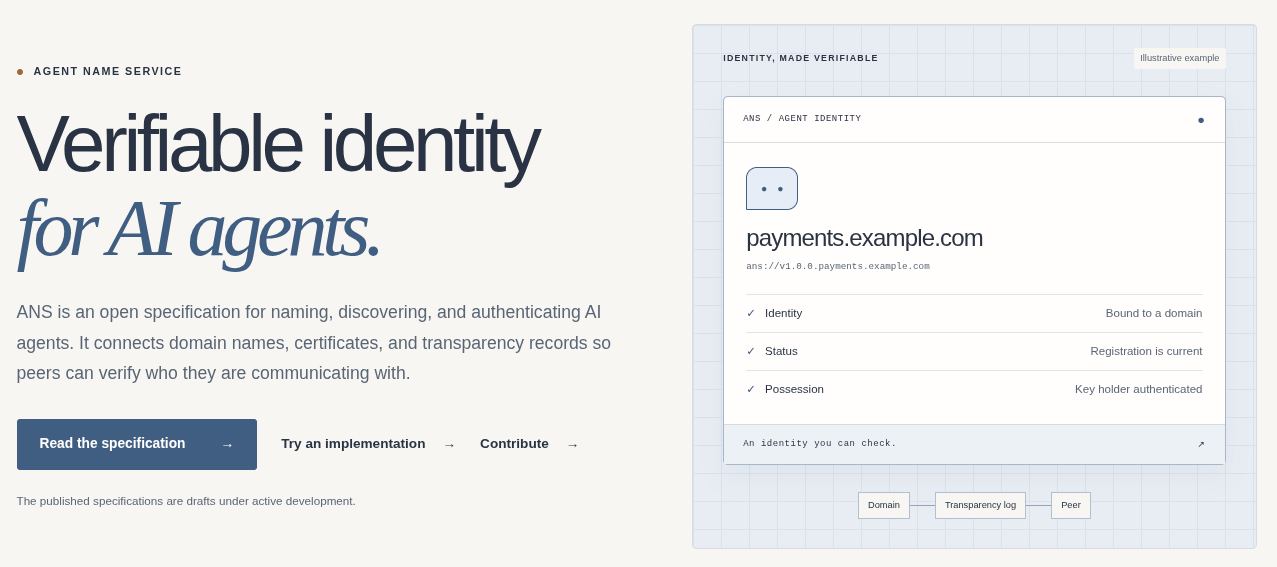
The Agent Name Service tackles this fundamental security gap by linking each individual agent directly to a domain name owned and controlled by its operator, mirroring the established relationship between a website and its domain. Under this scheme, each specific version and deployment of an agent receives a structured name, formatted similarly to ans://v1.4.2.travel.example.com.
To successfully register an agent within the system, the operator must first prove verifiable control over the designated domain. Once ownership is established, specialized cryptographic certificates are issued for the agent. Every single registration is subsequently logged into a public, tamper-evident log that can be independently read and verified by anyone on the network.
In addition to the public log, ANS publishes detailed configuration data about each registered agent within the Domain Name System, commonly known as the internet’s core address book. This integration allows other systems and platforms to discover and look up agents using existing, familiar networking tools rather than having to invent entirely new lookup mechanisms from scratch.
The underlying architecture relies heavily on established web standards. The main DNS records utilize a specialized format borrowed from a separate collaborative initiative known as DNS-AID. ANS complements this structure by adding a single proprietary record of its own, which directly points to the agent’s specific entry within the public transparency log.
When an agent transmits a request to a remote system, the receiving platform can automatically verify several critical trust parameters. It can check that the agent’s registration genuinely exists, ensure that the credentials have not been revoked, and confirm that the calling agent actually holds the cryptographic private key tied to the registered domain identity.

It is important to note the precise boundaries of the service: ANS is strictly designed to handle authentication and identity. Deciding what an authenticated agent is actually authorized to do once it connects is left entirely up to the receiving system, meaning platforms must still implement their own internal access control checks.
The Setup Behind ANS
Governance and technical oversight of the project are managed through a dedicated technical steering committee. The committee initially begins with five seats, currently occupied by three representatives from GoDaddy, Ken Huang of DistributedApps.ai, and Michael Kantor of Hashgraph Online.
This initial leadership lineup is designed to be transitional rather than permanent. The project charter mandates that the first formal election must be held within twelve months of the launch. Following that initial election, strict governance rules outlined in the project charter prevent any single corporate entity from holding half or more of the committee seats, ensuring long-term vendor neutrality and preventing any one organization from unilaterally controlling the direction of the standard.
Furthermore, the charter stipulates that technical committee meetings must remain open to the public, ensuring that ongoing discussions, architectural debates, and core decisions maintain complete transparency for the wider developer community.
Regarding the software codebase, the foundational libraries written in Go, Rust, and Java currently operate under the permissive MIT license. However, the governance model dictates that all new code contributed to the project moving forward must be licensed under the Apache 2.0 license, aligning the project with standard open-source compliance frameworks used across major Linux Foundation initiatives.
Some Lore Info
The conceptual origins of the Agent Name Service trace back to 2025, when early specifications were submitted as an Internet-Draft to the Internet Engineering Task Force, the premier standards organization for the internet. A subsequent follow-up draft was submitted in October of that year. While architectural drafts submitted to the IETF help shape technical discussions, they hold no formal standing or official endorsement from the body itself.
With the recent transition, the Linux Foundation has formalized the specification for production environments. The reference implementation code, alongside functional local demonstration environments, is publicly hosted on the project’s official GitHub page, while the complete technical specifications remain accessible on the project website.