The ongoing cat-and-mouse game between copyright holders and digital pirates has taken a distinct turn toward software development platforms, presenting a unique challenge for enforcement agencies. Earlier this year, the complete source code for Movix, a prominent pirate streaming site, was published openly on GitHub. This unprecedented move has become a persistent thorn in the side of the French anti-piracy organization ALPA (Association de Lutte contre la Piraterie Audiovisuelle), which represents major Hollywood studios via the Motion Picture Association (MPA), local music rights groups like SACEM, and various domestic film industry stakeholders.
Despite multiple copyright infringement notices, legal battles, and widespread domain blocks, the infrastructure powering Movix has proven remarkably resilient. While the platform itself was targeted earlier this year by a sweeping judicial order in Paris, the open-source nature of its codebase has transformed the enforcement effort into a digital game of whack-a-mole. Even as rights holders successfully pressure developer platforms to scrub original repositories and duplicate forks, fresh iterations of the code continue to surface online, driven by persistent contributors who operate in plain sight.
The saga surrounding Movix escalated significantly in March when the Paris Judicial Court issued a landmark ruling targeting online piracy. Acting on behalf of several prominent French film and television industry groups, the court ordered major domestic internet service providers—including Orange, SFR, Free, and Bouygues Telecom—to implement network-level blocks against Movix alongside 21 other unauthorized streaming portals. The injunction was granted for an initial duration of 18 months, reflecting the judiciary’s growing impatience with unauthorized distribution networks.
Evidence presented during the court proceedings underscored the massive scale of Movix’s operations. According to findings compiled by ALPA’s sworn investigative agents, the streaming portal offered users unauthorized access to an expansive catalog comprising 7,236 feature films and 2,956 television series. More crucially, the site’s traffic data demonstrated an extraordinary level of user engagement. Movix attracted upwards of 387,000 unique French visitors in a single month, comfortably surpassing the traffic metrics of any other individual platform cited in the same judicial blocking order.

Like many traditional pirate websites facing judicial blocks, Movix demonstrated a familiar capability to pivot toward alternative domain names to circumvent internet service provider restrictions. However, what truly sets Movix apart from standard streaming operations is its embrace of open-source principles. Rather than keeping its underlying architecture private, the creators behind the portal chose to publish the entire source code openly on GitHub, allowing anyone to download, inspect, copy, and deploy their own versions of the service.
The publicly accessible repository includes the site’s frontend interface, backend server logic, a dedicated browser extension, and accompanying mobile applications. Accompanying documentation within the project’s README file proudly presents Movix as France’s first open-source streaming site infused with artificial intelligence capabilities, noting that the entire project was built using modern, rapid development techniques often referred to as vibe-coding.
Takedown and Repeat
The public availability of proprietary streaming infrastructure on a mainstream developer platform naturally drew the immediate attention of rights enforcement bodies. ALPA quickly mobilized, initiating a sustained campaign of Digital Millennium Copyright Act (DMCA) takedown notices directed at GitHub. These notices argued that the shared code violated copyright protections by facilitating the mass unauthorized distribution of protected audiovisual works.
The enforcement timeline began in earnest during the spring. In late March, ALPA submitted its first formal notice targeting an initial Movix repository hosted on GitHub. The platform promptly complied and blocked access to the repository on March 26. Shortly thereafter, in mid-April, a second repository uploaded by the exact same user account drew a second takedown notice. GitHub responded by disabling the second repository on April 14. During this second intervention, ALPA explicitly urged GitHub’s platform administrators to ban the uploader’s account entirely to prevent further infractions. Despite this request, the account remained active, setting the stage for future uploads.

True to the decentralized nature of open-source software, the removal of the official repositories did little to permanently halt the distribution of the code. Merely two weeks after the April takedown, a new GitHub account was established. Archived web data indicates that by early May, this new account was already hosting a fresh, fully functional copy of the Movix source code. Over the subsequent weeks, the repository steadily gained traction within certain developer circles, accumulating 94 stars and 21 distinct forks by late June as other users replicated the project on their own profile pages.
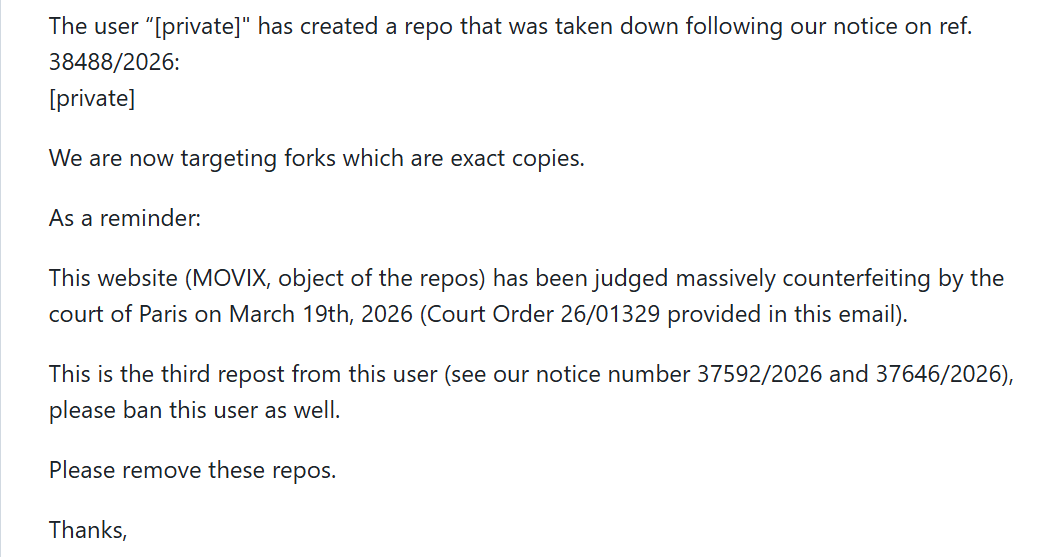
Recognizing the renewed availability of the infringing material, ALPA escalated its legal pressure in September. On September 22, the anti-piracy group submitted a fresh takedown request targeting the new repository hosted under the second account. GitHub processed the notice and blocked the repository the following day, on September 23. However, blocking the central repository did not eliminate the numerous copies that other users had already created through GitHub’s fork feature.
To address these lingering duplicates, ALPA launched a broader sweep targeting secondary copies in November. The organization submitted a comprehensive takedown notice listing 38 specific forks that represented exact digital copies of the Movix codebase. Reviewing the targeted links confirmed that GitHub subsequently disabled all 38 repositories within a day of receiving the notice.
Interestingly, ALPA’s formal notices did not itemize specific motion pictures or television episodes being infringed upon within the code repositories. Instead, the notices contained standard legal phrasing asserting that ALPA members owned the exclusive rights to the titles listed in the documentation, even though no specific titles were explicitly enumerated within the text of the repository complaints. Throughout these successive filings, ALPA repeatedly implored GitHub to take stronger administrative action against the persistent uploader, pointing out that the September repository represented the third consecutive repost of the exact same infringing material by the same individual.
The Code Lives On
Despite the diligent execution of takedown notices by GitHub and the legal backing of the Paris court order, the underlying technology powering Movix continues to circulate widely across the internet. The systemic challenge for copyright holders is that once software code is published online, it achieves a degree of permanence that is exceptionally difficult to eradicate entirely through administrative notices.
Data retrieved from GitHub indicates that within less than 24 hours of GitHub blocking the September repository, both a brand-new GitHub account and a replacement repository were simultaneously established on September 24. Commit history and metadata from this latest iteration reveal that the repository continues to mirror the full Movix codebase, omitting only specific private configuration files.
Recent activity logs show that synchronization updates continued to be applied to the repository as recently as mid-November, arriving mere days after ALPA filed its mass takedown notice against the 38 forks. Furthermore, technical attribution linked these ongoing code updates directly to the exact same GitHub user account that ALPA had repeatedly petitioned platform administrators to ban since the spring.
Beyond the source code repositories hosted on developer networks, the Movix brand itself remains visible across the wider web, with various independent operators launching distinct streaming portals utilizing the site’s name and interface design. Whether rights-holding organizations like ALPA will expand their enforcement actions to pursue these new domain deployments, or how GitHub will ultimately handle the persistent user accounts operating behind the ongoing code distributions, remains to be seen as the legal and technical battle unfolds.