The Domain Name System Operations, Analysis, and Research Center (DNS-OARC) gathered experts from across the global internet community in Vancouver, Canada, for its 47th meeting from November 9 to 10, 2026. For network engineers, researchers, and operators deeply immersed in the foundational mechanics of the internet, the two-day event offered an intensive overview of the critical operational hurdles, security evolutions, and architectural debates shaping today’s DNS landscape. From managing massive traffic datasets to preparing for the looming post-quantum era, the conference highlighted how the backbone of internet navigation continues to adapt to hostile environments and scaling pressures.
A Cuckoo Filter for Massive DNS Traffic Streams
Analyzing DNS traffic remains one of the primary methods for understanding network activity, threat intelligence, and security threats. Nearly every online transaction begins with a DNS query, making the protocol a universal telemetry source used for everything from routine consumer web browsing to tracking malicious botnet orchestration. For threat intelligence platforms, capturing and parsing these query streams is essential, but the sheer volume of data presents formidable engineering challenges.
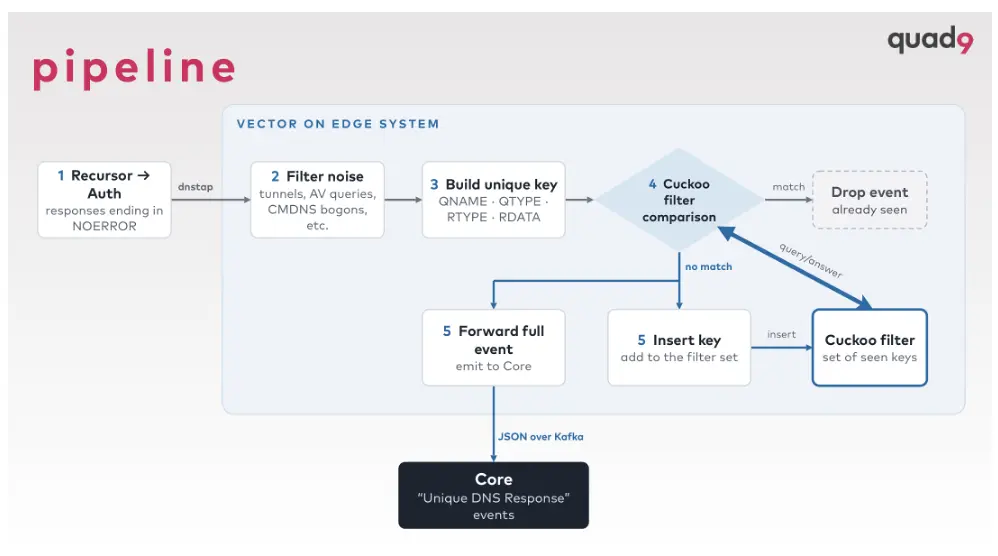
During the Vancouver meeting, John Todd reported on Quad9’s investigation into implementing a "cuckoo filter" to optimize the processing pipeline of their open recursive resolver service. While Quad9 does not operate the absolute largest recursive resolver on the internet, its query streams are nonetheless massive, requiring highly specialized storage and querying tools.
A cuckoo filter offers a probabilistic data structure that can respond with complete certainty when a queried name is absent from a stored set, though it cannot state with absolute certainty that a name is present. The probability of false positive results depends directly on the selectable bit size of the object’s fingerprint, where larger fingerprints reduce false positive rates. Quad9’s ongoing development explores features like a Least Recently Used (LRU) storage regime featuring cache entry deletion and insertion, alongside a Time to Live (TTL) for stored entries. Initial performance metrics indicate that this approach is remarkably efficient, opening up new analytical capabilities for tracking newly observed domains, monitoring changes in name properties, analyzing string similarities, and identifying threats based on intrinsic name characteristics.
Chasing Milliseconds in DNS Resolution
Large-scale network operators continually grapple with a classic architectural dilemma: balancing latency against cache hit rates. Deploying a resolver closer to the customer significantly reduces latency, but it serves a smaller population of end clients, which in turn diminishes the cache hit rate. Conversely, placing a resolver deeper within the core network increases the query load and improves cache hit rates, but the physical and topological distance introduces higher latency.

Network operators strive to find the optimal compromise between these competing priorities. Comcast shared insights during the conference regarding its edge compute deployments, reporting a respectable 10-millisecond latency to reach the resolver cache. Achieving this performance metric across an extensive network infrastructure underscores significant advances in modern deployment engineering.
Cat and Mouse Resolution Loops
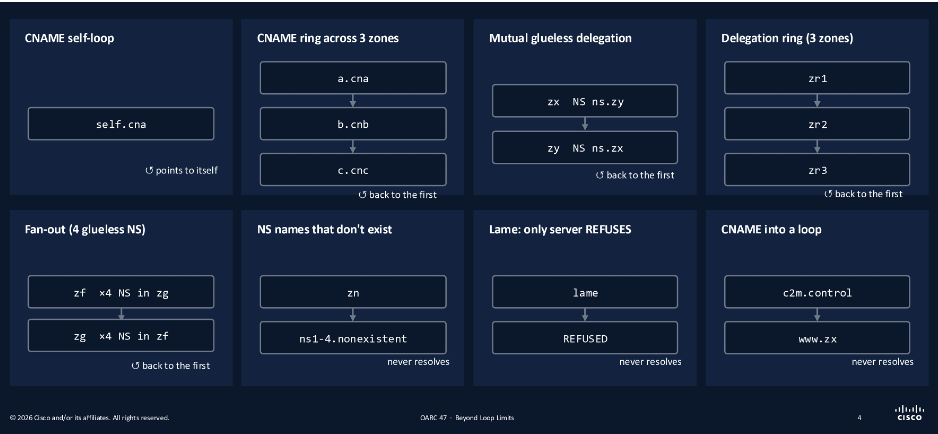
DNS configurations frequently establish complex operational trails that resolvers must meticulously follow. These paths include label sequences within a domain name, alias records introduced via CNAMEs, and the resolution of nameserver identities into IP addresses when glue records are missing or untrusted. Malformed or deliberately convoluted configuration structures can trap a resolver in endless processing loops, artificially inflating resource consumption. Cisco’s DNS group presented multiple examples where resolution logic triggers extensive computational effort that can never lead to a successful resolution.
To defend their infrastructure, recursive resolvers employ strict integrity controls. They maintain tracking logs of encountered CNAMEs to halt resolution immediately upon discovering a repeated name, enforce upper limits on CNAME chains, and operate under strict overall time and work budgets for each resolution task. When a task is terminated due to budget exhaustion, resolvers cache the original name for a short duration to immediately intercept and block subsequent repetitions. However, the operational consensus emerging from these findings is that simply stopping a loop does not eliminate the underlying cost imposed on the resolver, making the suppression of repeated work far more critical to preserving overall system performance and capacity.
The Shift Toward Parent-Centric Delegations
Recent architectural adjustments in software like the BIND recursive resolver, highlighted earlier in the year by ISC’s Ondrej Sury, point toward a broader transition to a parent-centric delegation model. Traditionally, nameserver (NS) delegation records exist within the delegated child zone but are also copied into the parent zone. Cautious resolvers historically followed the parent zone’s copy before independently querying the child zone for authoritative verification.
Recent updates have eliminated these additional child-zone queries because they offered little practical security benefit. If a parent record is corrupted to mislead a resolver, the vulnerability has already been exploited, and a query to a compromised child record would yield similarly misleading results. Shane Kerr presented experimental data demonstrating that when operating a zone completely devoid of NS records, none of the major open recursive resolvers objected to the omission.

This practice is currently the subject of debate within the Internet Engineering Task Force (IETF). One proposed draft outlines how recursive resolvers should formally adopt the parent-centric delegation model, while a competing draft proposes delegation revalidation by fetching child zone records and ensuring they are signed via the Domain Name System Security Extensions (DNSSEC). While DNSSEC guarantees the authenticity of a returned response, it does not inherently protect the pathway used to discover nameservers or prevent on-the-wire interception of delegation data unless additional validation measures are applied.
DNS Resolution Misbehavior and Query Multiplication
Efficiency remains a primary goal for DNS architects, but empirical data reveals ongoing challenges with query multiplication. An APNIC Labs study evaluated query volumes directed at non-existent names, utilizing a measurement platform that conducted 116 million tests across a diverse global sampling of end users over a seven-day period. By assigning a unique DNS name to each user, the methodology deliberately bypassed resolver caching behavior.
The 116 million tests generated a staggering 513 million queries at the authoritative nameservers, averaging 4.43 queries per unique name—a noticeable increase compared to a similar 2019 study that recorded a multiplication factor of 2.37. This inflation is partly driven by protocol limitations that restrict queries to a single resource record type at a time, requiring separate, back-to-back queries for IPv4 and IPv6 address records, alongside newer HTTPS service record queries.
However, protocol design alone does not account for the entire surge, particularly the duplication of queries occurring within the first 10 milliseconds. Researchers attribute this partly to the widespread deployment of front-end load balancers in large ISP environments, which occasionally duplicate queries to mitigate the impact of dropped packets on backend servers. Furthermore, the study demonstrated that the level of query duplication varies significantly depending on the type of negative response returned, with SERVFAIL responses generating heavy duplication comparable to complete radio silence, while conventional NXDOMAIN responses proved far more efficient.
Quantum Computing and DNSSEC
The long-term threat posed by quantum computing to classical cryptographic algorithms has forced internet standards bodies and operators to accelerate post-quantum cryptographic preparations. While building stable, large-scale quantum computers with millions of qubits once felt decades away, recent advancements have shortened that timeline, prompting calls to take post-quantum cryptography seriously—particularly for digital signatures and data requiring long-term integrity.
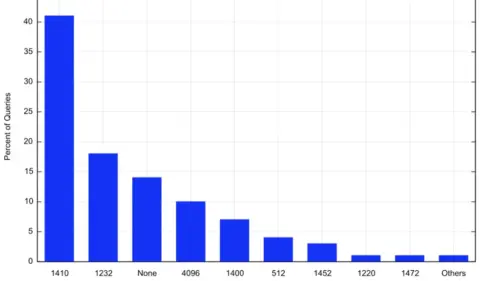
Core cryptographic standards such as ML-KEM, ML-DSA, and SLH-DSA are largely established, with ML-KEM enabled by default across major browsers and operating system TLS libraries. Within DNSSEC, however, the transition presents unique logistical hurdles. Presentations from Cloudflare’s Vicky Shrestha and Verisign’s Matt Thomas underscored a persistent industry anxiety: the DNS has historically been shaped by packet size limitations.
Implementing post-quantum digital signatures significantly increases response sizes. While the User Datagram Protocol (UDP) can technically accommodate larger payloads, IP fragmentation remains notoriously unreliable across the public internet. Conversely, routing all traffic over the Transmission Control Protocol (TCP) introduces state-maintenance overheads and potential bottlenecks on authoritative servers. Early measurements assessing ML-DSA-44 deployment point to widespread breakage, indicating that the path toward post-quantum DNSSEC will require standardized protocols, updated provisioning frameworks, and a fundamental re-evaluation of how servers and resolvers handle large payloads and sustained TCP connections.
Analyzing NSEC and NSEC3 Deployment
Evaluating the operational deployment of DNSSEC negation mechanisms reveals stark differences in how signed zones are maintained. Operators generally choose between pre-signing complete zone files before publication or utilizing dynamic signing architectures that attach signature records as the final step of generating a response.
For negative responses, these architectural choices carry distinct implications. Pre-signed zones rely on NSEC or NSEC3 records to cryptographically bind adjacent names, allowing recursive resolvers to aggressively cache these spans and defend authoritative infrastructure against random name attacks. Dynamic signers, by contrast, construct responses on demand for specific non-existent queries, offering precise assertions but requiring continuous cryptographic computations that make them more vulnerable to volumetric random-subdomain attacks. Because metrics and averages across the global DNS long tail can skew interpretations, understanding these deployment nuances remains critical for operators optimizing their zone security.
Channel Encryption Between Resolvers and Authoritative Servers
While stub-to-recursive channel encryption advanced rapidly through standards like DNS over TLS, DNS over HTTPS, and DNS over QUIC, securing the path between recursive resolvers and authoritative servers has lagged. Unlike stub-to-recursive communication, recursive-to-authoritative channels lack end-user IP privacy requirements, and connections are rarely persistent, meaning the overhead of establishing an encrypted channel per transaction can outweigh the benefits.
To overcome the challenge of detecting server capabilities without exhaustive pre-probing, engineers are exploring signaling mechanisms. Proposals include embedding transport capabilities within parent-zone DELEG records or utilizing opportunistic service binding transport hints inserted into the Additional section of DNS responses. Operators noted that opportunistic signaling offers an incremental, highly targeted solution that avoids disruptive architectural overhauls to fundamental DNS delegation principles.
The Continuing Debate Over the ANY Query Type
The special ANY query type has long occupied an unusual space in the DNS architecture. While initially envisioned as a convenience method to retrieve all defined resource record sets for a given name, it has frequently been exploited in amplification attacks due to the massive size discrepancy between small queries and large responses.
To mitigate these vulnerabilities, RFC 8482 allowed responders to return truncated or minimal responses rather than complete record sets. However, ongoing discussions, including a current IETF internet draft, propose a more definitive approach: retiring support for the query type entirely by having responders return a NOTIMPL (not implemented) response code.
The Vancouver meeting concluded with extensive discussions on these and other technical sessions, with complete documentation and presentation slides remaining accessible via the official DNS-OARC workshop website.