
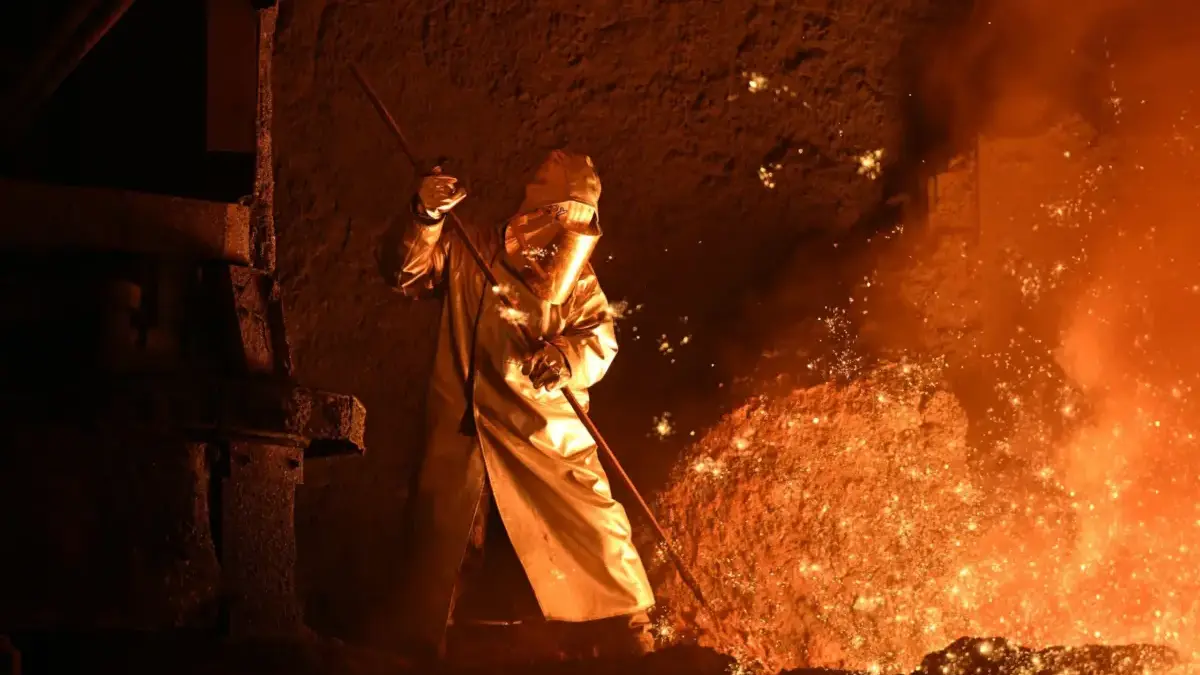
The iron and steel industries rank consistently among the largest industrial polluters on the planet, driving a massive wave of climate-tech startup activity aimed at curbing greenhouse gas emissions. For years, numerous entrepreneurial ventures have attempted to slash the sector’s carbon footprint by pioneering entirely new metallurgical processes to produce metals without traditional fossil-fuel-driven infrastructure. However, Helix Carbon believes that this prevailing industry strategy is fundamentally flawed.
"Any attempt to decarbonize the steel industry without dealing with the blast furnace is not going to work," David Brown, the co-founder and chief executive officer of Helix Carbon, told TechCrunch.
The blast furnace is the colossal industrial apparatus responsible for converting raw iron ore into the molten iron required to manufacture steel. Rather than abandoning or replacing these century-old structures, Helix Carbon wants to clean them up from the inside out. The startup’s innovative approach promises to significantly slash the steel industry’s carbon emissions while simultaneously boosting profit margins for iron producers—a rare win-win scenario for a notoriously carbon-intensive industrial process.
To understand why Helix Carbon’s strategy is unique, it helps to examine the traditional chemistry of ironmaking. Blast furnaces have been utilized to forge iron for centuries. The process traditionally relies on coke, which is a purified, processed form of coal, to help transform raw iron ore—essentially iron bound tightly up with oxygen—into metallic iron. The burning coke supplies the immense thermal energy required for the chemical reaction, but it does not take part in the reduction process directly. Instead, carbon monoxide gas produced from the combustion does the heavy lifting of reducing the iron, stripping away its oxygen atoms.
This industrial reduction process releases staggering amounts of carbon dioxide, or CO2, which industrial facilities typically dump straight into the atmosphere. But Helix Carbon has devised a clever technological method to capture that waste carbon dioxide, convert it directly into carbon monoxide, and recycle it right back into the blast furnace to continue the metallurgical reaction.
The core of Helix Carbon’s process relies on an advanced electrolyzer, a specialized device that uses electricity and a catalyst to cleave an oxygen atom away from a carbon dioxide molecule. While electrolyzers are far from a brand-new invention, Brown noted that his startup’s proprietary design can handle the entire raw exhaust stream straight out of a blast furnace. Most commercial electrolyzers available today are notoriously delicate pieces of equipment. They typically work only on purified, highly concentrated carbon dioxide streams, meaning that industrial exhaust gases normally have to undergo extensive and costly pre-processing before an electrolyzer can safely utilize them. Helix Carbon’s hardware bypasses this limitation.
By injecting recycled carbon monoxide back into a blast furnace, iron producers can drastically reduce the amount of coke they need to burn. The exact volume of potential reduction remains a subject of ongoing industry debate, according to Brown. Some academic and scientific papers suggest that as much as 90% of the traditional coke requirement could theoretically be eliminated through carbon monoxide injection, while other conservative studies place the figure closer to 30% to 40%.
Taking a pragmatic market approach, Helix Carbon is initially proposing that iron producers start by replacing 33% of their traditional coke consumption. The company calculates that utilizing its proprietary technology to achieve this benchmark would save producers approximately $14 per ton of iron produced.
"That may not seem like a lot, but margins in the iron industry are famously thin," Brown explained, highlighting why even modest per-ton operational savings can translate into massive financial incentives for heavy industry operators.
According to data compiled by Grand View Research, the global iron and steel sectors comprise a combined $2 trillion market, making the industry an intensely appealing commercial target for early-stage startups chasing massive scale. Yet, it is also a notoriously slow-moving market, largely because heavy industrial equipment has an exceptionally long operational lifespan.
"There are blast furnaces that have lived for over 100 years," Brown noted, emphasizing the sheer durability and entrenchment of existing manufacturing infrastructure. Because convincing heavy industry to adopt brand-new capital equipment takes time, Helix Carbon has mapped out a commercialization strategy designed to bring in revenue much earlier in its corporate lifecycle. To achieve this, the startup plans to court the specialty chemicals industry first before driving deep penetration into primary metals.
"We don’t need to capture the CO2 first," Brown said. "We just utilize it, and that opens up the door of making chemicals on-site right out of waste streams."
Helix Carbon presented its technology live onstage during the Startup Battlefield pitch competition at TechCrunch Disrupt in San Francisco.


Leave a Reply