
As the global internet infrastructure approaches a major cryptographic milestone, technical operators and network administrators are closely monitoring the upcoming rotation of the Domain Name System (DNS) root key. Scheduled for October 11, 2026, the transition marks only the second time the foundational cryptographic key securing the entire internet’s domain name hierarchy has been rolled since DNS Security Extensions (DNSSEC) were deployed at the root level.
Unlike subordinate keys in the DNSSEC architecture, which rely on a designated parent key to validate their authenticity, the root key occupies a uniquely isolated position. Every standard Zone-Signing Key and Key-Signing Key relies on a cryptographic chain of custody leading back to a parent zone. Because the root zone sits at the very top of the domain name hierarchy, it has no parent. Consequently, authenticating a new root key requires a specialized mechanism whereby the legacy key signs across the incoming key, followed by an extended observation period to allow validating resolvers worldwide to adopt the new trust anchor.

The operational parameters for this transition are defined by RFC 5011, titled "Trust Anchor Update." The standard dictates a mandatory "add hold-down time" of 30 days, or the expiration time of the original Time to Live (TTL) of the first trust point resource record set containing the new key—whichever is greater. This rigorous safeguard ensures that validating resolvers observe at least two independently validated resource record sets containing the new key before accepting it into local trust stores.
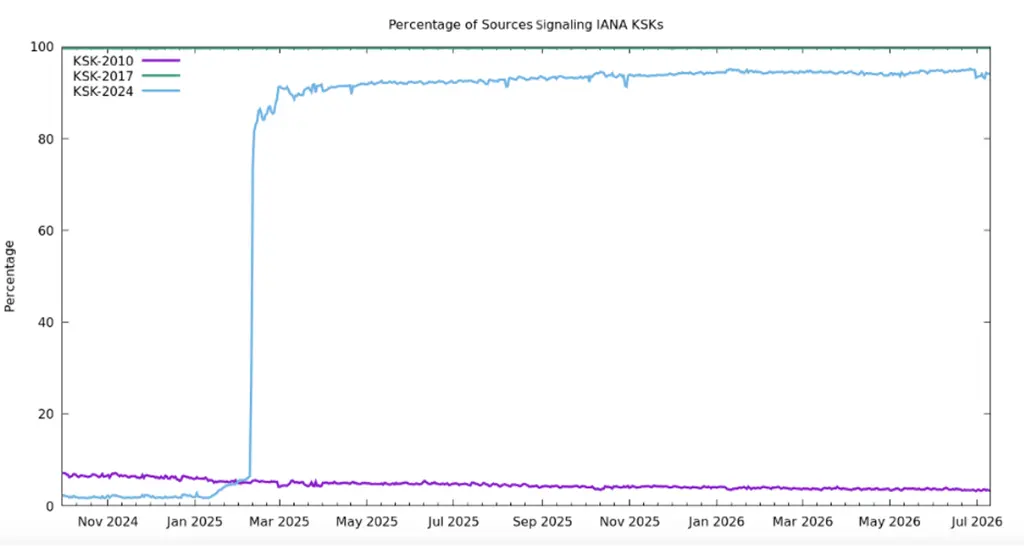
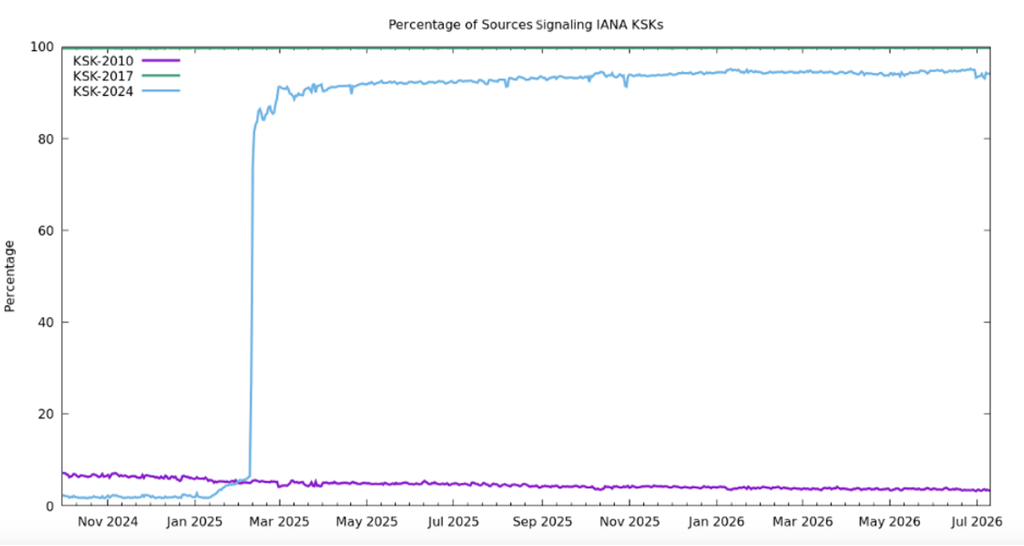
For the 2026 event, the procedure does not involve a shift in cryptographic algorithms, but rather a standard replacement of the underlying public and private key pair. The incoming Key-Signing Key, designated as KSK-2024, was published by the Internet Assigned Numbers Authority (IANA) on its platform in July 2024 and formally integrated into the root zone’s DNSKEY resource record in January 2025. With the long lead-up concluding, the critical operational phase arrives on October 11, 2026, when IANA officially utilizes KSK-2024 to generate the digital signature for the root zone’s DNSKEY resource record set.
Evaluating readiness across the decentralized expanse of the global internet requires specialized measurement techniques. Because the root infrastructure handles billions of queries daily without tracking the individual end users behind recursive resolvers, network engineers rely on dedicated signaling standards to gauge global preparedness.

Two primary measurement methodologies provide visibility into how recursive resolvers are handling the transition. The first approach is outlined in RFC 8145, which defines a mechanism for signaling trust anchor knowledge in DNSSEC. Under this standard, recursive resolvers embed the key tags of their currently trusted keys directly into queries sent toward authoritative root servers. Operators of root zone infrastructure, such as Verisign, can analyze these incoming query logs to determine which key tags are actively presented by reporting resolvers. Data gathered through this method in mid-2026 indicated that approximately 90% of reporting resolvers had incorporated KSK-2024 into their trust anchor sets. However, raw resolver counts do not necessarily correlate with the actual volume of end users behind those systems, as some validating resolvers serve millions of clients while others support only a handful.
To bridge the visibility gap regarding end-user populations, the community relies on RFC 8509, which establishes a Root Key Trust Anchor Sentinel for DNSSEC. This protocol folds the signaling mechanism back toward the querier rather than forwarding it to root servers. By evaluating specific DNS labels designed to test whether a resolver trusts a particular key tag, measurement systems can determine whether an end user relies on a validating resolver that has successfully adopted the new cryptographic material or whether it is lagging behind.
Large-scale measurement campaigns utilizing advertising-based systems, such as the platform operated by APNIC, have been running millions of tests daily to monitor the trajectory of KSK-2024 adoption. Throughout mid-2026 and leading up to the October rollover date, findings from these telemetry campaigns revealed that roughly 70% of tests supporting the sentinel mechanism confirmed the loading of KSK-2024 as a trusted key.
While global averages offer a high-level view of progress, granular analysis reveals significant disparities across individual autonomous systems and regional networks. Comprehensive tracking of network-specific adoption rates highlights distinct segments of the internet where recursive resolvers have been slower to update their local trust configurations. Among networks demonstrating lower acceptance rates for KSK-2024, several prominent telecommunications providers and regional internet service providers appeared with substantial numbers of validating tests showing a lack of the incoming key.
For example, network measurements identified lower adoption markers across diverse global regions, including entities such as Telefonica de Costa Rica in Central America, Swazi Mobile in Eswatini, Capricorn Networks in South Africa, Hutchison Telecoms in Sri Lanka, Teletalk in Bangladesh, Mauritanian Telecommunication in Mauritania, and various regional operators in Ukraine, the Philippines, Iraq, and India. While these networks maintain active DNSSEC validation frameworks, the data indicates that a notable portion of their underlying recursive infrastructure had not completed the inclusion of KSK-2024 into local trust collections ahead of the transition window.
Network operators and system administrators whose autonomous systems register low trust signals on telemetry dashboards face a compressed timeline to verify their configurations. Industry groups recommend that technical teams utilize available validation tools, such as the testing resources provided by Cloudflare and other community partners, to evaluate local resolver behavior. Ensuring that recursive systems properly recognize and trust the incoming root key before and during the rollover window is essential for preventing potential resolution failures and SERVFAIL errors for end users relying on strict DNSSEC validation.

Leave a Reply