
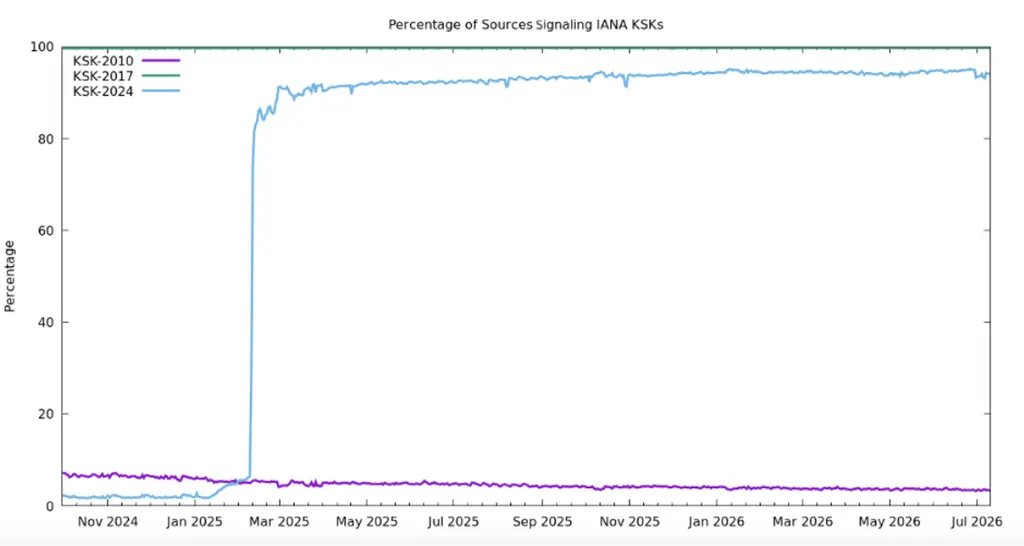
As the internet infrastructure community looks toward the scheduled October 11, 2026 rollover of the Domain Name System (DNS) root key, new measurement data reveals a complex landscape of preparedness among recursive resolvers worldwide. While major infrastructure operators and automated systems have made substantial progress, millions of users across various global networks still rely on DNS resolvers that have yet to incorporate the incoming cryptographic key into their local trust anchor sets.
The upcoming root key rollover is a uniquely significant event in internet operations. Unlike subordinate cryptographic keys within the Domain Name System Security Extensions (DNSSEC) hierarchy, the root key possesses no parent key to validate its authenticity. For standard zone-signing and key-signing keys, verification relies on a parent zone signing across the subordinate key value via a Delegation Signer resource record. Because the root zone sits at the apex of the global naming hierarchy, it lacks this traditional hierarchical oversight.

Instead, authenticating a new root key requires the existing Key-Signing Key to cryptographically sign the incoming key. Validating resolvers must then observe this signature over an extended period to establish trust. Established technical guidelines, notably outlined in RFC 5011, mandate a strict "add hold-down time" of at least 30 days or the original Time-To-Live expiration period. This safeguard ensures that resolvers encounter multiple validated resource record sets containing the new key before accepting it into local cache configurations.
The 2026 event does not introduce a new cryptographic algorithm; rather, it represents a routine rotation of the public and private key pair. The incoming key, designated as KSK-2024, was officially published by the Internet Assigned Numbers Authority in July 2024 and subsequently integrated into the root zone’s DNSKEY resource record in January 2025. The final operational transition on October 11, 2026, involves the key being actively utilized to generate the digital signatures for the root zone’s core records.
Understanding the operational readiness of the global network requires peering into how recursive resolvers handle trust anchors. Network engineers rely on specific telemetry techniques to evaluate whether resolvers have successfully incorporated KSK-2024. One primary mechanism stems from RFC 8145, which involves recursive resolvers embedding the key tags of their trusted anchors directly into queries directed toward authoritative root servers. By analyzing these query logs, infrastructure operators can gauge the distribution of trusted keys across reporting systems.

Data gathered by root server operators such as Verisign indicates that approximately 90% of reporting resolvers have successfully added KSK-2024 to their local trust anchor sets. However, engineers note that raw resolver counts do not directly translate to user population impact. While some reporting resolvers serve millions of active end users, others support only a single device, meaning percentage-based metrics require careful contextualization regarding actual user exposure.
To measure end-user exposure more precisely, engineers utilize a complementary protocol defined in RFC 8509, known as a Root Key Trust Anchor Sentinel. This approach reverses the telemetry signal, allowing queriers to detect whether a resolver trusts a specific key based on how it responds to specially crafted queries containing designated key tags. If a resolver recognizes the sentinel label and lacks the specified key in its trust anchor set, it returns a SERVFAIL response rather than normal data, enabling researchers to quantify the proportion of end users situated behind unready validating resolvers.
Large-scale measurements conducted through advertisement-based collection systems, averaging roughly 16 million tests per day, provide broader visibility into these adoption trends. Among tests originating behind DNSSEC-validating resolvers, analysis indicates that roughly 70% of those supporting the Sentinel mechanism have successfully loaded KSK-2024 as a trusted key.
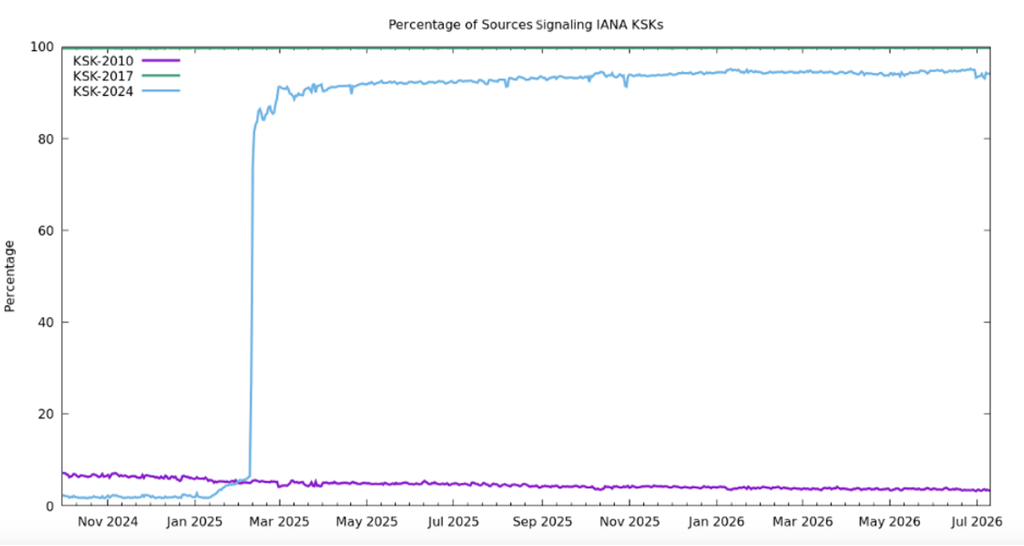
Despite these positive global averages, significant variations persist across individual Autonomous Systems and regional service providers. Comprehensive monitoring data highlights numerous network operators where the adoption rate of KSK-2024 remains notably low among validating resolvers. Prominent examples appearing in recent telemetry reports include telecommunications providers and regional internet service providers across diverse geographical regions, ranging from parts of Latin America and Africa to Asia, the Middle East, and portions of Europe and North America.
For instance, networks such as Telefonica de Costa Rica, Swazi Mobile, Hutchison Telecoms in Sri Lanka, and several major operators in the Philippines, Iraq, and India exhibit substantial volumes of validating queries where the incoming key has not yet been loaded into local trusted key collections. In some isolated network environments, measured adoption rates hover well below traditional operational expectations, signaling potential resolution failures for local users once the rollover takes effect.
Network administrators whose organizations appear among those with lagging adoption metrics are advised to audit their DNS infrastructure configurations immediately. Operators can utilize specialized diagnostic tools, such as testing pages maintained by Cloudflare and other infrastructure providers, to verify local resolver behavior and ensure that their systems are fully prepared for the cryptographic transition. Without timely intervention, resolvers failing to trust KSK-2024 risk encountering widespread validation failures, cutting off affected end users from securely resolved domains across the global internet.

Leave a Reply