
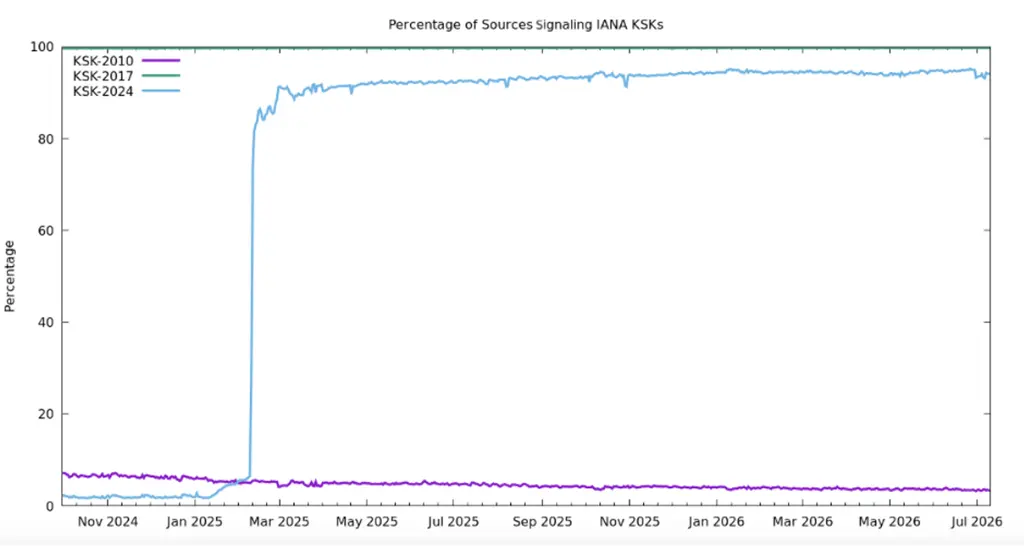
As the global technology community counts down the final days toward a major infrastructure milestone, the Domain Name System (DNS) prepares for a scheduled root key rollover. Unlike standard security updates that happen regularly across subordinate domains, altering the root key of the internet is a delicate and monumental operation. Because the root stands at the absolute apex of the DNS hierarchy, it lacks a parent domain to automatically validate its authenticity, making the transition a critical moment for network operators, recursive resolvers, and system administrators worldwide.
The mechanics of maintaining security within the Domain Name System Security Extensions (DNSSEC) framework rely entirely on chains of trust. For ordinary Zone-Signing Keys and Key-Signing Keys within subdomains, validating authenticity is straightforward. A parent key simply signs across the child key or its cryptographic hash—published as a Delegation Signer resource record—to establish trust. However, the root key is unique because no parent entity exists above it.
To bridge this gap during a rollover, the legacy key-signing mechanism requires the old key to sign the new key, establishing a transition period known as "old signs new." Following this, an extended duration is mandated to allow all validating DNS clients sufficient time to discover, retrieve, and implicitly trust the incoming key. Guidance outlined in RFC 5011, titled "Trust Anchor Update," governs this critical transition phase. The specification dictates a mandatory hold-down period of 30 days or the expiration time of the original Time-To-Live for the initial trust point resource record set containing the new key, whichever is longer. This rigorous safeguard ensures that recursive resolvers must observe at least two validated sets containing the incoming key before they officially incorporate it into their local trust anchor configuration.

The transition process is designed to execute automatically. When the new key is integrated into the root zone’s resource record set, validating resolvers naturally encounter it during routine record retrieval. Once the specified hold-down interval elapses, compliant resolvers add the value to their local caches of trusted keys. The operational shift focuses purely on replacing the cryptographic private and public key pair rather than changing the underlying algorithm itself. The incoming key, designated as KSK-2024, was first published on the Internet Assigned Numbers Authority website and subsequently added to the root zone resource record set.
With the rollover date fast approaching, network engineers and infrastructure operators face a pressing question: have recursive resolvers across the global Internet successfully incorporated KSK-2024 into their trust anchor sets, and how can this adoption be accurately measured?
Gaining Visibility into Global Trust Signals
Measuring the readiness of the internet’s decentralized architecture requires specialized techniques to peer into recursive resolvers and determine whether they have adopted the incoming key. Industry researchers utilize two primary methodologies to evaluate trust anchor deployment across global networks.

The first approach relies on RFC 8145, which outlines methods for signaling trust anchor knowledge in DNSSEC. Under this standard, a recursive resolver embeds the key tags of its currently trusted keys directly into queries sent upstream toward authoritative root servers. Resolvers can append these tag values into the query name itself—such as appending a specific string indicating the numeric identifiers of the keys it trusts—or include them within an EDNS key tag option. By analyzing the query logs gathered by root server operators like Verisign, network analysts can map out a statistical sampling of which keys active resolvers currently configure. While initial data reports indicate high levels of reporting resolvers adopting the incoming key, this metric alone does not fully translate to the actual end-user population behind those resolvers, as some systems serve millions of clients while others serve only a single machine.
To capture a more comprehensive view of end-user exposure, researchers employ a second method based on RFC 8509, known as the Root Key Trust Anchor Sentinel for DNSSEC. This mechanism folds the trust signal back toward the querier rather than forwarding it to root servers. By utilizing specific prefixes in the leftmost label of a DNS query, the mechanism prompts a compliant resolver to check its internal trust anchor set. If the resolver recognizes the queried key tag as a trusted anchor, it returns a standard positive response; if it does not, it returns a server failure status.
Researchers leverage large-scale measurement frameworks, such as APNIC’s ad-based measurement system, to pose these specialized queries to millions of end users daily. This methodology quantifies the exact proportion of internet users located behind validating resolvers that have either successfully adopted or lagged in incorporating the new key.
Evaluating Adoption and Identifying Network Gaps
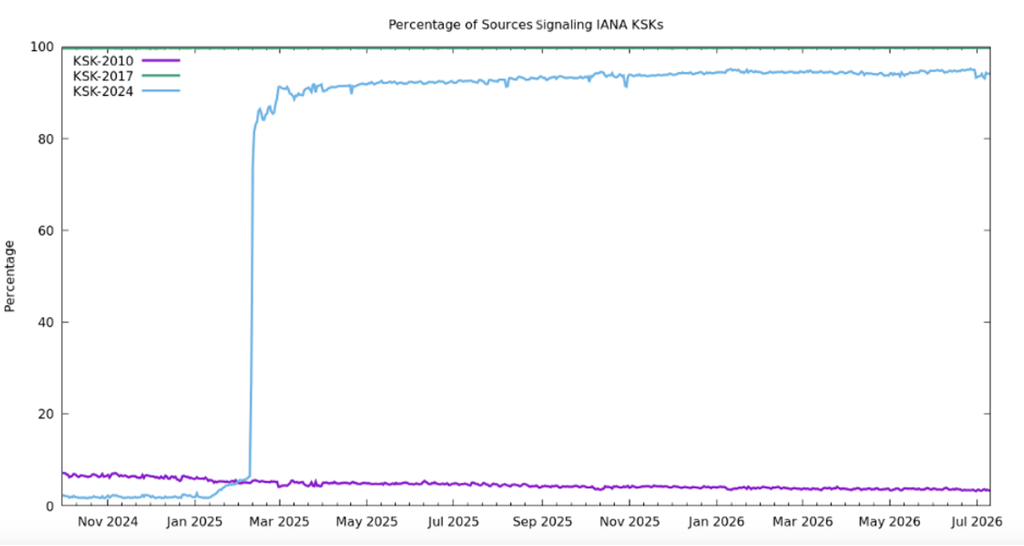
While broad statistical averages provide a high-level overview of global readiness, aggregated numbers frequently obscure critical regional and network-specific variances. Large-scale measurement campaigns conducted throughout the year, scaling up significantly as the deadline approaches, reveal that while a substantial majority of compliant resolvers have completed the transition, a notable margin of systems has yet to adopt the incoming trust anchor.
When researchers break down the telemetry by specific networks and Autonomous System Numbers, clear outliers emerge where adoption rates lag significantly behind the global average. Analysis of networks showing lower acceptance rates highlights specific internet service providers across various global regions where recursive resolvers have been slow to update their configurations. For instance, large telecommunications providers and regional network operators in parts of Latin America, Africa, South Asia, the Middle East, and parts of Europe display markedly lower adoption percentages among their reporting resolver populations.
These discrepancies indicate that certain regional infrastructure providers risk encountering resolution failures once the root key rollover officially takes effect. If an Internet Service Provider’s recursive resolvers fail to load the incoming key before the transition, users relying on those networks may experience widespread SERVFAIL errors when attempting to access DNSSEC-secured domains, effectively cutting them off from compliant web services.
Network administrators and system operators whose organizations appear among those with low trust signal rates are strongly encouraged to audit their DNS infrastructure. Utilizing diagnostic testing tools provided by organizations like Cloudflare allows engineers to verify whether their local resolvers are fully prepared for the transition. Ensuring that recursive resolvers are updated and properly configured before the scheduled activation remains vital to preventing user disruption and maintaining the cryptographic integrity of the global Domain Name System.

Leave a Reply