The global architecture of the Internet is undergoing a profound transformation, driven by surging bandwidth demands, the rapid aging of legacy subsea cable systems, and a dramatic shift toward private ownership by major technology conglomerates. These seismic changes in global network infrastructure were front and center at the North American Network Operators Group (NANOG) 98 meeting in mid-October 2026 in Miami, Florida. The opening keynote presentation, delivered by Paul Brodsky of TeleGeography, provided a comprehensive look at the historical evolution, current pressures, and future trajectory of the international telecommunications landscape.
To understand the modern challenges facing network operators, industry experts look back at the foundational decades of the commercial Internet. Since its inception, the overarching story of global Internet infrastructure has been defined by unrelenting demand growth. Growth rates were exceptionally high during the early 1990s as the core National Science Foundation Network (NSFNET) in the United States transitioned into a mixed infrastructure. During this period, commercial providers were established in parallel with existing academic and research networks, with annual growth rates routinely hitting 100% across all parts of the network.
Sustaining such massive demand growth over extended periods is exceptionally challenging. It requires a constant, aggressive refresh of underlying infrastructure and, from time to time, comprehensive changes to the platform’s internal architecture. While overall growth rates have naturally slackened off from those unsustainable early peaks, positive growth has persisted to the present day, accompanied by ever-increasing demands placed on network infrastructure.
Over the past decade and a half, the industry completed a major architectural shift to cope with these pressures: the large-scale adoption of replicated service points and the overlay of Content Distribution Networks (CDNs). This structural change allowed operators to pre-provision content and services much closer to end-users, matching the modern digital profile of on-demand access. The primary motivation behind this redesign was to push network growth pressures and associated infrastructure investment costs out to the network edge, effectively relieving the intense bottlenecks and growth pressures previously experienced by operators managing the inner core of the global network.
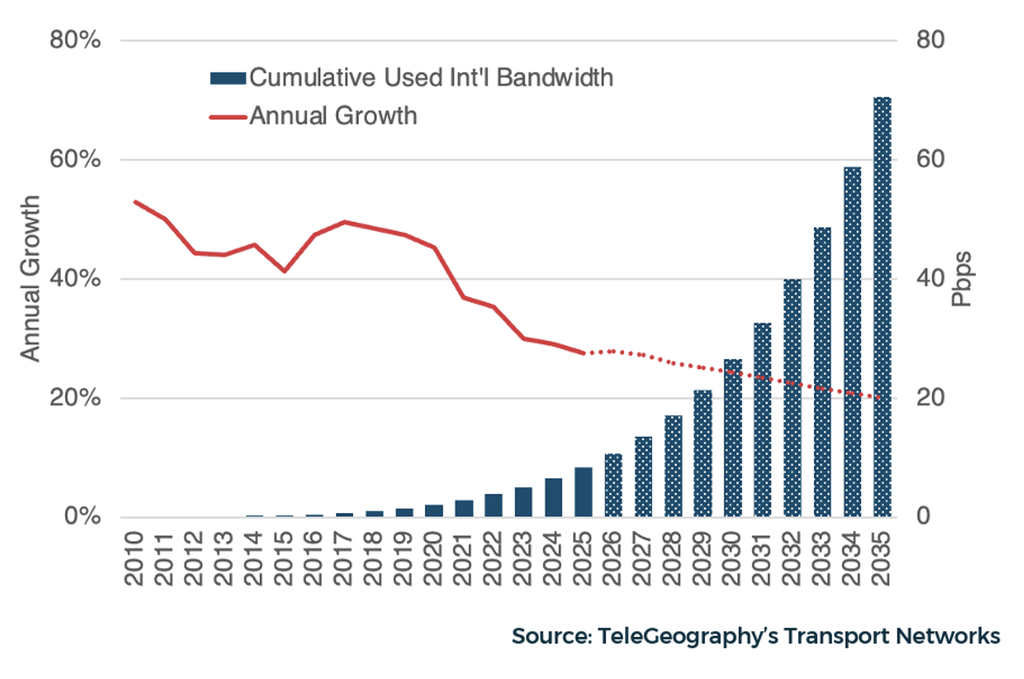
This decentralized redesign has been somewhat effective in managing traffic scale. When examining the growth in demand for international bandwidth over the past 15 years, annual percentage growth levels have appeared to taper off year-by-year. However, today’s 30% annual growth level still translates into massive absolute increases in the total capacity required for international bandwidth.
Each annual increment in demand now represents an escalating requirement for additional in-service capacity. Currently sitting at approximately two Petabits per second (Pbps) per year, this required addition is projected to skyrocket to more than ten Pbps per year of additional global capacity by the year 2035.

Compounding this relentless appetite for bandwidth is the inevitable aging of physical assets. Network operators must constantly factor in the standard service life of subsea cable infrastructure, which typically spans around 25 years. Much of the international cable capacity that was installed around the turn of the century has reached or exceeded its operational lifespan and is now demanding replacement. Approximately a quarter of the world’s current subsea cable length is expected to be officially decommissioned and retired by 2030.
Fortunately, the engineering capabilities of submarine cables have improved dramatically over the years. Modern systems feature significantly more fibre pairs packed into a single physical cable, expanded optical transmission capacity achieved through the deployment of L and C band optics, and the emerging adoption of two-core fibre strands instead of traditional single-core designs. The cumulative result of these engineering leaps is a steady, ongoing improvement in the unit cost of capacity.
This technological efficiency is directly reflected in the market price of leased capacity along major transatlantic and transpacific routes. In the economics of telecommunications, falling unit costs expose latent demand, which in turn drives further orders for expanded capacity. These higher-capacity systems can subsequently operate at even greater levels of efficiency, triggering further reductions in the unit cost of deploying brand-new cable systems.
The combination of an aging international submarine cable inventory, the enhanced efficiency of new systems, soaring demand, and a strategic industry desire to improve resilience through route diversity is fueling a sustained wave of investment. Current announcements for upcoming cable projects point toward robust annual capital expenditures ranging between USD 5 billion and USD 6 billion across the 2026 to 2029 period.
A critical question facing the industry is the origin of this massive capital. In recent years, major technology hyperscalers—specifically Google, Meta, Microsoft, and Amazon—have significantly scaled up their direct involvement in cable projects. Today, an astonishing 38% of international cable investments are made directly by these four hyperscalers to operate private networks for the exclusive use of the funding entity. Furthermore, these companies are active participants in consortium arrangements that account for an additional 25% of cable projects. Non-hyperscaler funding accounts for the remaining 37% of the market.
This investment dynamic varies considerably by geographic region. The transatlantic route has become the most extreme example of this trend, with roughly 85% of its capacity now tied to private hyperscaler funding. Google and Meta have emerged as the most prolific owners in this space, building extensive portfolios of fully owned and operated subsea cables.
The driving force behind this decisive pivot toward private cable infrastructure lies in the high degree of economic concentration within the modern Internet market. This market concentration has enabled hyperscalers to accumulate substantial capital reserves. Consequently, these companies can afford to own and operate private cable systems, granting them complete, uncompromised control over service delivery without the dependencies or bureaucratic friction associated with third-party carriers.

At the same time, the traditional consortium model has become less viable when a single dominant lessee controls an overwhelming proportion of a cable’s total capacity. If such a dominant lessee were to exit the consortium, the financial viability of the cable could collapse, leaving the original funding entities with a stranded asset. The rise of the private cable model emerged as a natural structural adaptation to these economic realities.
Despite their technical and operational efficiency, these private cable systems are viewed with caution in various political circles. Some national governments have expressed growing unease regarding the centralization of international communications conduits in the hands of foreign private entities. This concentration of ownership raises complex questions surrounding sovereign control over the specialized marine infrastructure required to maintain it, such as the global fleet of submarine repair vessels and existing maintenance pooling arrangements within designated submarine cable maintenance zones. Many policymakers increasingly view these international pathways as critical national infrastructure, where any catastrophic disruption could trigger severe societal and economic consequences. Entrusting these essential communication backbones entirely to foreign private corporations creates unique geopolitical vulnerabilities.
The contemporary landscape of global connectivity extends far beyond physical glass fibres resting on ocean floors, representing a technological evolution from earlier eras. Today’s sophisticated fibre optic networks ultimately replaced an earlier, heavy reliance on satellite communications. Throughout the 1960s and subsequent decades, satellite systems positioned in geostationary Earth orbit (GEO) were utilized to support a wide array of international communications.
However, the geostationary orbital plane is a finite resource, currently hosting 569 active spacecraft. Bouncing digital data packets off a satellite positioned approximately 36,000 kilometers away inevitably introduces extended propagation delays, or latency. As soon as reliable undersea fibre-optic systems became available, major network operators and telecommunications providers rapidly shifted their international traffic away from satellites and onto terrestrial and subsea cables wherever geographic reach permitted.
Communications services that remained on geostationary spacecraft were largely restricted to broadcast media and connectivity solutions for otherwise unreachable, highly isolated destinations. However, continuous refinements in digital signal processing capabilities, paired with the commercial maturation of reusable rocketry, have enabled an entirely new generation of physically compact spacecraft deployed into Low Earth Orbit (LEO).
Because these modern LEO constellations operate at much lower altitudes, each satellite covers a relatively small geographic footprint. Consequently, sustaining a connection requires thousands of individual satellites working in concert, with a user’s communication link automatically handing off from one satellite to another every few seconds. The resulting architecture delivers sustained data throughput reaching hundreds of Megabits per second.
Advanced inter-satellite laser links further enable data packets to be seamlessly relayed across the orbital constellation, spanning vast oceans with only a sparse distribution of ground stations required on Earth. For an end-user equipped with a modest terminal antenna, the available capacity and latency of modern LEO broadband services are directly comparable to traditional terrestrial broadband infrastructure.
The financial stakes in the LEO space race are immense. SpaceX has invested upwards of USD 20 billion into its Starlink platform, while Amazon’s competing LEO initiative is slated to carry a similar price tag of USD 20 billion. By comparison, the capital outlay for all newly constructed submarine cable systems globally across the three-year window from 2026 to 2029 is projected to total USD 22 billion.
The financial performance of these space-based networks underscores their commercial viability. During the third quarter of 2026, Starlink reported quarterly revenues of USD 5.25 billion alongside a net profit of USD 2.4 billion. This translates to an annualized profit of approximately USD 9.6 billion on an initial capital outlay of USD 20 billion, representing a staggering return on capital of 48%. In contrast, institutional investors backing consortium submarine cables typically target a return rate of 12% to 14%, while traditional terrestrial broadband infrastructure investments generally yield returns between 5.5% and 9%.
The primary financial divergence between subsea cables and LEO satellite platforms stems from their distinct market positioning. Starlink is engineered primarily as a last-mile retail access system, serving users with specialized connectivity requirements in remote, rural, or otherwise underserved geographic regions. Operating effectively as a direct-to-consumer provider with a strong market position in these specialized niches, Starlink can command premium pricing for its services. Furthermore, because it operates under a direct retail model, it avoids the necessity of revenue-sharing agreements with intermediary third-party service providers.
The high capital barrier to entry—hovering around USD 20 billion—inherently limits direct market competition. Submarine cable systems, conversely, feature a much lower barrier to financial entry, with individual cable projects typically costing between USD 100 million and USD 400 million. The more modest returns associated with cables accurately reflect a higher baseline likelihood of competitive market pressure.
While Amazon’s developing LEO service carries the potential to challenge Starlink’s dominance in remote broadband access, analysts note that LEO systems and submarine cables ultimately serve entirely distinct segments of the telecommunications ecosystem. Rather than engaging in direct competition, they occupy complementary roles. LEO constellations specialize in solving difficult last-mile connectivity challenges in demanding, hard-to-reach environments, whereas submarine cables remain the unrivaled, high-volume, low-risk backbone for the bulk movement of data across the core of globally distributed computing platforms.