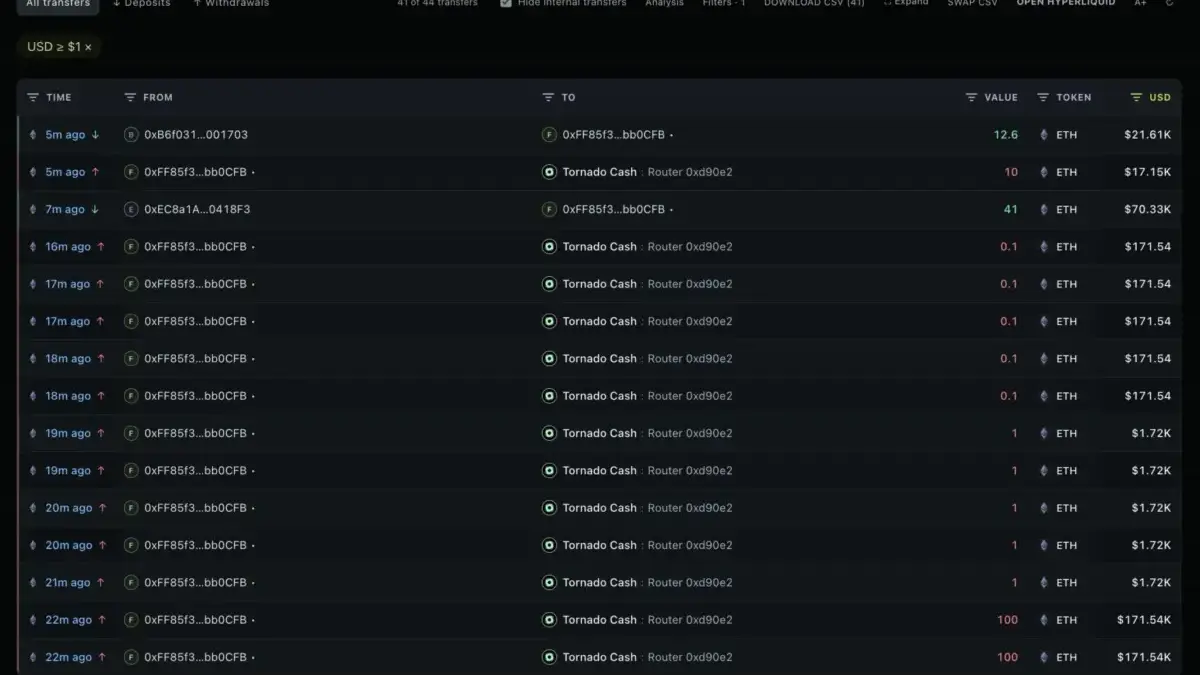
The decentralized finance landscape has once again been shaken by a major cross-chain security failure. According to incident tracking data provided by blockchain security firm SlowMist, the recent Fusionist ACE bridge exploit has generated an estimated $5.7 million in total losses across two distinct stages of an unfolding attack. The breach began when unauthorized, unbacked ACE tokens were minted directly on the BNB Chain and subsequently dumped onto the open market. This sudden influx of artificially created supply triggered a sharp price collapse for the asset. Astute traders quickly capitalized on the resulting market disruption, utilizing the project’s Endurance bridge reserves to withdraw genuine, fully backed ACE tokens at heavily discounted rates.
The cascading fallout from the exploit eventually reached centralized cryptocurrency exchanges, leading to immediate defensive measures. On Monday, November 23, major South Korean digital asset platform Bithumb officially halted trading for the ACE token after discovering clear indications that abnormally issued tokens had successfully penetrated centralized trading venues.
Security analysts and blockchain monitoring agencies have emphasized that this incident was not a straightforward exploit where a single malicious actor walked away with $5.7 million in a clean, one-transaction heist. Instead, the total damages accumulated through a complex sequence of events involving both direct illicit minting and subsequent secondary market arbitrage. Approximately $1.87 million has been specifically traced through the primary attacker’s fund flows, while another 53.7 million genuine ACE tokens—valued at roughly $3.7 million at the time of the incident’s reference prices—were drained through the official bridge reserves. SlowMist’s combined $5.7 million loss estimate serves as a working metric rather than an audited, final accounting total. Nevertheless, the exploit strikes at the foundational promise of cross-chain interoperability: that a token issued on one blockchain corresponds directly to real, accounted-for value on another.
A Privileged Minter Printed Tokens That Had No Backing
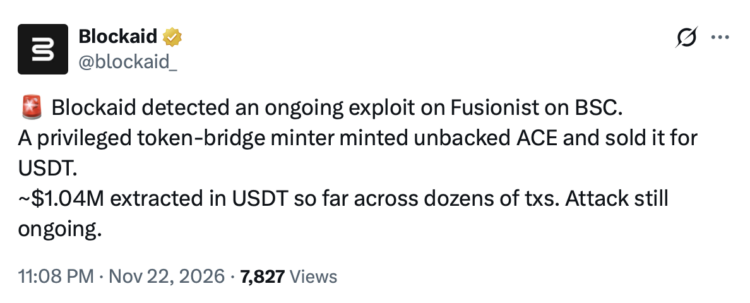
The vulnerability first came to light on November 22, when blockchain security firm Blockaid issued a public alert regarding the Fusionist bridge-minter exploit. The firm’s preliminary assessment described the core mechanism of the attack with blunt clarity, noting that a privileged token-bridge minter had created unbacked ACE tokens out of thin air and subsequently sold them for Tether.
Blockaid initially estimated that roughly $1.04 million had been extracted while the exploit was still actively in progress. However, security experts quickly clarified that this figure was merely an interim snapshot of an ongoing situation rather than a definitive cap on the overall financial damage.
Shortly after the initial warnings, prominent on-chain monitoring account Onchain Lens reported that an entity suspected of orchestrating the exploit had routed 1,091.5 Ethereum—valued at approximately $1.87 million at the time—through the privacy mixer Tornado Cash. Industry observers pointed out that this movement of funds represented the laundering of the attacker’s proceeds rather than an additional layer of losses to be stacked on top of the initial extraction estimates. Both figures simply describe different chronological points within the same suspected perpetrator’s fund flow.
In response to the mounting crisis, the Fusionist team acknowledged the ongoing ACE exploit on the BNB Smart Chain on Sunday, urging community members and investors to immediately suspend all transfers, trading, and bridging activities connected to that specific network. Despite these urgent warnings and operational pauses, the project had not yet provided a fully reconciled loss figure or a comprehensive technical post-mortem detailing how the privileged minting authority was compromised or abused.
In the architecture of decentralized finance, a bridge minter is strictly designed to create a token representation on a destination chain only when corresponding value is properly locked and accounted for on the source chain. Once the administrative right to mint is illicitly seized or misused, a blockchain can easily display perfectly ordinary-looking balances that possess zero underlying backing.

This particular vulnerability highlights a familiar and recurring failure mode within the broader blockchain ecosystem. Prior security incidents, such as a similar bridge-role exploit that minted unbacked tokens at the CrediX protocol, demonstrate just how hazardous elevated bridge permissions can be. While past incidents do not establish the exact root cause of the Fusionist breach, they underscore why privileged roles within smart contract bridges represent some of the most critical and heavily targeted security boundaries in the entire digital asset space.
Traders Found a Second Exit Through Real ACE Reserves
While the initial minting spree captured early headlines, the subsequent secondary drain of protocol reserves may ultimately prove to be the more consequential phase of the security breach.
According to SlowMist’s incident tracking logs, market participants quickly noticed the severely discounted ACE tokens resulting from the market disruption caused by the unauthorized supply flood. Capitalizing on the arbitrage opportunity, traders used the project’s cross-chain bridge to withdraw approximately 53.7 million genuine ACE tokens from the Endurance-side reserves. SlowMist valued this specific reserve outflow at approximately $3.7 million based on prevailing reference prices.
The underlying mechanism of this second stage is straightforward from an economic perspective. Because the unauthorized minting flooded the market with cheap, unbacked supply, the representation of ACE on the BNB Chain suddenly plummeted in value. Meanwhile, the cross-chain bridge continued to honor conversions, accepting those heavily discounted tokens in exchange for genuine, valuable ACE on the Endurance network. Anyone who possessed the technical ability and capital to complete that conversion path could secure real, uncompromised tokens in return for heavily impaired assets.
Security researchers emphasize that the $3.7 million figure represents a valuation of the total ACE reserve outflow rather than definitive proof that every single recipient successfully liquidated those tokens for cash. Furthermore, it does not imply that every ordinary trader who utilized the bridge during the chaos was an active collaborator in the original security breach. A vital legal and operational distinction exists between the malicious actor who initiates a protocol compromise and everyday market participants who trade through a financial system whose internal defenses have already silently failed.
Regardless of individual intent, the economic fallout remains severe. A cross-chain bridge can technically execute transactions without crashing while still producing a deeply disastrous financial result. When unbacked supply can be legally and programmatically redeemed for genuine, locked reserves, the core validation checks have failed at the most critical juncture.
Bithumb’s Monday Halt Shows How Far the Problem Travelled
The wider contagion of the exploit became starkly apparent on Monday, November 23, when centralized cryptocurrency exchanges began taking emergency steps to protect their users. South Korean exchange Bithumb officially suspended ACE deposits and withdrawals early in the morning, followed by a total halt to spot trading effective at 7:30 a.m. local time, according to formal security notices published on the platform.
In translations of its public announcements, Bithumb explicitly stated that it had confirmed concrete indications that abnormally issued ACE tokens had successfully entered cryptocurrency exchanges. To support its emergency suspension, the exchange pointed public observers toward two specific BNB Chain transactions that allegedly served as vectors for the contaminated supply. While those blockchain records provide vital evidence leads for ongoing investigations, a comprehensive independent decoding of the entire transaction trail remains outstanding across the wider market.
Bithumb’s decision to halt trading was implemented as a protective, precautionary response rather than a finalized determination of absolute customer losses. Nonetheless, the incident creates a severe practical dilemma for everyday token holders who never interacted with the compromised bridge. Because digital assets are fundamentally fungible within open markets, centralized exchanges and token issuers now face the arduous task of deploying credible methodologies to identify tainted supply and determine fair treatment for customer deposits, balances, and open trades.
The Real Security Question Is Why the Bridge Could Honor the Claims
There is a natural human temptation when analyzing crypto exploits to focus entirely on the massive headline-grabbing figures and token volumes. However, the more critical security question revolves around why the bridge contract was programmed to automatically honor redemption claims without verifying the authenticity and backing of the incoming supply.
An infrastructure system does not need to suffer a complete loss of control over its entire underlying blockchain to experience a catastrophic failure within a single privileged contract role. Furthermore, the successful completion of a bridge transaction should never be treated as independent proof that the asset being transferred was fully and legitimately backed.
Industry observers emphasize that the project’s official response cannot safely conclude with a temporary pause notice and a vague promise to investigate the matter. Fusionist faces mounting pressure from the community and institutional partners to explicitly disclose which specific minting permissions were compromised, whether those administrative privileges have been permanently revoked, the exact volume of unbacked ACE created, how severely the Endurance-side reserves were depleted, and what avenues remain open to cover outstanding claims.
Simultaneously, digital asset exchanges must formulate defensible token-treatment plans, while everyday holders deserve clear answers regarding whether a permanent capital shortfall exists and who bears ultimate financial responsibility for covering it.
While market analysts rightly point out certain qualifications—such as the reality that the $5.7 million figure is an external estimate, that market prices fluctuated wildly during the incident, and that SlowMist’s classification of the event as a private-key leakage remains preliminary—these nuances do not diminish the severity of the bridge’s structural accounting failure.
The next credible milestone for the project will not be a restored user interface or a reassuring social media post, but rather a fully transparent, cryptographically verified reconciliation of all tokens minted, reserves withdrawn, and assets remaining to back legitimate claims. Until that comprehensive accounting is provided, the estimated $5.7 million fallout stands as a stark warning regarding the persistent security vulnerabilities and systemic risks inherent in trusting automated bridge accounting.