
Federal Bureau of Investigation agents have arrested the co-founder of a prominent Canadian cybersecurity firm in Pennsylvania as part of an expanding, high-stakes international investigation into the notorious ShinyHunters hacking group. The syndicate recently gained global notoriety after breaching federal systems and obtaining sensitive data belonging to thousands of bureau personnel.
The arrest of Edward Dubrovsky, a veteran cybersecurity professional, ransomware negotiation expert, and author, marks a major escalation in the federal probe. The operation underscores how law enforcement agencies are increasingly scrutinizing the gray areas surrounding incident response firms, ransomware intermediaries, and the complex ecosystem of digital extortion negotiations.
According to multiple sources close to the investigation, Dubrovsky was taken into custody on Thursday after traveling to Philadelphia to attend a major industry gathering. The annual Cyber Risk Summit, held between October 5 and October 7 at the Loews Philadelphia Hotel, brought together hundreds of insurance professionals, risk managers, and security experts to discuss emerging threats, regulatory compliance, and cyber extortion trends.
While the New York Times initially reported on the arrest of a Canadian man in Pennsylvania on suspicion of assisting ShinyHunters without publicly naming him, federal court records and industry sources quickly linked the detained individual to Dubrovsky. A statement posted to social media by FBI Director Kash Patel acknowledged the apprehension of a suspect connected to the cybercriminal ring, though initial federal announcements maintained a tight lid on specific details.
Court documents filed in the Eastern District of Texas—which sources indicate has now become the central command hub for the multifaceted ShinyHunters investigation—reveal that Dubrovsky was formally charged with cyber extortion and related conspiracy offenses. Specifically, federal prosecutors allege "conspiracy to threaten to impair the confidentiality of information with the intent to extort money" and "interference with commerce by threats."

A review of online inmate locators maintained by the U.S. Bureau of Prisons initially placed a 54-year-old individual matching Dubrovsky’s description in a federal detention facility in Philadelphia. However, subsequent court dockets show that the legal proceedings were formally transferred to Texas on October 9. Available records indicate that Dubrovsky has not yet retained legal counsel or had a public defender appointed by the court. Representatives for the FBI declined to comment on the ongoing proceedings.
Dubrovsky is a well-known figure within the North American cybersecurity community. According to his professional biography and LinkedIn profile, he previously co-founded Cypfer, a Canadian security company that specialized in handling ransomware negotiations and extortion response advisory services for corporate clients. Cypfer served as the premier corporate sponsor for the Philadelphia cyber risk conference where Dubrovsky was apprehended. More recently, Dubrovsky transitioned to another Canadian security startup and conference sponsor, CyberSteward.
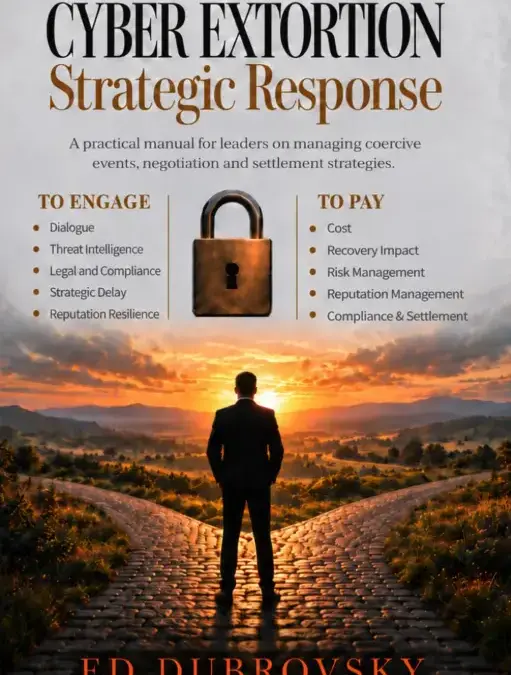
Just weeks before his arrest, Dubrovsky maintained an active public presence, sharing insights on LinkedIn regarding the evolving landscape of extortion advisory services. He wrote extensively about navigating complex digital demands, emphasizing the importance of strategic communication during high-pressure corporate crises. In addition to his advisory work, Dubrovsky authored "Cyber Extortion Strategic Response," a comprehensive 252-page volume designed to guide organizations through the intricacies of post-breach decision-making.
In promotional materials for his book, Dubrovsky highlighted a core philosophy of modern incident response: that opening lines of communication with malicious actors is fundamentally distinct from authorizing a ransom payment. Engagement, according to his published frameworks, can serve alternative strategic objectives, such as validating attacker claims, buying precious time for forensic analysis, gathering intelligence, and preserving organizational options while executive leadership evaluates legal and operational next steps.
The federal case against Dubrovsky forms part of a much broader, fast-moving crackdown on the ShinyHunters collective, a cybercrime operation that has wreaked havoc on corporate and government networks alike. According to federal estimates, the group has successfully extorted more than $70 million from victims globally over the course of the year.
ShinyHunters typically relies on sophisticated social engineering, targeted phishing campaigns, and stolen corporate credentials to infiltrate software-as-a-service providers and enterprise cloud environments. Once inside, the actors siphon proprietary databases and sensitive documents, subsequently threatening public disclosure unless substantial cryptocurrency ransoms are satisfied.

The investigation gained significant momentum last month when Dutch law enforcement authorities arrested Pepijn van der Stap, a reformed hacker and cybercriminal, during coordinated raids. Investigators have spent weeks analyzing electronic devices and digital artifacts seized during those international operations. Sources indicate that federal investigators are examining the operational overlap between various ransomware negotiation intermediaries and cybercriminal syndicates, suggesting that additional charges against principals at other security and advisory firms could be forthcoming.
The pressure on investigators intensified dramatically in the wake of Van der Stap’s detention. A prominent affiliate within the ShinyHunters network operating under the pseudonym "Rey" seized control of the group’s public communication channels and began taunting federal authorities. The threat actor publicly boasted about infiltrating the FBI’s online recruitment portal, extracting sensitive background information that reportedly included personnel unit assignments, military specializations, and confidential medical and psychiatric records.
International reporting last week identified the individual operating as Rey as Saif Al-din Khader, a teenager who has since been detained and is reportedly cooperating with federal investigators. Investigative reports highlighted that Khader was apprehended as the cybercrime group attempted to execute an extortion campaign against a specialized digital aviation and navigation unit that had been divested by aerospace giant Boeing in late 2025.
As the legal proceedings shift toward Texas and federal prosecutors pore over newly acquired digital evidence, the case continues to send shockwaves through the cybersecurity and cyber insurance industries. With multiple suspects in custody and international cooperation yielding a wealth of intelligence, federal authorities are signaling that the net is tightening around the infrastructure supporting some of the world’s most aggressive extortion syndicates.



Leave a Reply