Broadly speaking, there are three types of Peanuts comics. There are the funny ones, the sweet ones, and ones that are both funny and sweet. And, let’s be honest, there are a good number of boring ones too. But, very generally speaking, those are the three types of good Peanuts comics: funny, sweet, and the ones that do both of those things.
This enduring classification speaks to the remarkable range of Charles Schulz’s landmark comic strip, which ran for nearly fifty years and captured the hearts of generations of readers worldwide. While the strip featured an expansive cast of memorable children—from the perpetually anxious Charlie Brown to the philosophically inclined Linus and the bossy, pragmatic Lucy—its breakout star was undeniably Snoopy, a beagle whose rich fantasy life and complex personality made him a cultural icon.
However, stripping away Snoopy’s famous alter egos reveals a fascinating subset of the comic’s history. Evaluating the humor of Charles Schulz often means looking past the high-flying World War I Flying Ace or the effortlessly cool "Joe Cool" persona to examine strips that focus purely on the nature of dogs and canine behavior. Limiting the scope to genuinely funny, dog-themed strips highlights Schulz’s impressive abilities as a joke-writer who understood both human nature and the distinct, often baffling habits of man’s best friend. Dog lovers looking for humor rooted in everyday pet ownership can trace this brilliance through five standout Peanuts comic strips.

5. The easy life of a dog
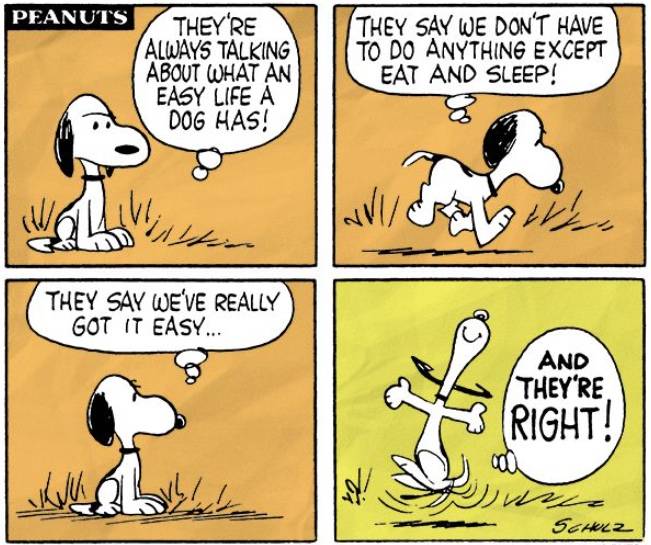
Dogs do live a pretty enviable life. They have no jobs, people bring them food for free, and simple pleasures like stick-throwing are entirely fulfilling. A lot of people wish life was that simple for them—I know I do. Here, Snoopy addresses those feelings of jealousy many humans have towards dogs and basically says “Yeah, being a dog is pretty great.”
Way to rub it in, Snoopy.
This strip brilliantly taps into the universal human fantasy of shedding adult responsibilities. While Charlie Brown and his peers grapple with homework, baseball losses, and the anxieties of growing up, Snoopy occupies a parallel universe free from societal pressures. Schulz uses this dynamic not just for a quick gag, but to poke gentle fun at the human condition. The humor arises from the stark contrast between human complexity and canine simplicity, a comedic tension that Schulz mastered over decades of publication.

4. Snoopy bites Charlie Brown
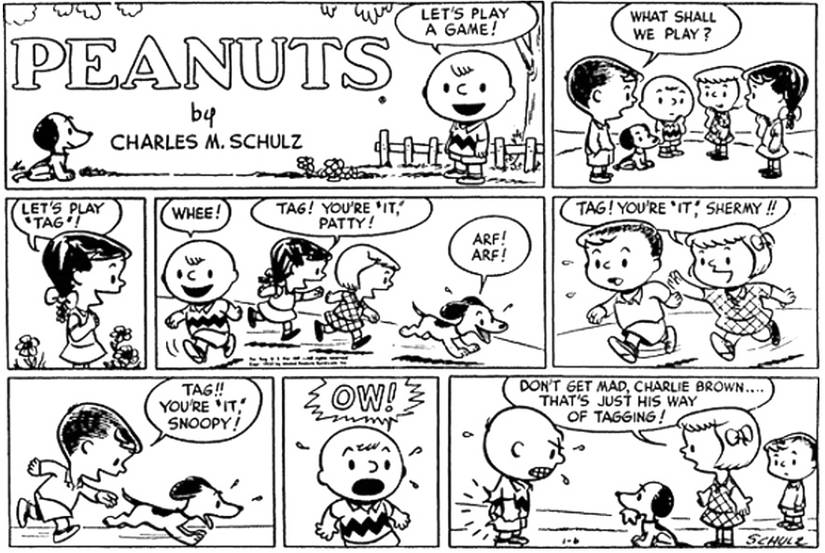
From Jan. 6, 1952, this is the first-ever Sunday strip of Peanuts. The comic had begun in 1950, running six days a week with its regular, four-panel daily strips, but its growing popularity brought it to Sundays.
In these early ones, Snoopy didn’t really have all of his more human-like personality traits that would become his signature. Instead, he was just a regular, adorable old dog, which is evidenced here when Snoopy does something that it’s hard to imagine him doing: biting Charlie Brown. It comes during a game of tag where a bunch of kids are running around, tagging each other. One of the kids tags Snoopy, then we see Charlie Brown shout “Ow!”
Then we see Charlie Brown with the back of his shorts missing, with an angry expression as Snoopy looks on innocently. Meanwhile, a kid named Patty—this is the original Patty, not Peppermint Patty—tells Charlie Brown, “Don’t get mad, Charlie Brown……. That’s just his way of tagging!”
This historical milestone offers a fascinating glimpse into the evolution of the strip. Long before Snoopy slept atop his doghouse while typing out Great American Novels or engaged in imaginary dogfights with the Red Baron, he was subjected to the clumsy realities of early 1950s suburban childhood. The image of a bewildered, pants-missing Charlie Brown combined with original Patty’s deadpan defense of the beagle remains one of the most delightfully absurd moments from the strip’s formative years.
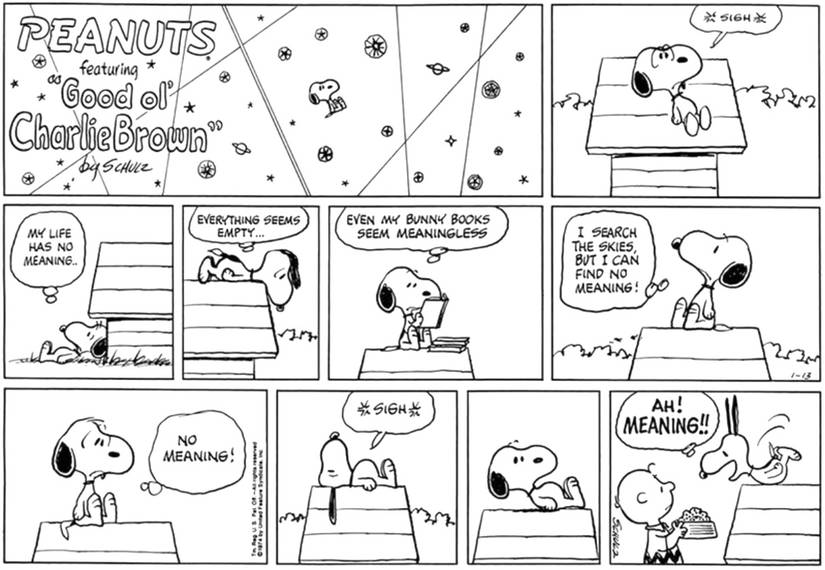
3. The meaning of life
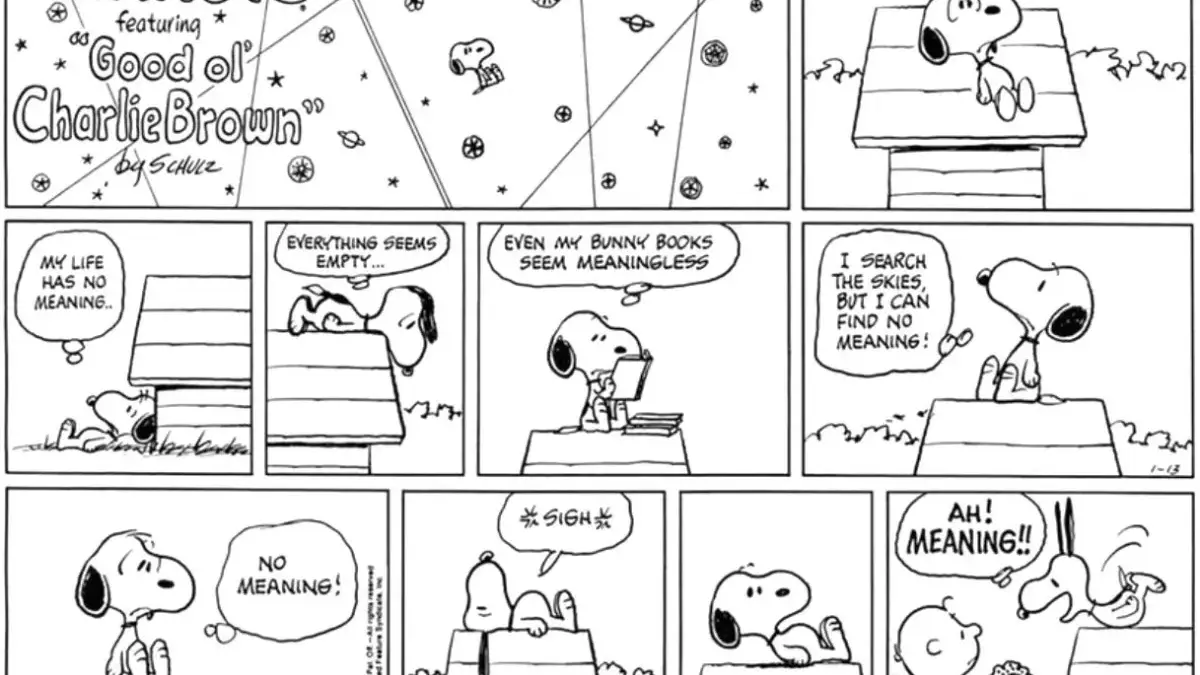
What I love about this one is it seems like it could be about something deeper. Snoopy is experiencing some serious malaise, feeling like his life has no meaning at all. And because we all love Snoopy, it makes us all empathize with him and worry about him. Snoopy often acts like more of a human than a dog, and in this comic strip, he seems like he is a super-depressed human. And then, after multiple panels that make Snoopy look like he’s going through a mid-dog-years crisis, Charlie Brown arrives with a full bowl of food. All of a sudden, Snoopy snaps out of it and his life has meaning again. Snoopy may act like a man, but he’s all-dog.
This strip showcases Schulz’s unique talent for blending existential philosophy with lowbrow slapstick. For the first few panels, the reader is invited into a genuinely melancholic headspace, wondering if the beagle is suffering from a profound crisis of purpose. The abrupt punchline—where intellectual despair is instantly cured by the arrival of kibble—serves as a reminder of Schulz’s comedic timing. It bridges the gap between sophisticated character study and traditional cartoon humor.
2. One pissed pup
I love how mad Snoopy is in this one. He’s such a happy dog that we rarely see him in a bad mood, which is why this one is so funny and feels like he’s being a real dog here. Dogs hate to see their food bowls empty, and it’s hilarious to see Snoopy play that very dog-like emotion.
While much of the humor in Peanuts relies on quiet melancholy or dry wit, Schulz occasionally leaned into bursts of pure, animated frustration. Dogs possess a very specific set of grievances, chief among them being a delayed meal or an empty bowl. By projecting intense, righteous indignation onto a beagle standing rigidly by his feeding dish, Schulz captures an experience familiar to anyone who has ever owned a hungry pet. It is a moment of pure, unfiltered animal annoyance elevated by expert visual character design.
1. Dog sleeping habits
Is this one too sweet? It is really funny, but I fear I’m breaking my own stupid rules here. I just couldn’t resist this one. I mean, it is about “dogs” and quite literally the “nature of dogs,” with Lucy talking about the reason for a distinctive dog behavior. Yet the sleepy Snoopy on top of Linus’ head is super cute. I guess it’s impossible to entirely separate the humor of Peanuts from its inherent sweetness.
Concluding this look at canine-focused strips with a moment of heartwarming affection highlights the core appeal of Schulz’s work. Even when he was dissecting the peculiarities of pet behavior or crafting sharp, cynical punchlines, the underlying warmth of the strip always shone through. By pairing an analytical conversation about canine instincts with the cozy image of a sleeping beagle, Schulz proved that the best moments in Peanuts often reside precisely at the intersection of humor and heart.