If you have followed the trajectory of desktop Linux over the past year, it has been practically impossible to miss the cultural and technological phenomenon known as Omarchy. And if you have followed Omarchy, you inevitably cannot escape its creator, David Heinemeier Hansson, globally recognized as DHH.
Hansson, famed for creating Ruby on Rails and co-owning 37signals—the software firm behind Basecamp and HEY—stepped boldly into the operating system arena with the release of Omarchy. Built as an opinionated Arch Linux setup centered around the sleek Hyprland tiling window manager, it initially captured attention with its striking aesthetics and a dedicated following. Yet, in its early days, it was widely viewed as just another Arch-based configuration in a crowded sea of similar desktop environments.
That dynamic shifted dramatically when artificial intelligence moved directly into the core of the operating system. With the launch of Omarchy Quattro, autonomous agents became first-class citizens of the desktop experience, and Omarchy’s popularity skyrocketed. The platform began pulling in mainstream users and creators who had never touched Linux before. Its plugin marketplace exploded, crossing 500 plugins within its first week of operation and subsequently growing to house thousands. Meanwhile, the newly established Omacom Foundation secured more than $18.5 million in financial and resource pledges, including substantial grants of AI tokens from industry giants like Anthropic, OpenAI, and Meta.
This meteoric rise has not occurred in a quiet or uncontroversial manner. Many long-time open-source advocates and Linux veterans harbor deep distrust toward AI-generated code, and the rapid influx of what critics dismiss as "vibe-coded" plugins has naturally ignited serious security concerns across the community.
Friction has manifested elsewhere in the ecosystem as well. Asahi Linux, the high-profile open-source project dedicated to making Linux run natively on Apple Silicon hardware, recently instituted a strict no-AI contributions policy and transitioned its codebase from the permissive MIT license to the GNU General Public License (GPL). The project explicitly cited concerns over AI-assisted code laundering as a primary driver for the change. Combined with Hansson’s well-documented penchant for vocal debates on social media platforms like Twitter, the creator remains a profoundly polarizing figure within tech circles.
To unpack this complex landscape, a wide-ranging interview was conducted via email, addressing the heavy bet on artificial intelligence, the fallout from the Asahi license shift, plugin security vulnerabilities, foundational funding, his vocal critics, and the roadmap ahead.
The Agent Age and the Linux Ecosystem
Reflecting on Omarchy’s rapid transformation from a niche tiling window manager setup into a mainstream phenomenon driven by AI integration, Hansson points directly to a paradigm shift in computing. He argues that the dawn of autonomous agents is fundamentally transforming how users interact with their machines.
"The age of agents is changing everything," Hansson explains. "We clearly saw its potential with Omarchy Quattro, and it’s no surprise to me that anyone who’s interested in agents is therefore also interested in Omarchy. We’ve simply made the best of a wonderful opportunity that’s been offered to Linux. Meanwhile, lots of other open source projects in this ecosystem have decided to take a very anti-AI stance, and their results are as you would expect."
While major desktop environments like Ubuntu are cautiously weaving AI features into their user interfaces, and international alternatives such as openKylin and openEuler explore similar pathways, few distributions have leaned into agentic workflows with the same aggression as Omarchy. Hansson attributes this hesitation to institutional inertia within traditional open-source governance models.
"Ubuntu is built on top of GNOME, which is extremely hostile to the idea of agent development," he notes. "So it’s not a surprise to me that they’re having a hard time integrating the best of AI into their distribution. The same goes for many other distributions that are deeply entwined with open source projects that are hostile to AI. It’s difficult to fully embrace the age of agents when you’re steeped in such thinking."
Commercial Software and the Open Source Philosophy
Another point of contention between Omarchy and traditional Linux orthodoxies lies in software selection. Where classic Linux distributions champion entirely open-source stacks, Omarchy integrated commercial voice-input technology via Superwhisper, drawing scrutiny from purists who argue the project prioritizes Linux accessibility over open-source principles.
Hansson makes no apologies for embracing proprietary or commercial solutions when they offer superior functionality. "I don’t have the repulsion to commercial software that many in the old Linux world have," he states. "I love commercial options when they give us the best software. I’ve worked on commercial software my entire life. I am happy to integrate the best commercial offerings, whether it’s Superwhisper or Spotify or Dropbox or anything else, into Omarchy. I’m creating a distribution that includes all the software that I personally want to use, and plenty of that software is commercial."
This pragmatic philosophy extends to hardware enablement, particularly regarding Apple Silicon. When asked whether Asahi Linux’s recent migration from the MIT license to the GPL—enacted in direct response to anxieties over AI code laundering—was a direct reaction to Omarchy’s expansion, Hansson remains unfazed.
"Asahi changing their license may be a response to Omarchy, but it also doesn’t matter," he remarks. "The Linux kernel is already licensed under the GPL, and we are in full compliance with those terms. We have a bunch of patches to the kernel that are available as open source. If Asahi is licensed in the same way, we will continue as we have all along and build on top of the best open source software. Isn’t that the point of open source? That any project is free to incorporate open software as long as they abide by the license? That certainly is how we approach it within Omarchy. I don’t see how anything changes at all."
Although some vocal members of the Omarchy community have expressed frustration toward Asahi over the license shift and the resulting inability to easily upstream compatibility work for M-series Apple hardware, Hansson maintains a balanced perspective. While confirming that Omarchy would have contributed its Apple Silicon work back upstream if Asahi lacked its restrictive anti-AI policy, he emphasizes that the roadblock does not derail Omarchy’s core mission. The distribution continues to leverage existing MIT-licensed codebases while independently filling remaining functional gaps.
Security, Vibe Coding, and the Plugin Marketplace
Perhaps the most persistent technical criticism facing Omarchy concerns the explosive growth of its plugin marketplace. Crossing the threshold of thousands of community-submitted extensions in a remarkably short timeframe, many of these tools are created by hobbyists utilizing generative AI—a phenomenon colloquially referred to as "vibe coding." Security-conscious developers frequently question how safety is maintained against potential malicious payloads.
Hansson pushes back against the narrative that AI-generated plugins inherently compromise security, framing automated oversight as a core strength of the platform. "The plugin marketplace is agentically reviewed," he explains. "There is surely more we can do to lock things down, but it’s already far more secure than, say, something like the AUR. I would say that it’s a feature, not a bug, that the majority of these plugins have been created by AI, as AI is incredibly good at sticking to established conventions. And it’s also very good at reviewing incoming code for security vulnerabilities."
Financial backing from the Omacom Foundation, which holds approximately $18.5 million in monetary and token pledges spanning a three-year period, has allowed the project to accelerate its operational ambitions. Hansson details that the capital is already being deployed to sustain a growing full-time staff, fund the AIR project to support digital artists, cover essential infrastructure costs, and provide community developers with hardware and tokens for architectural initiatives like Omarchy M and Omarchy Dragon.
Regarding the eventual depletion of these financial reserves, Hansson displays characteristic nonchalance. "We will find a way to spend all the money," he notes. "And when it’s gone, we will either have succeeded so well that it’ll be easy to raise more, or the world has changed to such an extent that Omarchy is no longer necessary. Both of these outcomes are just fine with me."
Confronting Controversy and Looking Forward
Navigating a project deeply tied to a polarizing public figure brings inevitable friction, yet Hansson remains largely unbothered by external criticism regarding his personality or his technological stances. His primary focus, he insists, is not attempting to convert skeptical veteran Linux users, but rather expanding the total footprint of desktop Linux by appealing to refugees from proprietary operating systems like Windows and macOS.
"I’m not here to persuade any haters," Hansson says. "I’m simply offering the gift of Omarchy to anyone who wants it. And if someone can’t accept it because they have a problem with me, their loss. Thankfully that’s a tiny but vocal minority in the existing Linux community. The ambition for Omarchy is much, much larger than just converting people over from other Linux distributions. In fact, I don’t really spend much if any time thinking about that. The way to make Linux win is by converting Windows and macOS users."
Addressing the recurring critique that the Linux ecosystem suffers from debilitating fragmentation—a problem critics argue is exacerbated by the introduction of yet another distinct distribution—Hansson dismisses the premise entirely. He contends that the real crisis facing desktop Linux is its chronically modest market share rather than the existence of varied user experiences.
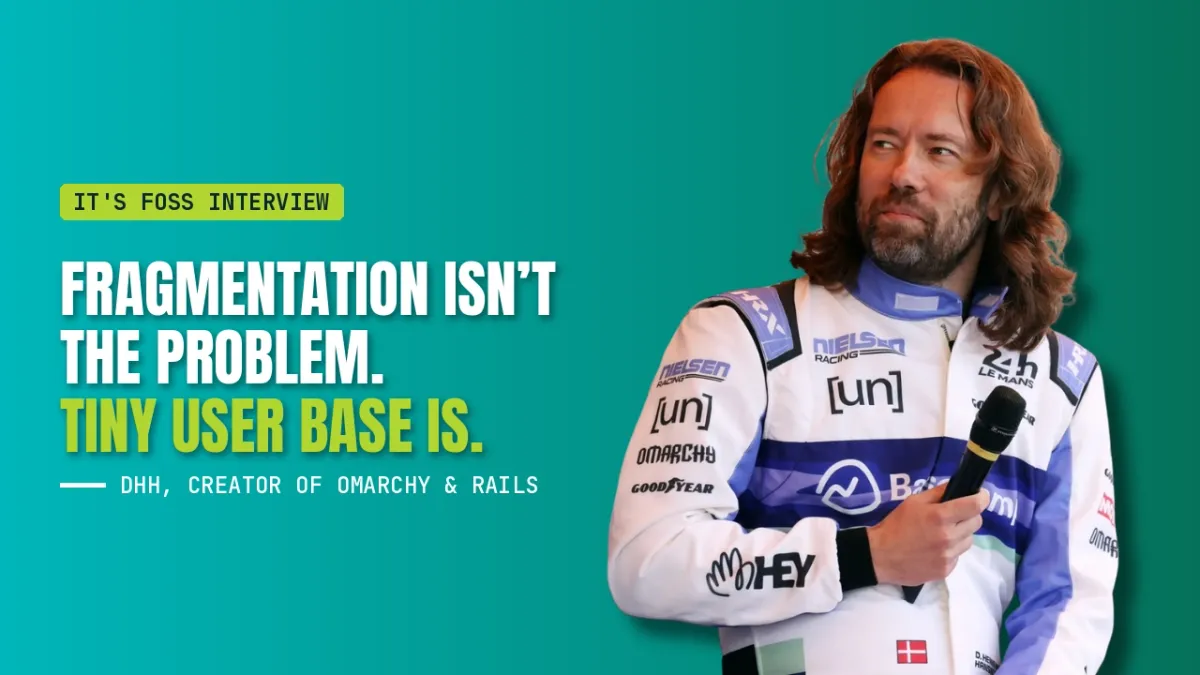
"There are very few Linux distributions that matter in any grand scheme of things," Hansson argues. "I don’t think fragmentation is a problem at all. What’s a problem is having such a tiny user base as Linux on the desktop has had for decades. Omarchy is on a mission to make a major dent in that by converting large numbers of Windows and macOS users to a distribution that is not only materially different from what they already have, but is the right answer for the age of agents. That turns out to be a pretty unique proposition in the world of Linux at the moment."
While day-to-day community operations and multifaceted maintenance are supported by a broader team and active contributors, Hansson confirms that his primary energy remains focused on user experience design and feature architecture. Looking toward the future of software development itself, he acknowledges the rapidly changing role of high-level languages as artificial intelligence systems evolve, noting that he now spends significantly more time engaging with lower-level environments than he would have previously considered.
When asked about secret long-term expansion plans—whether targeting servers, mobile devices, or proprietary hardware—Hansson offers a characteristic touch of cryptic ambition, encapsulating the project’s relentless trajectory: "First we take Manhattan, then we take Berlin."
For traditional Linux enthusiasts who remain hesitant or skeptical about the integration of artificial intelligence, Hansson offers a straightforward piece of advice: "Take another look with fresh eyes and an open mind. AI is the most amazing thing we’ve made computers do. Don’t miss out because of your priors, because of politics, because of what the technology looked like a year ago."