
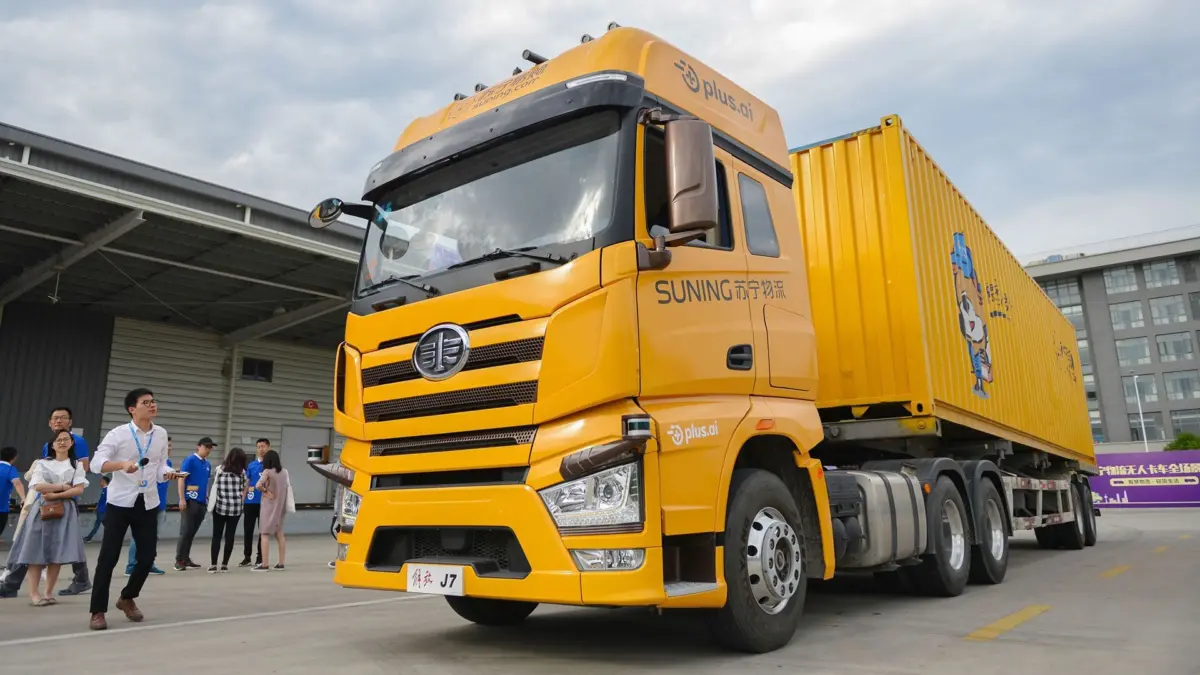
The high-stakes world of artificial intelligence has inadvertently created a lucrative black market, turning routine logistics and supply chains into targets for sophisticated criminal rings. In a striking illustration of the lengths to which modern cargo thieves are willing to go, an ambitious autonomous trucking startup recently fell victim to a high-profile heist. However, the criminals who targeted the firm—lured by the promise of multi-million-dollar AI hardware—ultimately walked away with nothing more valuable than beach material.
PlusAI, a prominent autonomous trucking startup that collaborates closely with tech giant Nvidia to develop advanced self-driving systems, maintains a fleet of commercial vehicles and trailers emblazoned with the prominent logos of both companies. To the casual observer, these co-branded rigs signal cutting-edge technological innovation on America’s highways. To opportunistic and organized cargo thieves, however, those same logos acted as an unmistakable beacon, advertising a rolling vault loaded with some of the most sought-after and expensive commodities on the global market: artificial intelligence graphics processing units.
According to recent reports, thieves successfully targeted the autonomous vehicle developer, making off with two of the company’s heavy-duty trailers. The stolen units were eventually tracked down and recovered at an undisclosed alternate location. But when the perpetrators pried open the doors expecting to unload crates filled with advanced silicon chips capable of training massive large language models, the joke was definitively on them. Instead of the prized enterprise-grade hardware they anticipated, the two stolen trailers contained a combined total of 40,000 pounds of ordinary sand, with each unit hauling roughly 20,000 pounds of the heavy mineral.
While the incident carries a certain comedic irony, it underscores a deadly serious and rapidly escalating economic crisis within the technology sector. The ongoing, unprecedented boom in AI data center construction has placed an extraordinary strain on the global supply chain for high-performance PC components. Essential hardware, including high-density RAM modules and enterprise-class GPUs, has grown exorbitantly expensive and severely constrained in availability.
This dramatic surge in market value has triggered a corresponding wave of crime across every tier of the technology industry. Law enforcement and security experts have documented a measurable rise in petty theft, with everyday package thefts increasingly targeting high-end PC builders who find themselves missing crucial components shipped directly to their doorsteps. Yet, the criminal enterprise has evolved far beyond porch piracy and opportunistic burglaries, shifting focus toward major corporate targets.
Enterprises, technology startups, and infrastructure providers are finding themselves squarely in the crosshairs of criminal organizations as they race to construct local AI servers and expansive data centers. These facilities represent immense capital investments, often housing millions of dollars worth of sensitive equipment and delicate hardware in a single location. The transit routes connecting manufacturing hubs, distribution centers, and construction sites have become particularly hazardous battlegrounds for logistics operators.
The scale of these operations highlights a level of organization and preparation previously unseen in traditional cargo theft. Recent months have provided stark examples of the growing threat landscape facing the technology supply chain. In the Chicago area, authorities investigated massive cargo heists targeting critical AI data center supplies, resulting in losses totaling approximately $1.3 million. In that particular multi-state criminal operation, law enforcement managed to recover roughly $300,000 worth of specialized copper wire alongside an estimated $1 million in high-tech equipment left abandoned or hidden by the fleeing suspects.
Other incidents have demonstrated an even greater level of brazenness and disregard for public safety. In California, cargo thieves actively transformed highways into zones of tactical confrontation, brazenly ramming and spinning security escort vehicles off the road in order to incapacitate convoys and hijack entire truckloads of valuable AI hardware. These violent highway tactics reveal that criminal syndicates are willing to employ dangerous methods to intercept shipments moving between facilities.
The PlusAI incident suggests that companies operating in the autonomous vehicle and AI sectors are acutely aware of these heightened risks. While the startup’s co-branded trailers ultimately proved to be a decoy or a routine heavy-haul test transport carrying ballast rather than expensive microchips, the episode highlights the profound paranoia and security challenges defining the current technological landscape. As the race for artificial intelligence supremacy continues to drive astronomical demand for specialized hardware, the logistics networks moving these components will likely remain prime targets for criminals hoping to cash in on the silicon gold rush—regardless of whether they find state-of-the-art processors or tons of sand at the end of the line.



Leave a Reply