

The AlmaLinux project has announced a major overhaul of its hardware verification infrastructure alongside the introduction of an entirely new software certification framework. For the first time in the enterprise Linux distribution’s history, users and publishers have a centralized, streamlined method to formally certify software compatibility, while the revamped hardware testing suite promises dramatic efficiency gains and a frictionless user experience.
Under the updated initiative, test results from both the hardware and software certification paths converge into a single, publicly accessible catalog. Designed to eliminate financial barriers and technical friction, the entire validation process is completely free of charge. Furthermore, the newly rewritten hardware testing suite removes the traditional requirement to install the Linux distribution directly onto a target machine to perform diagnostic checks, opening up broader participation for system administrators, enterprise IT departments, and independent hardware vendors alike.

Validating Software and Hardware Compatibility
In the context of the updated AlmaLinux platform, software certification functions as an official listing paired with community-driven confirmations. Software publishers can add their products to the catalog and designate which major versions of AlmaLinux the software supports.
The validation of these listings relies on real-world deployments. Users running software on their own hardware across various AlmaLinux releases can submit confirmations to verify compatibility, though participants are required to sign up for an account to post their findings. This crowdsourced verification model aims to build a robust database of verified enterprise applications running natively on the distribution.

Hardware certification has received an equally significant modernization effort. The core validation utility, known as alma-certify, has been rewritten from the ground up. According to project developers, the redesigned tool is capable of achieving sub-ten-minute certification runs on the vast majority of modern hardware configurations.
A major workflow improvement in the updated alma-certify utility is that it no longer requires a dedicated AlmaLinux operating system installation to execute tests. Instead, the tool can operate directly from live media or from an existing installation already present on the machine. Additionally, the development team has introduced a streamlined machine registration flow that utilizes QR codes to simplify the device onboarding process.
The diagnostic utility functions by performing a comprehensive scan of the host system. It records hardware components down to the firmware and driver level, then executes a series of rapid diagnostic checks to determine compatibility. The test suite covers a broad spectrum of subsystems, beginning with computation and memory integrity, storage device health, and networking drivers. It also evaluates kernel state, virtualization capabilities, graphics processing units, and a wide array of peripherals to ensure the underlying system meets the operational standards expected of an enterprise-grade Linux deployment.
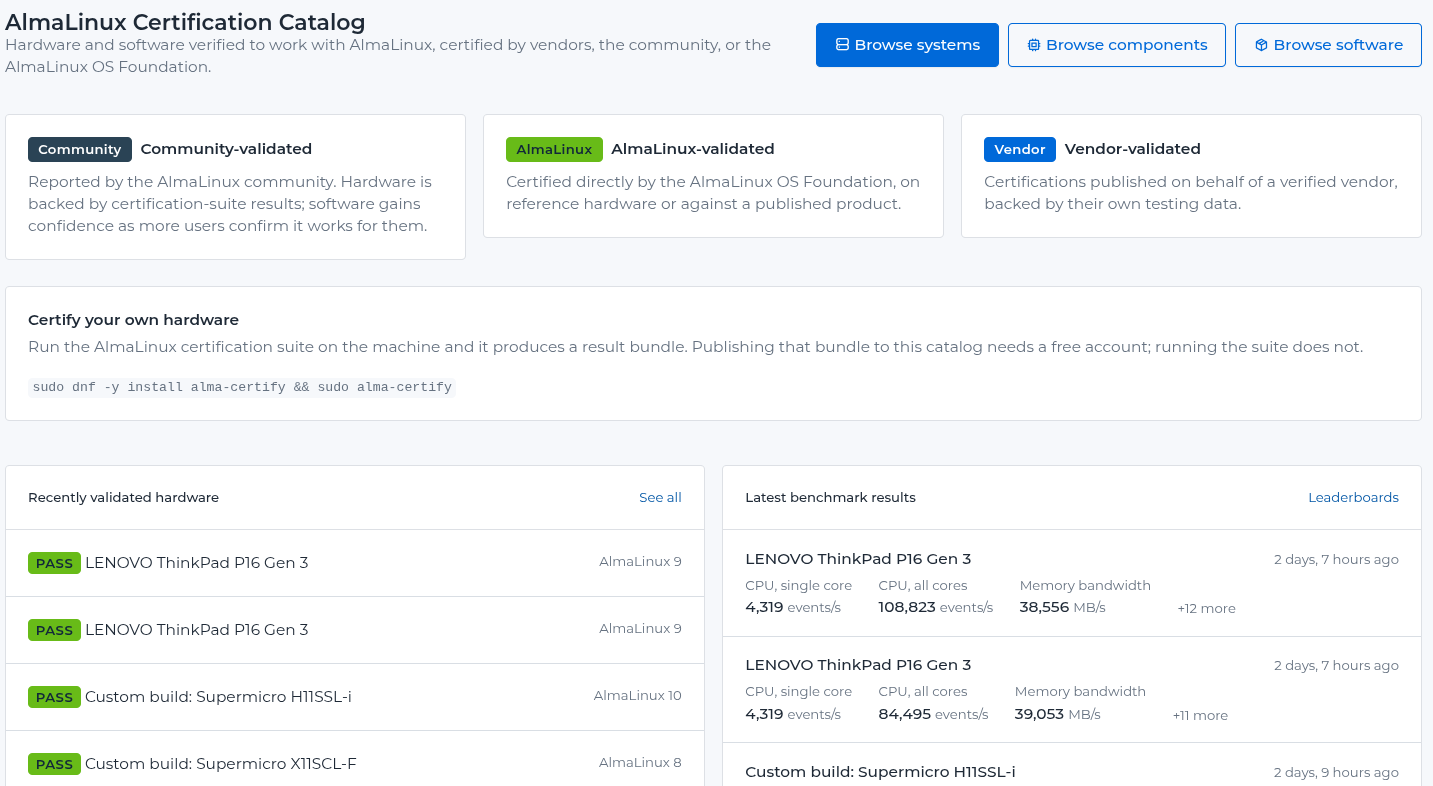
Tracking and Analyzing Results in a Public Catalog
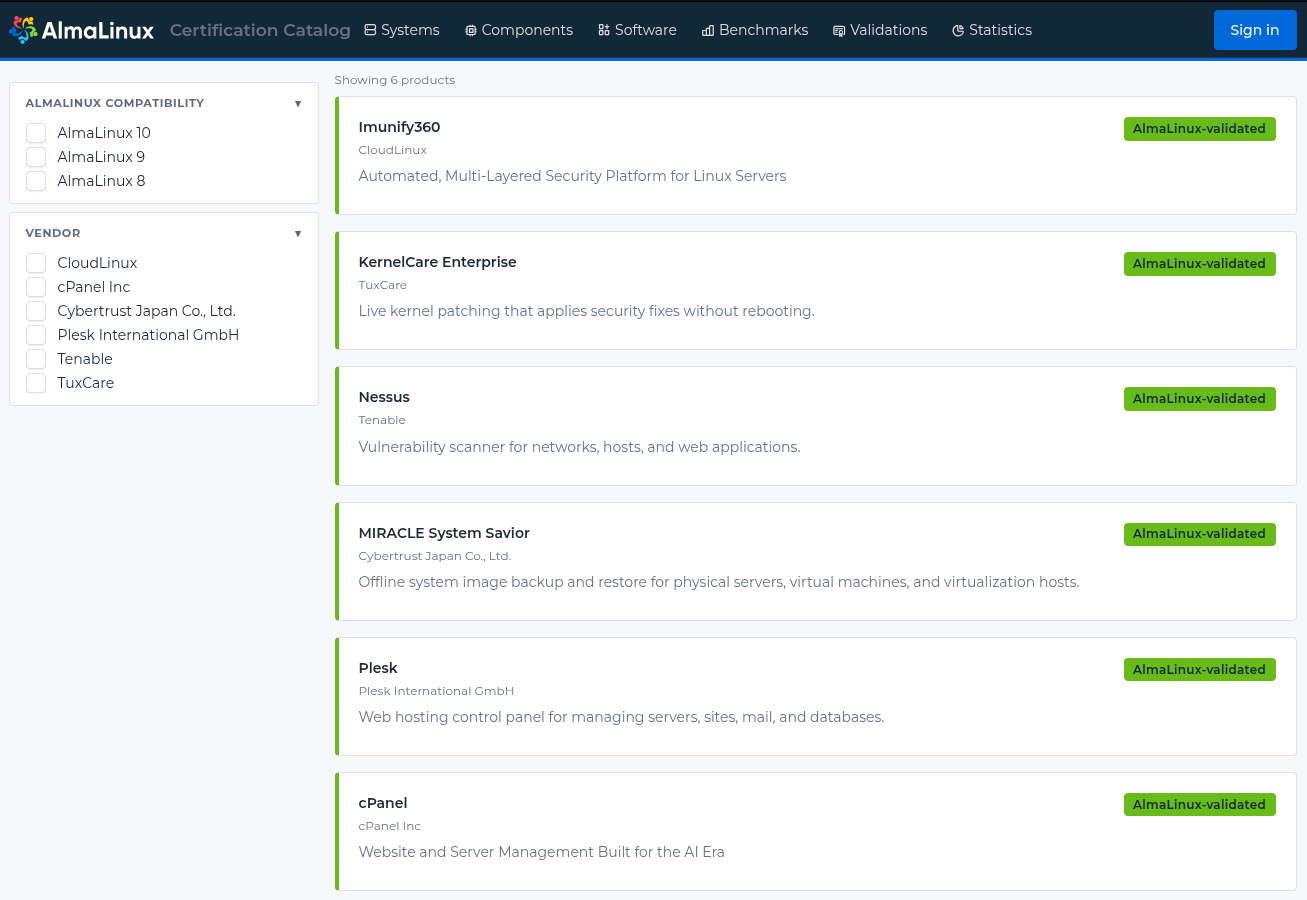
All validation data feeds directly into the public AlmaLinux catalog. Every entry in the catalog serves as a transparent data point that anyone can analyze, displaying validated systems, individual components, and certified software alongside benchmark figures generated from the published test runs.
To maintain historical accuracy and accountability, every major release of AlmaLinux is tracked independently within the platform. This separation allows users to verify provenance and track compatibility across different lifecycle stages of the distribution. The catalog interface is designed for rapid searching and filtering, and developers or enterprise analysts can utilize a free, read-only application programming interface to collect validation data in bulk for automated tracking and compliance monitoring.
Jonathan Wright, the Infrastructure Lead for AlmaLinux, emphasized the practical value of the new validation infrastructure for the broader community and enterprise stakeholders. He noted that many organizations and individuals require empirical proof that AlmaLinux runs smoothly on the hardware they already possess before they are willing to adopt it in production environments. With the updated toolset, users can easily generate that proof themselves.
Furthermore, Wright pointed out that every submitted validation result strengthens the argument for official vendor support. When organizations document their successful deployments, it demonstrates to hardware and software vendors that officially supporting AlmaLinux requires minimal effort while delivering high value to shared customers. By encouraging users to test hardware sitting right in front of them or software they rely on daily, the project hopes to foster a collaborative ecosystem where validations accumulate over time, making subsequent listings just as impactful as initial ones.
Ultimately, the long-term success of this renewed certification initiative depends on active participation from individual users, system administrators, and technology vendors who must invest the time to run diagnostic tests and manually publish their findings to the portal.

Leave a Reply