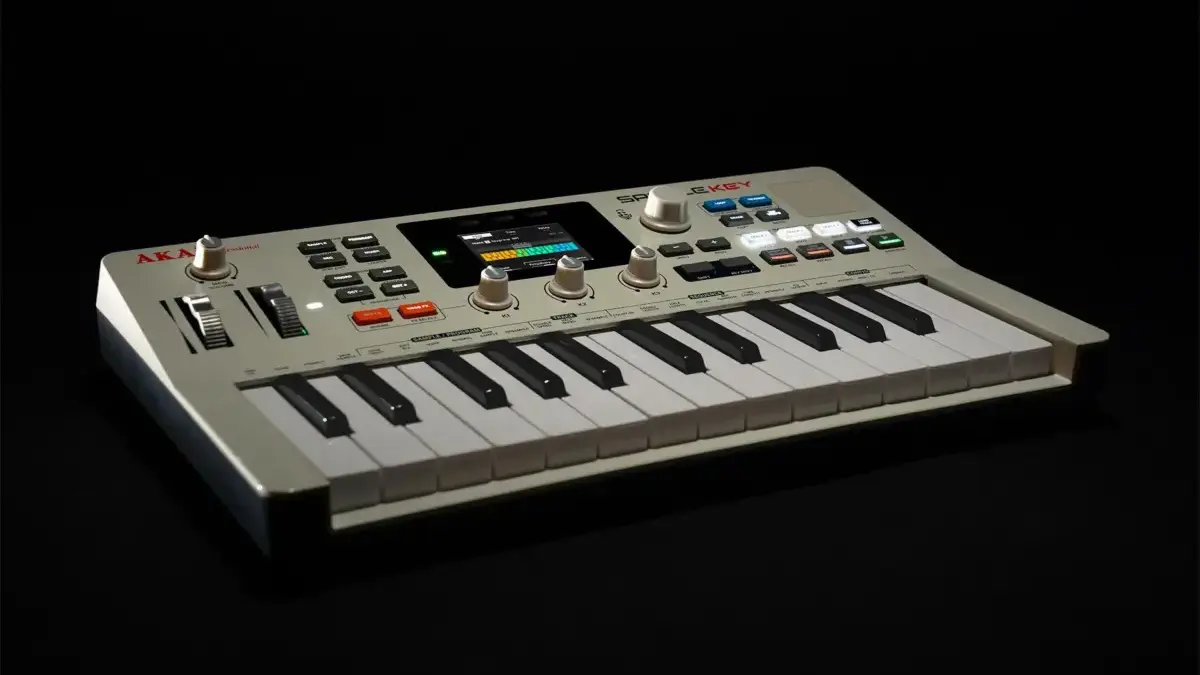
Akai has offered an intriguing glimpse into the future of its portable production lineup, recently teasing its upcoming MPC Sample Key on Instagram. Beyond the initial hardware teaser, the company has announced a significant shift in philosophy for the ecosystem: it plans to open-source the software, inviting the modding community to hack, customize, and experiment with the firmware to their hearts’ content. While official details regarding a launch date, pricing, and full technical specifications remain tightly under wraps, exclusive images obtained by The Verge provide a closer look at the instrument, revealing a feature set designed to pivot away from traditional drum production and lean heavily into melodic creation, live performance, and modular integration.
The MPC Sample Key shares structural DNA and control layouts with the previously released MPC Sample, carrying over familiar elements such as three context-sensitive encoders and a large main encoder for navigating menus and parameters. However, a closer examination of the leaked images indicates that the hardware has been fundamentally re-architected for pitched sample playback rather than the aggressive sample-chopping workflow typical of traditional beat-making machines. In fact, the iconic "chop" button found prominently on the standard MPC Sample is entirely missing from the Sample Key layout.
This functional shift is further underscored by the inclusion of dedicated pitch and modulation wheels sitting proudly above the keys, a staple of modern synthesizers and keyboards that was absent on the drum-centric predecessor. The instrument features a 25-key keyboard layout—corrected from initial assumptions—accompanied by dedicated buttons labeled "chord" and "arp," alongside controls for shifting the octave range.

These dedicated interface additions suggest powerful new ways to interact with sound. While running drum samples through an arpeggiator can occasionally yield interesting, glitchy rhythmic patterns, an arpeggiator is universally associated with creating driving melodic sequences and basslines. Similarly, a dedicated chord mode would offer little utility for traditional drum programming, but it becomes indispensable when triggering complex harmonic structures with sampled instruments or internal synth engines. These options appear to directly replace the drum-chopping functionality of the standard MPC Sample, signaling that Akai is targeting a different kind of creator—one who focuses on melodies, textures, and harmonic progression.
Further enhancing its potential as a live performance tool, the MPC Sample Key appears to feature a dedicated looper. Such a tool could prove exceptionally useful for musicians looking to layer sounds in real-time, build up complex arrangements on the fly, or capture spontaneous ideas during a live set without navigating deep menu structures. Additionally, while the original MPC Sample utilized Flex Beat effects for rhythmic manipulation and stutter effects, the Sample Key introduces a mysterious new effect or processor labeled "Swarm." While the exact nature, parameters, and sonic capabilities of "Swarm" remain unclear at this early stage, its inclusion hints at innovative sound design possibilities tailored for modern electronic music producers.
True to the all-in-one ethos that has characterized much of Akai’s portable hardware evolution, the Sample Key retains a built-in microphone and speaker, enabling creators to capture sounds from the environment and jam out ideas wherever inspiration strikes, without needing to plug into an external sound system or computer. While official photographs of the rear panel have not yet surfaced, configuration options and labeling visible on the front panel suggest exciting connectivity potential. Beyond standard MIDI implementation, the layout implies the presence of control voltage (CV) outputs, which would allow the MPC Sample Key to integrate seamlessly with modular synthesizers, semi-modular gear, and analog Eurorack setups.
The decision to open-source the software platform represents a particularly notable move for Akai, opening the door for hardware hackers, custom firmware developers, and the broader DIY electronic music community. By encouraging users to tinker with the code, Akai could foster a vibrant ecosystem of custom modifications, user-created features, and community-driven updates that extend the lifespan and utility of the hardware far beyond factory specifications. As anticipation builds for a formal product launch, producers and gear enthusiasts will be watching closely to see when Akai officially pulls back the curtain on pricing, availability, and the full technical capabilities of the MPC Sample Key.