Airbnb is tightening the reins on what hosts can demand from travelers before they depart, igniting a fierce debate across the platform’s community and drawing sharp lines between property owners. The policy shift, which applies to all reservations booked on or after November 20, is designed to relieve vacationers of heavy checkout chore lists—tasks that have long drawn frustration, particularly when paired with steep cleaning fees.
Under the updated guidelines, hosts are generally prohibited from asking guests to complete time-consuming duties or work typically handled by a professional cleaner. Specifically, the rules forbid demands such as stripping beds, hauling trash off-site, and washing or putting away dishes. Furthermore, any remaining house rules or requests must be clearly and transparently disclosed in a designated listing section prior to booking.
For weary travelers who have long grumbled about paying hefty cleaning fees only to be greeted by a lengthy list of domestic chores upon departure, the policy change sounds like a welcome relief. However, within online host communities, Reddit threads, and creator forums, the regulation has triggered a tempest. The dispute has evolved into a much larger, highly polarized philosophical debate regarding the fundamental nature of short-term rentals, the boundaries of hospitality, and what guests truly owe to the people renting them a place to stay.
While some hosts argue that the corporation is overstepping its bounds and stripping away their autonomy, others are urging their peers to embrace the update, arguing that short-term rentals must align more closely with traditional hospitality standards.
Some Hosts Want Airbnb to Reverse Course
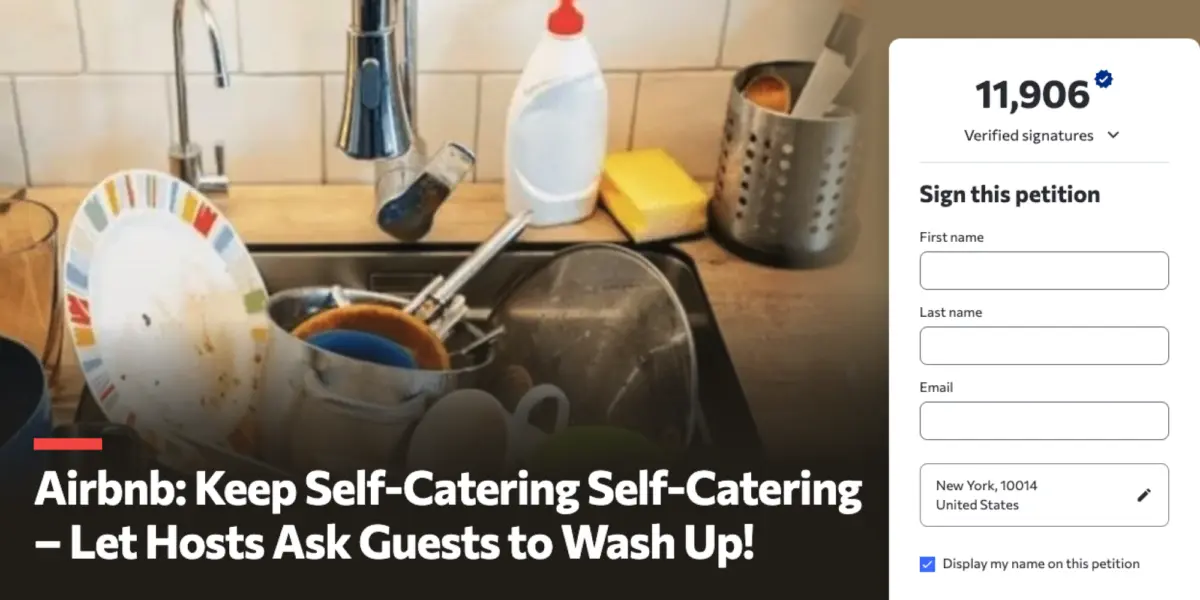
The backlash from discontented property owners has been swift and organized. A Change.org petition titled "Airbnb: Keep Self-Catering Self-Catering — Let Hosts Ask Guests to Wash Up!" has rapidly accumulated over 11,000 verified signatures. The organizers argue that renting a property equipped with a kitchen inherently carries a baseline level of responsibility for what happens in that space.
"These are not professional cleaning duties," the petition states, framing the requirement as an ordinary aspect of living responsibly in somebody else’s property. While the petition’s organizers clarify that they support restrictions on excessive demands—such as laundering linens or performing deep-cleaning routines in the kitchen—they draw a firm line at washing dishes, warning that additional cleaning overhead for hosts could eventually translate into higher overall prices for guests.
The resistance extends beyond petitions, with some disgruntled operators even calling for strikes. According to reports from WIRED, participants in a prominent Facebook group for hosts proposed a coordinated effort to unlist their properties for a day or two to send a clear message to the corporate office. One member wrote that Airbnb built its empire on the backs of property owners, arguing that it was time to remind corporate leadership who actually holds the power.
Similar sentiments echo in coastal regions and rural getaways alike. Ryan Robbins, a host based in Searsport, Maine, told NEWS CENTER Maine that while he already cleans his property himself and typically only asks guests to handle their dishes, the sweeping rule change still restricts his operational freedom. Robbins noted that the directive ultimately prevents hosts from managing their properties the way they believe they should be able to.
On Airbnb’s official community forum, a frustrated host argued that the company was actively limiting the ability of owners to protect their investments, writing that they are not running traditional hotels, but rather sharing their private properties. Similar outrage has surfaced heavily on Reddit. One host opened a scathing thread by calling the policy a new low for an already unpopular corporation, pointing out that local cleaners in their region frequently do not include dishwashing in their standard service. The poster argued that manually scrubbing a week’s worth of accumulated dishes between tightly booked reservations creates a severe logistical bottleneck.
The frustration has even inspired radical ideas. One Reddit user went so far as to ask fellow hosts whether they could collectively band together and build an entirely separate, rival platform to bypass Airbnb altogether.

Other Hosts Think the Outrage Is the Problem
Despite the loud chorus of discontent, a significant faction of hosts is pushing back against the outrage, arguing that the new policy is long overdue and beneficial to the platform’s ecosystem as a whole.
In a popular discussion thread within the r/airbnb_hosts subreddit, one superhost shared their own perspective as both an owner and a traveler. They described a particularly frustrating personal trip where they paid a steep cleaning fee only to be instructed to strip beds, start a load of laundry, and navigate a complex parking garage just to dispose of garbage. By contrast, at their own rental, this host prefers to handle tasks like removing sheets themselves specifically so they can inspect the linens for damage. Another commenter noted that their professional cleaning crew explicitly requests that guests leave beds intact for the exact same reason.
Several hosts expressed a different kind of frustration: they already offered a completely effortless checkout experience and are now disappointed that their listings will lose a unique competitive edge. One commenter wrote that their only selfish complaint was feeling like their listing would no longer stand out by simply not requiring a single chore upon departure.
In another widely discussed post, a user who described their accommodations as "no chores stays" urged fellow operators to recalibrate their expectations. Emphasizing that short-term rental owners are fundamentally in the business of hospitality, the user pointed out that traditional hotels never ask their guests to strip beds or wash dishes, and private rentals shouldn’t either.
Other contributors to the online debates suggested that considerate guests tend to clean up naturally as a matter of basic etiquette anyway. Forcing every single visitor to comply with a rigid, mandatory chore list risks alienating and frustrating the very people who would have naturally left the property in immaculate condition.
Guests Still Have Responsibilities
While the new guidelines curtail burdensome cleaning tasks, the discussion among hosts has also touched upon critical overlapping issues, such as local government regulations, building codes, noise ordinances, and fire safety precautions.
To address these operational necessities, Airbnb provides a separate, designated section specifically for local rules. This includes compliance with homeowners association (HOA) bylaws and municipal mandates that, if violated, could result in heavy fines for the property owner. Industry observers note that these legal and safety disclosures should not be confused with a blanket permission slip for hosts to impose arbitrary domestic chores.
Furthermore, the updated cleaning policies do not give travelers free rein to trash a rental property. Airbnb’s foundational ground rules for guests explicitly prohibit leaving a lodging in a condition that demands excessive or deep cleaning. Examples of violations that fall outside acceptable bounds include moldy, neglected dishes left piled in sinks or heavily soiled carpets. When guests cross these lines, hosts retain the ability to penalize them through cleanliness ratings, formal reviews, and damage claims through the resolution center.
As the platform adapts to the shifting landscape of guest expectations and host reactions, many believe the dust will eventually settle based on common sense and human decency. As one pragmatic Reddit commenter summarized, most guests clean up simply because it is normal human behavior, not because a laminated list demanded it, while those who refuse to respect a space will likely remain unchanged regardless of what the official rules happen to state.