
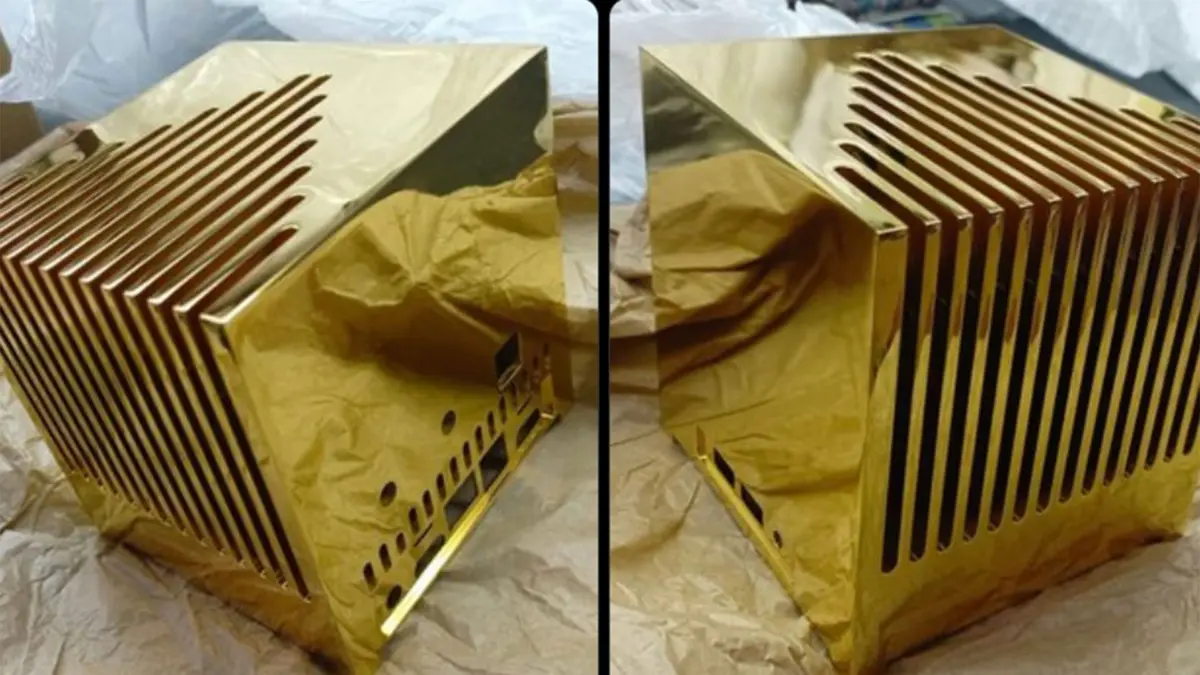
In the world of high-end personal computing, enthusiasts are often willing to pay a hefty premium for top-tier performance, exotic cooling solutions, or custom aesthetic modifications. From custom-loop liquid cooling systems with hardline acrylic tubing to meticulously hand-crafted wooden desks and bespoke chassis designs, the pursuit of PC perfection knows few financial bounds. However, a recent custom order reported by Fanless Tech takes the concept of luxury hardware into an entirely different financial stratosphere. A dedicated chrysophile—a lover and collector of gold items—has commissioned a special edition mini PC featuring a passive cooling chassis constructed entirely out of pure 24-carat gold, bringing the total estimated price tag of the machine to an astonishing $1.7 million.
The foundation of this remarkably opulent build is the Kubb Fanless PC, a compact desktop measuring roughly five inches on each side, with exact dimensions of 120 by 120 by 120 millimeters. Normally positioned as a sleek, minimalist desktop solution for professional environments or design-conscious users who value silent operation and a compact footprint, the standard Kubb Fanless PC is already a premium product. It relies on a completely passive cooling architecture, meaning it generates zero fan noise because heat is dissipated entirely through the metal chassis rather than through active airflow.
In its standard commercial configuration, the Kubb Fanless PC is built with materials typical of the high-end consumer electronics industry, keeping its weight at a modest 4.6 pounds, or approximately 2.1 kilograms. However, substituting the default chassis materials with pure 24-carat gold fundamentally transforms the physical and financial characteristics of the device. Because gold is an exceptionally dense precious metal, the weight of the mini PC balloons dramatically. The finished gold-chassis version tips the scales at a staggering 28.7 pounds, or roughly 13 kilograms, making this compact five-inch cube almost as heavy as a fully loaded full-tower workstation desktop packed with multiple graphics cards, heavy-duty power supplies, and massive aluminum radiator assemblies.
While the primary driver behind this astronomical price tag is undoubtedly the raw material cost and the sheer extravagance of housing a computer in solid gold, the modification does introduce a fascinating, if largely impractical, engineering quirk. Gold possesses significantly better thermal conductivity than aluminum, which is the industry standard material used for passive heatsinks, cooling fins, and fanless chassis designs across the computer hardware ecosystem. Copper is also widely utilized for its high thermal conductivity in high-performance CPU coolers and GPU cold plates, but pure gold surpasses traditional aluminum setups by a noticeable margin when it comes to transferring thermal energy away from internal components.
This enhanced thermal conductivity means that the massive block of precious metal surrounding the mini PC’s internal components is theoretically exceptionally efficient at pulling heat away from the processor and other critical system chips, radiating it outward into the surrounding air through convection alone. In a standard fanless system, managing thermal loads without active airflow is always a delicate balancing act between the thermal design power of the components and the surface area and mass of the heatsink enclosure. By utilizing a heavy, highly conductive precious metal chassis, the system leverages physics to maintain stable operating temperatures without ever needing to spin up a mechanical fan.
Despite this thermodynamic advantage, industry observers and hardware analysts note that the performance benefits are largely academic for the vast majority of users. Even though gold outperforms aluminum in pure thermal conductivity, the marginal gains in cooling efficiency do not come close to justifying a $1.7 million investment for any practical computing workload. For that kind of money, a buyer could construct an entire fleet of enterprise-grade data centers, acquire countless high-end workstations equipped with the most powerful consumer and professional graphics cards on the market, or invest in custom liquid-submersion cooling setups that offer superior thermal headroom while leaving millions of dollars to spare.
Nevertheless, the creation of this ultra-luxury system highlights a persistent niche within the PC enthusiast community where computing hardware crosses over into the realm of high-end art, jewelry, and status symbols. Similar to how automakers offer bespoke customization programs that allow wealthy buyers to deck out vehicle interiors in rare leathers, custom woods, and precious gemstones, the high-end PC modding scene occasionally caters to clientele for whom cost is entirely secondary to exclusivity and personal taste. Earlier hardware excess has seen the introduction of gilded graphics cards featuring real gold plating, such as high-end custom variants of flagship GPUs with price tags running into the tens of thousands of dollars, but a complete system built with a solid 24-carat gold passive chassis represents a rare pinnacle of excess.
As the boundaries between luxury collectibles and high-performance computing continue to blur for ultra-wealthy buyers, custom projects like the gold Kubb Fanless PC demonstrate the extreme lengths to which personalization can be taken. While it remains a one-of-a-kind novelty that few people in the world will ever touch or see outside of enthusiast reports, it remains a striking testament to what happens when cutting-edge compact computing engineering collides with unbridled material wealth.


Leave a Reply