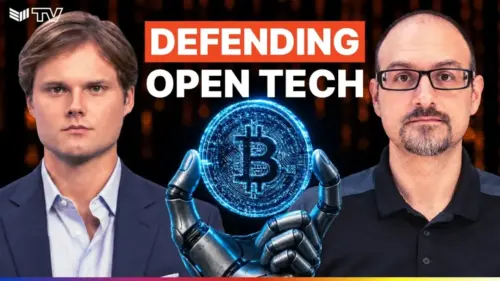
The intersection of traditional institutional finance and the emerging digital asset economy reached a notable milestone recently when Danny Baer, Head of Revenue and Investments at Meanwhile, sat down to discuss the creation and operational
mechanics of his Bermuda-based firm. As Baer detailed during a comprehensive interview on Bitcoin Magazine’s BMTV, Meanwhile has successfully engineered what is believed to be the world’s first fully licensed life insurance carrier operating entirely on a Bitcoin standard.
Unlike traditional financial institutions that merely dabble in crypto exchange-traded funds or offer custodial services for digital assets, Meanwhile has restructured the fundamental balance sheet of an insurance provider. The company holds its regulatory capital entirely in Bitcoin, prices its products in Bitcoin, and pays out its life insurance policies directly in Bitcoin. According to Baer, this unique architectural model allows the firm to bypass the structural limitations and currency devaluation risks inherent in legacy fiat-based insurance systems, creating a completely novel asset class for long-term wealth preservation.
Building a Sovereign Balance Sheet in Bermuda
The journey to establishing a fully licensed life insurance carrier operating on a native cryptocurrency standard was neither simple nor quick. Securing regulatory approval required navigating the stringent compliance frameworks of international jurisdictions. Meanwhile ultimately found a welcoming and forward-thinking regulatory environment in Bermuda, a domicile renowned for its sophisticated approach to digital asset regulation and insurance innovation.
By obtaining an official license from the Bermuda Monetary Authority, Meanwhile proved that a financial institution could maintain 100% of its reserves and regulatory capital in a volatile, non-sovereign digital asset while still meeting the rigorous solvency and liquidity standards required of modern insurers. Baer emphasized that the operational model is completely indifferent to the short-term fiat price fluctuations of Bitcoin. Whether the market trades at $10,000 or $10 million per coin, the underlying mechanics of the balance sheet remain intact because the liabilities and assets are perfectly matched in the same native currency unit. Traditional insurers, by contrast, are weighed down by decades-long fiat liabilities that are continuously eroded by inflation and monetary expansion, leaving them unable to compete with a model rooted in a hard, fixed-supply asset.
High-Profile Backing and Institutional Validation
The viability of a Bitcoin-native life insurance carrier has not gone unnoticed by heavyweights in both the traditional financial sector and the technology industry. Meanwhile’s capitalization table features a notable roster of high-profile institutional backers and venture capitalists, including alternative investment giant Apollo, Bain Capital Crypto, insurance stalwart Northwestern Mutual, and tech visionary Sam Altman.
The participation of firms like Northwestern Mutual and Apollo signals a profound shift in how legacy financial institutions view the long-term integration of digital assets. These entities recognize that the decades-long investment horizon characteristic of the life insurance industry makes these institutions natural sources of permanent capital for the expanding Bitcoin economy. Rather than treating Bitcoin as a speculative trading instrument, insurers operating on multi-decade timelines view it as the ultimate foundational layer for generational wealth transfer.
How a Bitcoin Life Insurance Policy Works
For the everyday policyholder, the mechanics of a Bitcoin-denominated life insurance policy are designed to provide both security and compounding value for beneficiaries. Baer broke down the core financial structure during the discussion, illustrating how a policy functions in practice. A client might commit a premium of 10 Bitcoin into the policy over time. Upon the triggering event, the policy can payout significantly more—potentially 15 or 20 Bitcoin to the policyholder’s family—all delivered in a tax-free structure depending on jurisdictional rules.
Furthermore, policies inside the Meanwhile ecosystem benefit from an internal, Bitcoin-denominated yield of approximately 2% that compounds over the life of the agreement. This means that the principal amount grows natively in satoshis and Bitcoin units rather than inflating fiat currency equivalents. For families seeking to pass down wealth across generations, this offers a vastly more durable currency foundation than legacy whole-life policies, which are tied to government-issued fiat currencies susceptible to systemic debasement.
Integrating into the Wider Bitcoin Economy
A critical component of Meanwhile’s long-term strategy involves recognizing the unique macroeconomic role that life insurers play as absorbers of long-term capital. With average policy durations stretching across decades—such as a 42-year liability horizon—life insurance companies naturally generate stable, patient capital that does not flee at the first sign of market volatility.
Baer addressed common misconceptions within the broader Bitcoin community regarding how life insurance capital operates. While many retail Bitcoin holders prioritize immediate self-custody and short-term liquidity, institutional-grade products require complex risk management frameworks, secured Bitcoin lending operations, and robust first-loss capital reserves. By providing these structured financial products, Meanwhile bridges the gap between individual long-term savings goals and institutional-grade financial security.
Ultimately, the advent of Bitcoin-native life insurance solves a major logistical and emotional hurdle for families holding digital assets. Under traditional estate planning scenarios, heirs frequently face the daunting task of hunting down lost hardware wallets, deciphering complex seed phrases, or navigating complicated custodial handoffs after a loved one passes away. By embedding Bitcoin into a regulated, legally binding life insurance structure, Meanwhile ensures that accumulated wealth can be securely, efficiently, and seamlessly transferred to the next generation without the operational friction and risks traditionally associated with digital asset inheritance.