For many self-hosters and home server enthusiasts, the anatomy of a growing homelab often follows a familiar, chaotic trajectory. What starts as a single machine running a handful of services quickly expands into a sprawling ecosystem of multiple physical nodes and dozens of isolated Docker containers. Navigating this architecture traditionally relies on a messy web of bookmarks, IP addresses, and specific port numbers, transforming routine maintenance into a daily memory test.
While modern overlay networks like Tailscale have largely solved the problem of secure remote connectivity—allowing users to pierce through domestic firewalls and carrier-grade NATs from anywhere in the world—once inside the network, the underlying complexity remains. Users are left trying to remember which physical machine is hosting a particular application and which port it happens to be mapped to. Standard workarounds, such as deploying a traditional reverse proxy with a custom domain, introduce an extra layer of ongoing maintenance, forcing administrators to juggle multiple configuration files every time a new application is introduced. Alternatively, provisioning individual Tailscale sidecars for every container creates an overwhelming administrative overhead, cluttering the network dashboard with dozens of discrete device entries, unique authentication keys, and individual state volumes.
This architectural friction prompted developer Marvin von Rappard to rethink internal container networking entirely, leading to the creation of an open-source automation tool called DockTail. The project addresses a fundamental gap in how modern containerized applications interact with Tailscale’s relatively recent capability known as Services, shifting the management paradigm away from physical hardware and toward application-centric identities.
The core premise of a Tailscale Service is deceptively simple yet powerful. Instead of assigning a secure network name and virtual IP address to a physical device, a Service exists as a distinct entity on the tailnet—such as a dedicated address for an application like Jellyfin. Multiple backend machines can then advertise that service, allowing Tailscale to handle the underlying routing dynamically. For a Docker host, this means the host machine remains a singular node on the tailnet, while the individual applications running inside it manifest as independent services. Access control lists can subsequently be tailored to target a specific service directly, granting users granular access to a single application without exposing the underlying host operating system.
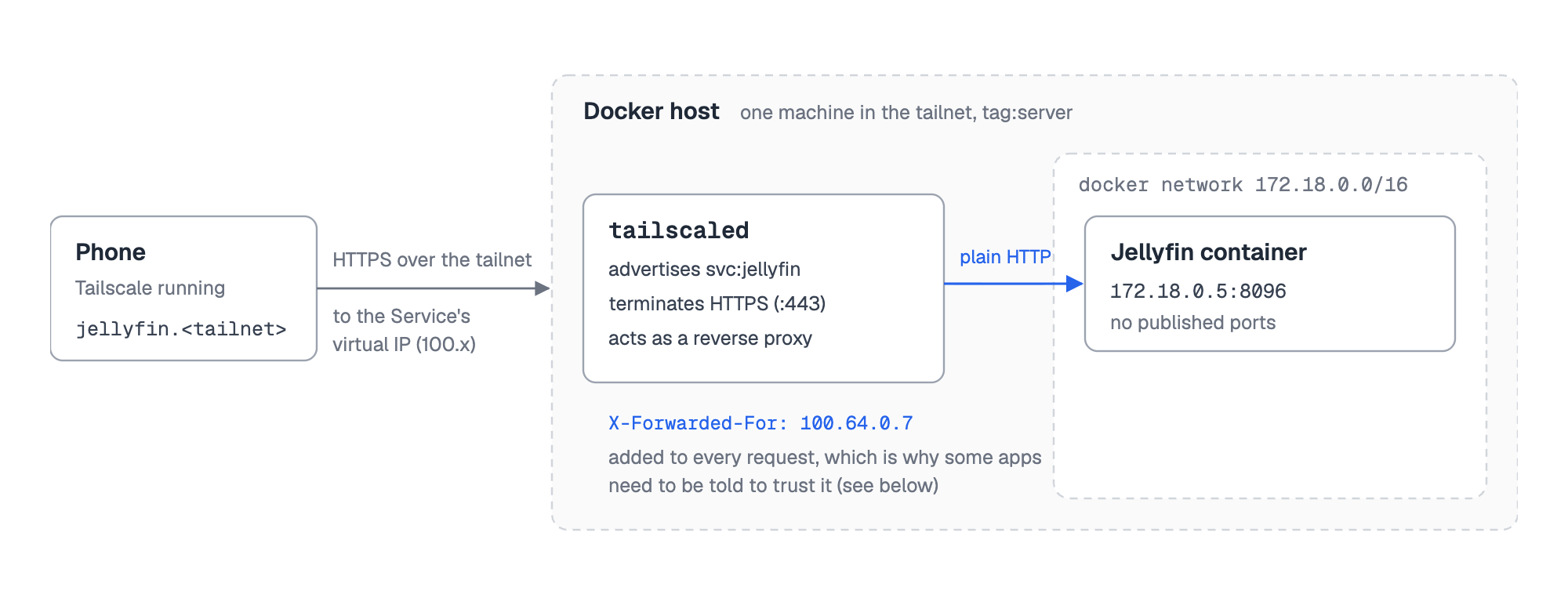
Examining the request path reveals how this architecture functions under the hood. When a client device on the tailnet initiates a connection to a specific application service name, Tailscale routes the traffic directly to the designated Docker host. Upon arrival, the local Tailscale daemon handles the encryption layer by terminating the HTTPS connection. It then translates the traffic into plain HTTP, appending standard proxy headers like the originating client’s IP address, before forwarding the packets internally to the targeted container over the local Docker network bridge. To the application itself, Tailscale effectively mimics the behavior of a standard reverse proxy, operating locally on the host machine without requiring external routing complexity.
Implementing this configuration manually for a single application requires establishing a tagged host machine to advertise the service, configuring policy definitions within the administrative access control panel to permit automatic service approval, and executing explicit command-line instructions on the host to bind the service name to the local application port. While this manual approach is manageable for a solitary container, it quickly becomes unsustainable when managing dozens of distinct applications. In a dynamic homelab environment where containers are frequently spun up, updated, or decommissioned, static configurations create a synchronization nightmare. The application definitions live inside localized Compose files, while the networking routes reside entirely within the centralized admin console and the local daemon’s state, leading to orphaned configurations whenever a container is removed.

Drawing parallels to how projects like Traefik revolutionized reverse-proxy management through declarative Docker labels, von Rappard sought to eliminate the disconnect between container orchestration and tailnet configuration. This realization led to the development of DockTail, an open-source utility designed to bridge the gap between Docker runtime events and Tailscale Services. Operating as a lightweight container deployed on each host, the tool monitors real-time Docker events and automatically translates container labels into the necessary tailnet service definitions.
By incorporating specific configuration labels directly into a container’s deployment file, administrators can automate the entire lifecycle of a Tailscale Service. When a container starts up, the management utility registers the service automatically, eliminating manual intervention in the admin console. Furthermore, because traffic is routed directly to the container’s internal IP address on the Docker network rather than relying on published host ports, the system bypasses traditional port-mapping limitations entirely. This architectural choice addresses a critical vulnerability inherent in manual setups: when a Docker container is recreated or redeouplyed, its internal network IP address frequently changes. A statically written routing configuration would inevitably break upon recreation, whereas an event-driven automation tool dynamically updates the routes in real time.
Transitioning to an application-centric networking model also uncovers subtle behavioral nuances regarding application compatibility. Because the underlying network daemon actively terminates incoming TLS connections and forwards plain HTTP traffic alongside standard proxy headers, certain backend applications require explicit configuration to recognize the upstream proxy. Applications that rigorously validate incoming request headers may reject connections initially unless they are explicitly instructed to trust local proxy loops or specific bridge network subnets. Configuring these applications to honor proxy headers ensures that logging systems and client-IP tracking mechanisms continue to function accurately within the containerized environment.
For many self-hosting enthusiasts, adopting a service-oriented network architecture offers a cleaner, more maintainable alternative to traditional bookmark management and manual reverse-proxy administration. By tying network configurations directly to container deployment files, routine maintenance tasks are significantly reduced. Adding a new application requires nothing more than appending a few descriptive labels to its deployment configuration, while removing an application ensures its associated network service is cleaned up automatically.
At the same time, experts note that while service-based routing excels for internal service discovery and secure private access across a distributed tailnet, traditional reverse proxies still hold a vital role for managing public-facing web traffic paired with custom domain names. Specialized routing tools and secure tunneling utilities remain tailored for specific edge cases, but for internal homelab orchestration, moving away from hardware-bound addresses toward application-level services represents a notable shift in how administrators interact with their private infrastructure. As open-source utilities continue to mature and integrate more deeply with modern orchestration platforms, managing complex private networks is becoming increasingly automated, allowing enthusiasts to focus less on infrastructure maintenance and more on the services themselves.