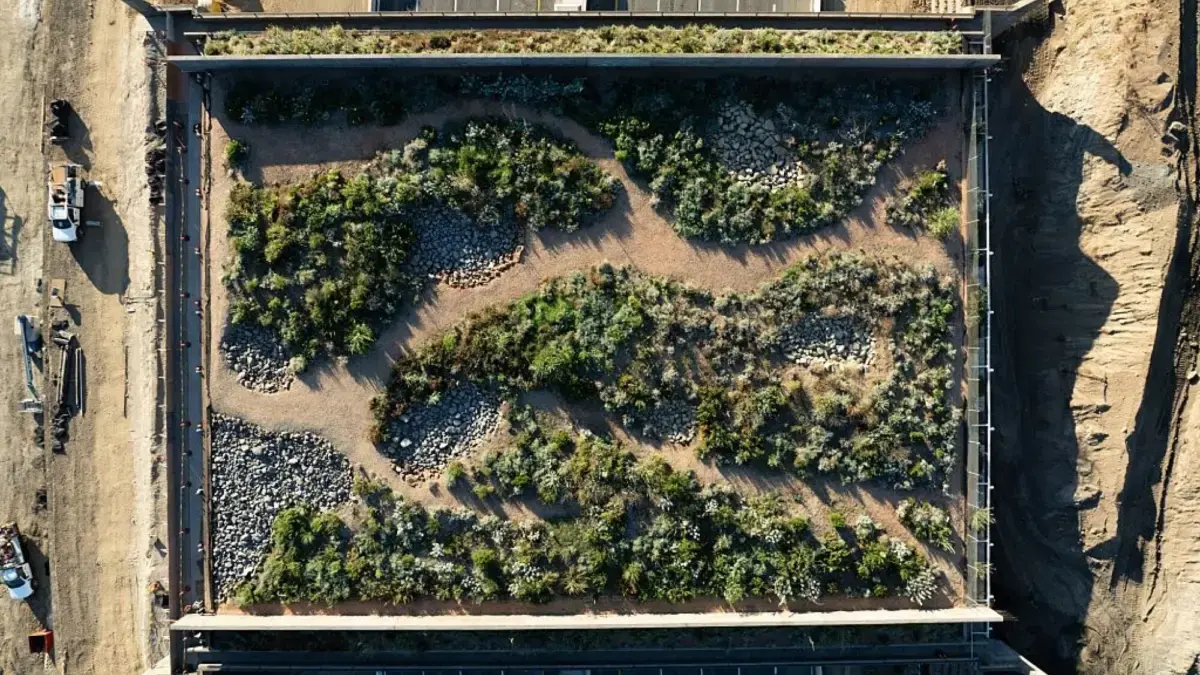
Soon, California drivers speeding down the 101 freeway won’t be the only ones commuting in comfort. As hundreds of thousands of vehicles rush down the multi-lane highway, their animal counterparts—the diverse wildlife population that inhabits Los Angeles County—will be similarly at ease.
That is because officials are putting the finishing touches on the Wallis Annenberg Wildlife Crossing, a massive, heavily vegetated overpass designed to help animals cross heavy traffic safely and comfortably navigate the natural lands split by rushing cars. Standing as a monumental achievement in modern conservation, the structure represents the world’s largest wildlife crossing.
What is the Wallis Annenberg Wildlife Crossing?
The newly engineered bridge connects the critical ecosystems of the Santa Monica Mountains to the Simi Hills, spanning an imposing 10 lanes of heavy traffic alongside an access road. The ambitious project has been a decade in the making, serving as a cornerstone of a nationwide scientific monitoring program spearheaded by collaborative partners including the National Wildlife Federation, the Mountains Recreation and Conservation Authority, and the National Park Service.
Financing for the ambitious undertaking was secured through a unique public-private partnership, bringing together government funding streams and generous philanthropic donations to turn a visionary concept into concrete and soil.
The crossing is anticipated to serve as a vital lifeline for local wildlife populations. For years, animals navigating the area have frequently met deadly fates from vehicles speeding along the state highway. Beyond the immediate danger of collisions, the freeway has created a severe barrier-like effect, resulting in geographic and genetic isolation for many species. Mountain lions, coyotes, bobcats, deer, and a wide array of bird, lizard, and snake species are expected to utilize the new pathway, allowing them to cross the busy freeway safely to find expanded territory for roaming, foraging, and mating.

How to view the Wallis Annenberg crossing trail cams
Over the past week, biologists have been actively installing a comprehensive series of wildlife cameras near the Wallis Annenberg Wildlife Crossing within the Santa Monica Mountains National Recreation Area. These devices are designed to rigorously track animal populations and movement patterns ahead of the crossing’s official public opening scheduled for December 2. By the time the ribbon is cut, scientists, conservationists, and nature watchers will be able to monitor the structure’s visitors via a network of 50 cameras and four specialized thermal video cameras.
Project leads recently shared with the Los Angeles Times that the curated photo stream from these cameras will eventually be made available to the public. For the time being, however, live video feeds are restricted to researchers and project administrators for security and monitoring reasons.
Even before its official opening, the cameras are already capturing hopeful moments that highlight the urgent need and immediate acceptance of the corridor. The path has already recorded its very first visitor: a single coyote trotting up the side of the currently unfinished earthen structure, shielded by the cover of night and the absence of blinding headlights.
The early sighting has sparked considerable excitement among scientists and conservationists working on the project, many of whom initially expected smaller, more agile animals to test out the crossing first.
Reflecting on the rapid adoption of the corridor, Beth Pratt of the Wildlife Crossing Fund shared her growing expectations with the Los Angeles Times.
"I wouldn’t have said this even a couple weeks ago, but I now think there’s a chance we’ll have a mountain lion use it before ribbon cutting," Pratt said. "Word gets out in the animal world, so who knows what’s going to happen?"