For decades, millions of Linux and Unix system administrators, developers, and everyday users have performed what can only be described as a classic terminal ritual: the three-step file swap. When faced with the common task of exchanging two files, the traditional approach required moving the first file to a temporary placeholder, relocating the second file into its permanent position, and finally moving the initial file from its temporary home to its final destination.
While this workaround has been a staple of shell scripting and system maintenance for generations, it has always carried an underlying sense of clumsiness. More critically, it introduced a fleeting moment of vulnerability during execution where one of the files temporarily ceased to exist entirely within the directory structure. For high-availability environments, mission-critical configurations, or automated deployment pipelines, this brief window of absence has long been a minor anxiety point for engineers striving for absolute reliability.
However, a modern enhancement integrated into the GNU Coreutils package is permanently retiring this cumbersome three-step dance. Beginning with version 9.5, the standard mv command features a dedicated option designed specifically to swap paths in a single, indivisible operation: mv --exchange. Developed to streamline file management and eliminate the risks associated with temporary naming workarounds, this feature brings a cleaner, safer, and more robust approach to native Linux file operations.
The Architectural Shift: Moving Beyond the Three-Step Dance
To understand the significance of the new flag, one must examine the traditional methodology. Consider a scenario familiar to any web administrator or software developer: managing server configurations, such as replacing an active nginx.conf file with a newly generated nginx.conf.new while preserving the older version as a quick fallback.
Under the classic approach utilizing the standard move command, the sequence of operations required multiple distinct commands executed in strict succession. The administrator would first move the active configuration to a temporary designation, such as nginx.conf.tmp. Next, the new configuration would be shifted into the primary location. Finally, the temporary file would be renamed to complete the rotation.

This multi-stage process introduced notable administrative friction and systemic risks. If a script interrupted execution or encountered an unexpected error between the first and second steps, the system could be left in an inconsistent state with missing dependencies or misconfigured services. Furthermore, monitoring tools or log analyzers scanning the filesystem in real time could witness erratic file states.
The introduction of the exchange option fundamentally alters this paradigm by consolidating the entire transaction into a single command line instruction. By executing mv --exchange nginx.conf nginx.conf.new, administrators can execute the swap cleanly and efficiently. Behind the curtain, this capability relies directly on the Linux kernel’s underlying system architecture, specifically leveraging the renameat2() system call equipped with the RENAME_EXCHANGE flag.
Because this transaction is handled at the kernel level, the swap is entirely atomic. At no point during the execution does either filename fail to exist, and external processes inspecting the directory will never encounter a half-completed transition. Both paths instantly trade places with mathematical precision, completely bypassing the need for intermediate temporary files.
Verifying System Compatibility and Availability
As with many modern utilities integrated into core system packages, availability depends heavily on the specific Linux distribution and software release cycle powering a given machine. To utilize the atomic exchange feature, users must ensure their system is running GNU Coreutils version 9.5 or higher.
Checking the installed version is straightforward through the standard command-line interface by requesting version details from the binary. On modern rolling-release distributions or recent stable enterprise releases, administrators will typically find versions matching or exceeding the requirement. Version numbering conventions in coreutils follow a strict multi-part logic rather than simple decimal scaling, meaning version designations like 9.11 represent a more recent release than 9.5.

Alternatively, administrators can quickly verify whether their specific build of the utility includes the functionality by querying the command’s built-in documentation flags and filtering for the parameter. If the output returns empty, the local distribution’s coreutils package predates the integration of the RENAME_EXCHANGE system call wrapper, necessitating an update or the continued use of traditional methods until system packages are upgraded. Distributions such as Fedora, NixOS, and upcoming stable enterprise releases incorporate the updated coreutils package natively, bringing the functionality to standard developer workstations and production servers alike.
Practical Application and Directory Management Nuances
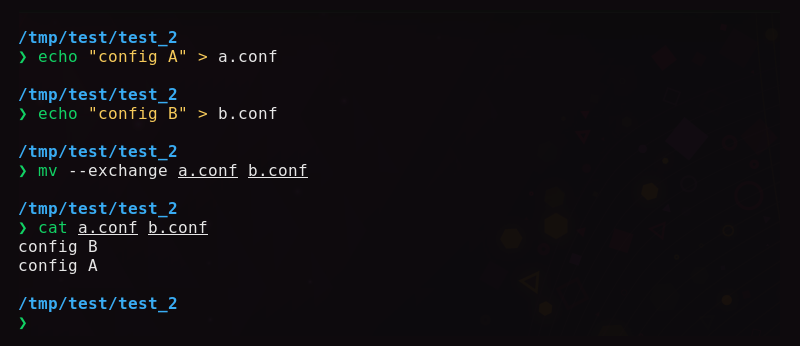
Putting the feature into practice demonstrates its immediate efficiency for routine file manipulation. Creating two distinct files and executing the exchange command instantly trades their underlying data streams without generating stray artifacts or cluttering directories with leftover temporary designations.
However, expanding this capability from individual files to entire directory trees introduces important syntactic considerations that caught early adopters by surprise. When attempting to swap two directories using the straightforward syntax, users may initially encounter unexpected errors generated by how the utility interprets trailing arguments.
In traditional file manipulation workflows, passing an existing directory as the final argument to a move command signals an intention to move the source object into that destination folder rather than replacing it. When mv --exchange is invoked on two directories without additional flags, the command interprets the second argument as a target container, attempting to locate or create a nested path that does not exist, resulting in a kernel-level error notification.
To successfully swap entire directory structures—regardless of how many nested files, subdirectories, or assets they contain—administrators must incorporate the -T or --no-target-directory flag. This additional parameter instructs the utility to treat the final argument strictly as a plain path name rather than a destination container. Once configured with this flag, the entire directory hierarchies trade places instantaneously. Because the operation only manipulates the directory entry pointers within the filesystem, the physical volume of data contained within the folders does not matter; a directory containing gigabytes of build artifacts swaps just as quickly as an empty folder containing a single text file.
Underlying Limitations and Filesystem Constraints
Despite its considerable utility, mv --exchange operates under strict architectural boundaries dictated by the Linux kernel and underlying storage subsystems. The most prominent constraint involves filesystem boundaries. The atomic swap can only occur when both participating paths reside on the exact same physical filesystem.
If a user attempts to exchange a file located on a standard persistent storage volume with a file positioned inside a memory-backed temporary filesystem mount, such as a tmpfs implementation, the kernel immediately rejects the transaction. Because the underlying system call cannot coordinate an atomic name swap across disparate filesystem drivers, the operation fails. While standard move commands seamlessly handle cross-filesystem transfers by copying data byte-by-byte and subsequently deleting the original source—a non-atomic process—the exchange feature refuses to compromise its atomicity, declining to perform background file copying operations.
Furthermore, the target storage medium itself must offer native support for the required system call. While common, modern Linux filesystems such as ext4, Btrfs, XFS, and tmpfs fully support the necessary metadata operations, older or specialized filesystems may lack the capability, restricting the utility of the exchange flag in legacy environments.
As modern Linux distributions continue to adopt newer coreutils releases, tools like mv --exchange represent a quiet but impactful evolution in system administration. By replacing error-prone manual workarounds with atomic, kernel-backed operations, developers and system engineers gain a cleaner and more reliable method for managing critical files and directory structures in production environments.