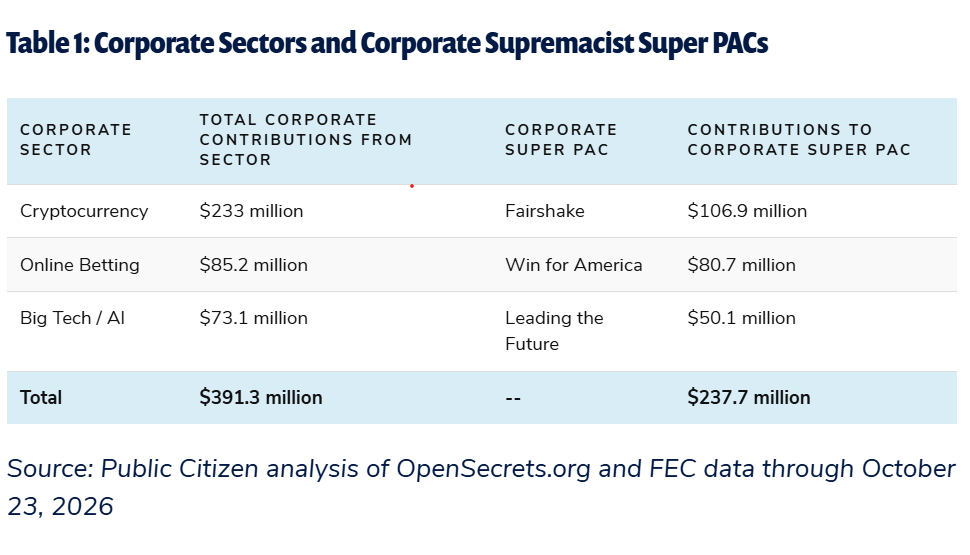
Cryptocurrency companies poured a staggering $233 million into political committees during the 2026 United States midterm election cycle, according to a comprehensive analysis of federal filings conducted by Public Citizen. Despite this unprecedented financial mobilization, the political landscape in Washington is shifting in ways that could fundamentally reshape the industry’s legislative agenda.
Democrats successfully won both chambers of Congress and are poised to take full legislative control in January. This historic shift opens a fresh window of opportunity—and significant peril—for the stalled CLARITY Act, a high-profile piece of legislation designed to establish comprehensive federal rules and market structures for digital assets.
The midterm results highlighted both the immense financial reach of the crypto lobby and the steep political resistance it continues to face. In Ohio, long-time crypto skeptic and prominent Democratic lawmaker Sherrod Brown successfully defeated Republican challenger Jon Husted. This victory came despite crypto-backed political action committees deploying a massive $64 million war chest explicitly aimed at unseating Brown.
Compounding the industry’s legislative challenges, Senator Elizabeth Warren—one of the most vocal and persistent critics of cryptocurrency in Washington and the most senior Democrat on the Senate Banking Committee—is widely expected to chair the powerful panel during the upcoming congressional session. With Warren at the helm, the next round of negotiations is virtually guaranteed to center on stronger consumer protections, heightened scrutiny of potential political conflicts of interest, and a deliberate shift in regulatory enforcement power.
Yet, a Democratic majority does not necessarily mean the complete death of market structure legislation. Several lawmakers and industry insiders believe a compromise remains achievable, provided the digital asset sector is willing to accept significantly stricter conditions.
A Different Deal for Crypto
The path forward for digital asset regulation remains fraught with political hurdles. Back in September, the Senate officially failed to advance the CLARITY Act, largely due to deep-seated partisan disagreements over ethics provisions and the scope of regulatory oversight.
In the wake of the midterms, Democrats are already reportedly discussing how to reshape the market structure debate from the ground up. House Democrats are reportedly considering expanding proposals originally introduced by Representative Maxine Waters into a much broader, comprehensive market structure bill. Such legislative packaging could incorporate rigorous consumer protections, an expanded operational mandate for the Securities and Exchange Commission, and strict new ethics restrictions targeting the personal crypto activities of public officials.
For the digital asset industry, this renewed legislative approach could finally mean separating its legitimate commercial push for clearer rules from the swirling controversies surrounding personal cryptocurrency ventures, such as those tied to Donald Trump. Democrats have already signaled aggressive plans to investigate the business dealings of the Trump family and other prominent corporate interests once they assume control of committees. Incoming House Oversight Committee Chair Robert Garcia is expected to lead inquiries into corporate corruption and conflicts of interest.
Industry observers argue that distancing the market structure debate from political controversies is a vital necessity. Hadley Stern, head of institutions at Silence Laboratories and founder of Fidelity Digital Assets, argues that Democrats are entirely justified in pursuing these investigations, noting that political entanglements are precisely what poisoned previous bipartisan legislative deals.
"A sitting president’s family launching memecoins and a stablecoin is a real governance problem," Stern said, adding that such actions would not be tolerated in traditional financial institutions. He emphasized that the digital asset industry of 2026 has evolved profoundly since Democrats last held the legislative gavel, expanding far beyond the speculative token boom and subsequent collapse of FTX in 2022. Today, the ecosystem encompasses federal frameworks for stablecoins, tokenized equities, and on-chain Treasury instruments. "You don’t regulate that by pretending it doesn’t exist," Stern noted.
What Would the Industry Have to Concede?
To secure legislation capable of surviving future shifts in political control, the crypto industry will likely have to accept much higher compliance and operational standards.
Paul Brody, founder and CEO of Nightfall Networks and former global blockchain lead at EY, anticipates that traditional banking institutions will ultimately emerge as political winners in the legislative process. He expects commercial banks to aggressively lobby to hold crypto companies to the exact same exacting consumer protection and cybersecurity standards that govern traditional financial firms.
While the digital asset sector has historically resisted such rigid mandates, Brody suggests that a wise strategic move would be to accept these conditions, particularly given that blockchain-native ecosystems remain inherently more flexible, programmable, and efficient than legacy financial rails.
Similarly, Lindsay Fraser, chief policy officer at the Blockchain Association, argues that consumer protection and technological innovation should never be treated as mutually exclusive objectives. "We can protect consumers while ensuring the law reflects how the technology actually works," Fraser said. She emphasized that the ultimate goal must be the creation of lasting policy that earns broad public trust, provides builders with a secure future within the United States, and reinforces American financial leadership globally.
Despite these constructive aspirations, achieving a legislative compromise will not be straightforward. Brody cautions that lawmakers will face numerous competing priorities, noting that cryptocurrency regulation will likely rank as a relatively low priority compared to high-stakes congressional investigations into corruption, intense federal budget battles, and foreign policy crises. Furthermore, the persistent threat of a presidential veto looms over any legislation that manages to navigate both chambers of Congress.
How the Binance Hack Could Influence Lawmakers
The policy debates unfolding in Washington are further complicated by external market shocks, most notably the fallout from the catastrophic Binance hack. Occurring on October 29, the incident resulted in the theft of over $6.3 billion, making it the largest security breach in the history of cryptocurrency. The hack injected fresh urgency and profound skepticism into ongoing discussions regarding exchange security, centralized custody models, and consumer safeguards.
While some lawmakers view the disaster as a glaring demonstration of why federal oversight is urgently needed, others argue the current legislative drafts fall woefully short. Representative Shri Thanedar acknowledged that while pending legislation might not solve every conceivable industry problem, it would nevertheless provide much-needed regulatory certainty and vital security guardrails. He framed the hack as a clear and sobering example of the dangers inherent in failing to enact appropriate federal laws.
Conversely, industry legal experts argue that the incident underscores profound gaps in existing legislative proposals. Maylea Ma, deputy general counsel at 1inch, asserted that rather than strengthening the case for the current draft of the CLARITY Act, the security breach highlights systemic vulnerabilities that the bill completely fails to address.
Ma pointed out that the hack centered on a centralized exchange’s hot wallet and a catastrophic signing failure. Because the current legislative draft includes no mandatory insurance requirements, loss payee provisions, or hot wallet balance caps, it would have done little to mitigate Binance’s losses or prevent the breach through mandatory security standards.
Prominent consumer advocates have echoed these concerns. Amanda Fischer, policy director at advocacy group Better Markets, publicly stated that the episode starkly demonstrates how fundamentally unsuited the current crypto ecosystem is for mainstream finance, arguing that centralized crypto exchanges should be barred from acting as direct custodians due to the systemic honeypot risk they create.
As lawmakers return to Capitol Hill to hash out the details of market structure legislation, market participants agree that the massive Binance breach will heavily influence legislative sentiment. Lawmakers are expected to demand significantly tougher consumer protections before lending their support to any bill championed by the crypto sector. Having spent years successfully convincing Washington that it deserves a seat at the regulatory table, the cryptocurrency industry must now determine whether it is willing to accept the heavy compliance obligations that come with it.