In the complex ecosystem of modern data centers and enterprise networks, Ethernet Virtual Private Network (EVPN) fabrics have become a foundational architecture. Administrators working with these environments are well-acquainted with MAC/IP routes and routine MAC mobility events, which are generally considered ordinary occurrences. A busy virtual machine shifting across hypervisors during routine live migration frequently triggers these events, maintaining active sessions seamlessly via Border Gateway Protocol updates. However, new security insights from industry experts suggest that treating every MAC move as an entirely benign operational event introduces significant security blind spots.
When a running virtual machine undergoes live migration, it retains its original MAC address while transitioning to a new hypervisor. Upon arrival, it transmits a gratuitous Address Resolution Protocol message, enabling the local leaf switch to learn the address and propagate the update across the fabric. A legitimate workload might migrate hundreds of times, accumulating a completely valid counter of moves.
The security concern arises because network fabrics cannot inherently assume that every observed MAC movement reflects a legitimate virtual machine migration. In certain scenarios, a MAC address belongs to a stationary server that has never moved, yet its sequence number continues to climb because another host within the same broadcast domain is actively transmitting frames bearing that exact address.
To comprehend how this vulnerability manifests, network architects must examine the fundamental evolution of MAC learning. Before the widespread adoption of EVPN, MAC learning occurred strictly within the dataplane. Switches and provider edge devices learned addresses by observing source fields in incoming frames, installing them into forwarding tables, and letting them age out following periods of inactivity.
With EVPN, this learning process shifts into the control plane. While a provider edge device still learns local MAC addresses from the dataplane, it subsequently advertises those addresses to every other peer using BGP. Remote nodes then learn these addresses from the control plane advertisements rather than traditional data plane flooding.
This transition transforms a MAC move into an explicit, trackable event. When a provider edge switch learns a MAC address locally that it previously categorized as remote, it re-advertises that address while incrementing the MAC mobility sequence number by one. In legacy environments, a poisoned MAC injection would eventually age out of the forwarding tables. Under EVPN, however, a forged frame becomes embedded within a BGP advertisement carrying an elevated sequence number. Every peer trusts and installs this information, maintaining it until the legitimate host eventually advertises itself once more.

This exploitation relies on an enduring architectural weakness in the Ethernet standard itself: the protocol does not verify the ownership of a source MAC address. Any connected host can place a neighbor’s MAC address into the source field of its frames, and the local leaf switch cannot distinguish it from the legitimate owner. Executing this behavior demands neither privileged network access nor complex packet manipulation techniques.
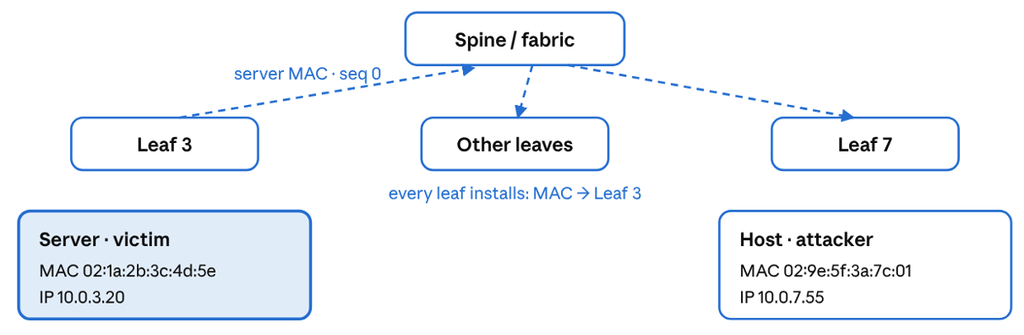
Because Ethernet forwarding relies entirely on destination addresses rather than source identifiers, an attacker only needs to place the victim’s MAC address in the source field. Once EVPN distributes this fabricated data, every leaf switch installs a forwarding entry pointing toward the attacker. The primary objective is not necessarily to intercept outgoing traffic originating from the victim, but rather to maliciously attract and hijack incoming traffic destined for it.
Workloads that communicate infrequently can leave this operational attack window open for extended periods. A storage target that remains idle for long stretches of time, for instance, represents a more attractive target than a heavily active virtual machine. While this tactic does not immediately grant direct access to the core fabric, it significantly increases an adversary’s visibility across the broader bridge domain. The overall impact depends heavily on the architecture residing behind the access port. Hypervisors hosting multiple virtual machines tend to be more exposed to these hijacking attempts, whereas container platforms often introduce supplementary switching layers that complicate exploitation.
PE Behaviour, Sequence Numbers and MAC Mobility Explained
The mechanics governing these interactions are defined in RFC 7432, which outlines the MAC Mobility Extended Community associated with MAC/IP Advertisement Type-2 routes. This extended community functions as a transitive BGP attribute carried within the same update message as the Type-2 route. Every provider edge device that imports the route target of the EVPN instance propagates the update, ensuring the mobility attribute accompanies the route across route reflectors.
When a provider edge device learns a MAC address locally, it evaluates existing local entries. If the address is newly discovered, it advertises the route with a mobility sequence number of zero. If the address was previously learned from a remote peer, the device compares sequence numbers. If the newly learned local route carries a higher sequence number than the existing entry, the device updates its local forwarding table and advertises the change with an incremented sequence number.
Industry standards also incorporate duplicate detection mechanisms to mitigate risks. Section 15.1 of RFC 7432 outlines that if a provider edge device observes a MAC address moving an excessive number of times within a defined timeframe—such as five moves within 180 seconds—it must alert the operator and temporarily suspend processing MAC/IP advertisement routes for that specific address. However, implementation details vary significantly among hardware vendors. Certain network operating systems suppress the affected MAC address until an administrator manually clears the state, while others flush the address and enforce a mandatory recovery period before retrying.

These operational nuances demonstrate that the threat relies primarily on two factors: the foundational lack of native MAC-origin authentication and reliance on conservative, easily bypassed rate-limiting safeguards. Together, these elements create persistent avenues for network abuse.
How Attackers Exploit EVPN Fabrics
An adversary seeking to exploit this behavior begins by transmitting frames across the access port of a compromised or controlled leaf switch, populating the source MAC field with the identifier of a target server elsewhere in the fabric. The local leaf switch treats this as a legitimate local learning event and advertises a new Type-2 route featuring an incremented MAC mobility sequence number.
Because EVPN control planes prioritize routes carrying the highest sequence number, all other leaf switches across the fabric update their respective forwarding tables. Consequently, traffic destined for the victim server is redirected toward the leaf switch where the attacker resides.
Duplicate-MAC protection mechanisms often fail to disrupt this activity because they are designed around strict thresholds. An attacker who carefully paces transmissions to remain below the configured frequency limit can easily avoid triggering automated alerts. Furthermore, because counters are typically maintained independently per provider edge device, activity distributed across multiple leaf switches becomes even harder to detect. Once the monitoring window expires, these counters automatically reset, allowing malicious traffic redirection to resume without friction.
When duplicate-MAC protections do trigger, they generally report a generic duplication event rather than a targeted attack. The resulting system alerts may surface on an entirely different segment of the network fabric from where the fraudulent activity originated. While route reflectors maintain a comprehensive view of all Type-2 routes and provide the clearest visibility into these anomalies, operators rarely investigate route reflectors first during routine incident response.
Detecting Anomalies in Production Environments
To effectively identify these vulnerabilities in production networks, operators can leverage the BGP Monitoring Protocol as defined in RFC 7854 to export routing updates to an external collector. By continuously tracking EVIs and MAC addresses alongside their originating peer, Ethernet Segment Identifier, sequence numbers, sticky flags, and timestamps, network teams can establish baseline behaviors and spot unauthorized modifications.
This telemetry should be cross-referenced against data from the access layer. DHCP snooping bindings, IEEE 802.1X session tables, and IPAM or port-inventory exports help verify where a given MAC address is legitimately authorized to reside. Any Type-2 route that directly conflicts with these authoritative access-layer records warrants immediate investigation. Additionally, forwarding duplicate-MAC and MAC-move syslog messages into a centralized Security Information and Event Management platform allows teams to tune alerts effectively, ensuring critical security events are not drowned out by operational noise.
Ultimately, these challenges bring core architectural assumptions into question. EVPN is engineered to inherently trust information learned from every leaf switch within the fabric. Access-port learnings are accepted as genuine, and control-plane advertisements from peers are treated as authoritative without secondary verification.
While enterprise operators naturally wish to avoid heavy packet processing overhead that could interfere with line-rate forwarding, robust mitigation tools are available. Trust can be reinforced at the access edge by enforcing strict port MAC limits, DHCP snooping, dynamic ARP inspection, IEEE 802.1X authentication, and static sticky MAC entries for mission-critical infrastructure. Without rigorous validation at the network edge, the control plane will continue to faithfully propagate incorrect information at scale, making access-layer security an absolute prerequisite for protecting the wider EVPN fabric.