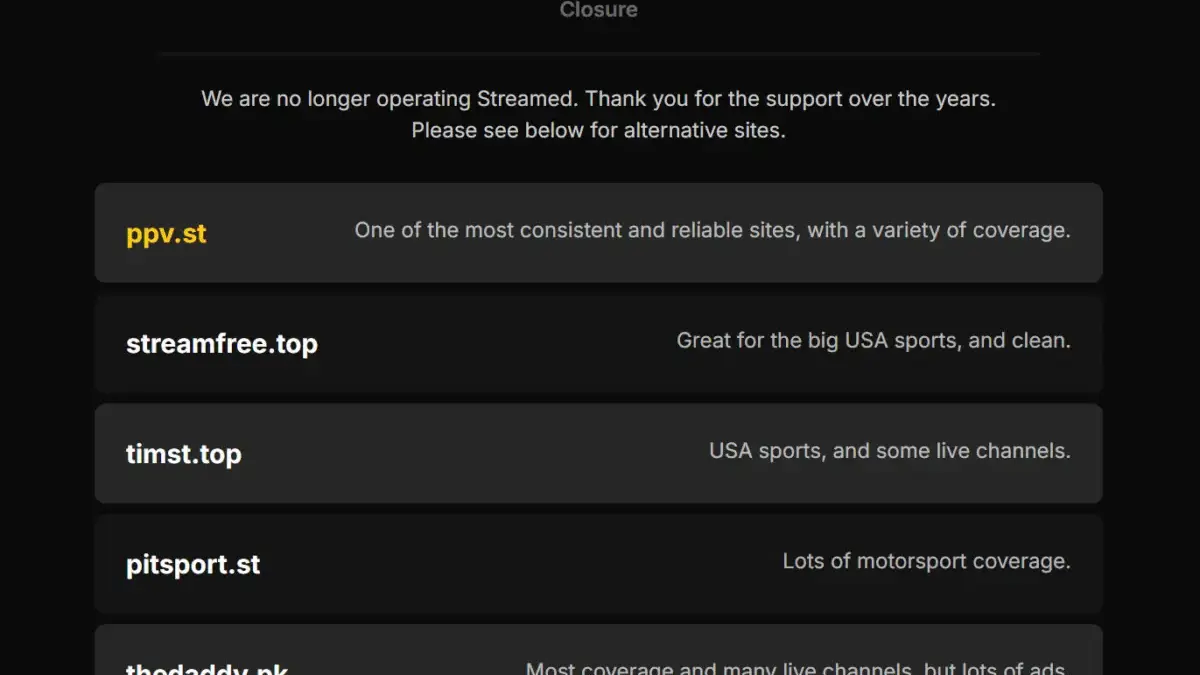
The sprawling live sports piracy ecosystem has suffered a major blow following the sudden and unexpected closure of Streamed, a foundational infrastructure provider that supplied video feeds to dozens of downstream pirate websites. Operators of the service posted a brief and unceremonious farewell message on the platform’s domains, bringing an abrupt end to a network that had grown into a massive distributor of unauthorized sports content across the globe.
Streamed operated on a model that has increasingly become the backbone of modern web-based piracy: "Piracy-as-a-Service" (PaaS). Rather than acting strictly as a consumer-facing destination site with its own standalone brand, Streamed provided ready-made video players and underlying technical infrastructure that other pirate websites could easily embed. This technical arrangement allowed numerous new or smaller pirate platforms to launch live sports coverage effortlessly, bypassing the need to host, manage, or fund their own expensive streaming servers and bandwidth capacity.
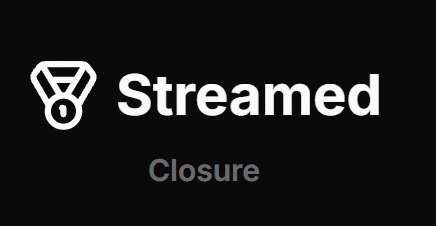
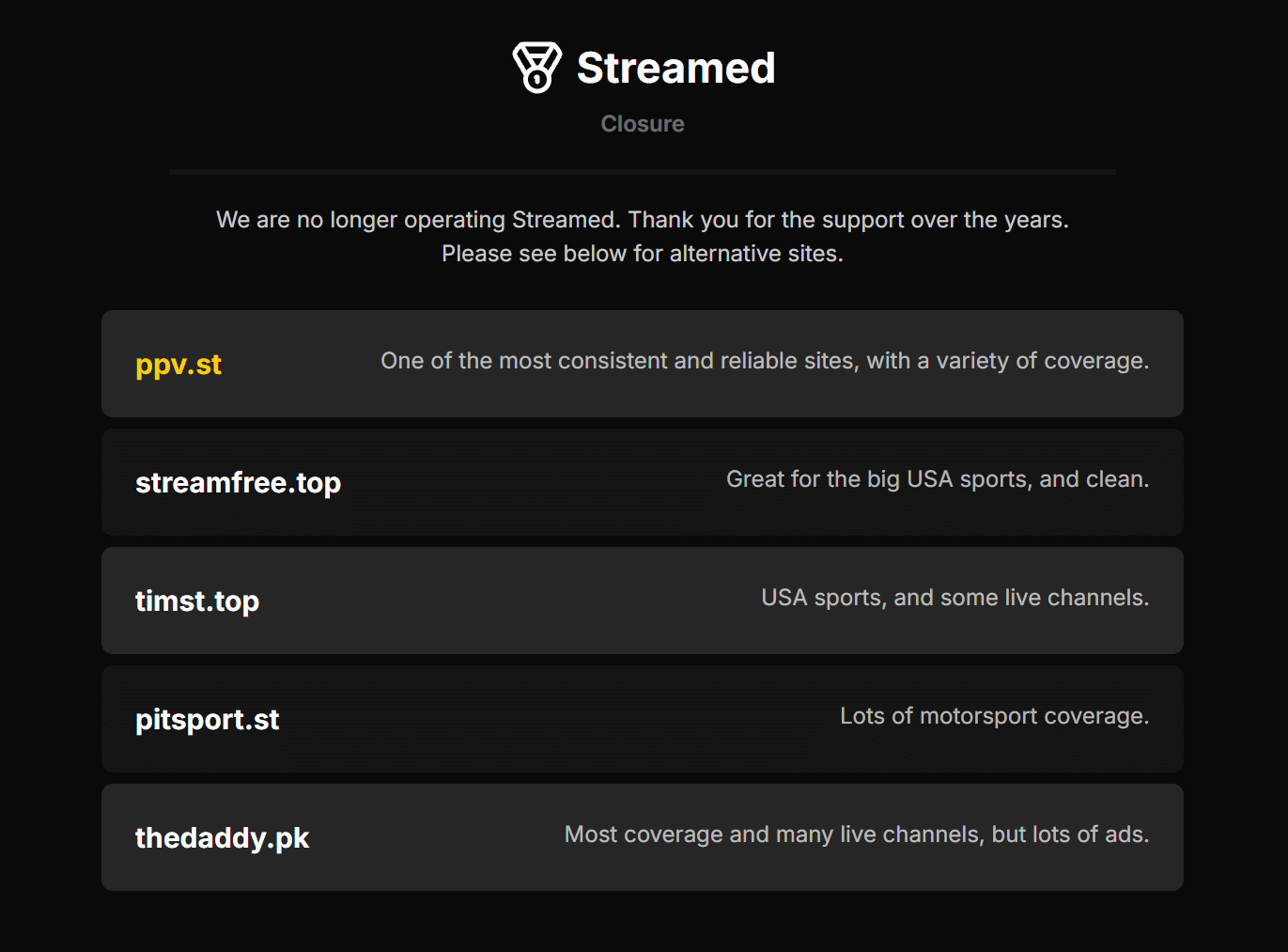
For years, Streamed served as the hidden engine room for a wide array of sports streaming portals. However, visitors attempting to access the platform’s primary domains are now greeted with a stark reality. A simple notice posted across the network reads, "We are no longer operating Streamed. Thank you for the support over the years." The operators did not provide any further explanation for their decision to pull the plug, leaving the wider piracy community and rights holders alike to speculate on the catalysts behind the sudden shutdown.

The closure was not confined to a single web address. The notice appeared simultaneously across multiple domains associated with the operation, including streamed.pk, strmd.link, and streamed.st, confirming a total and coordinated withdrawal from the web.
Pointing to Rivals in a Unexpected Farewell
In an unusual twist for a major piracy shutdown, the operators did not simply take the infrastructure dark and disappear. Instead, the closure notice included a section offering advice to former users and downstream site operators, explicitly listing five alternative sports streaming platforms. The farewell message provided brief descriptions for each alternative, ranging from general sports hubs to specific niches, and even included a candid warning about one recommended destination having "lots of ads," such as the site thedaddy.pk, alongside mentions of alternatives like ppv.st and pitsport.st.
This unprecedented redirection of traffic highlights the interconnected and symbiotic nature of the illicit streaming ecosystem. While Streamed itself has exited the market, its operators appear to have cleared a path for their user base to migrate toward competing services.
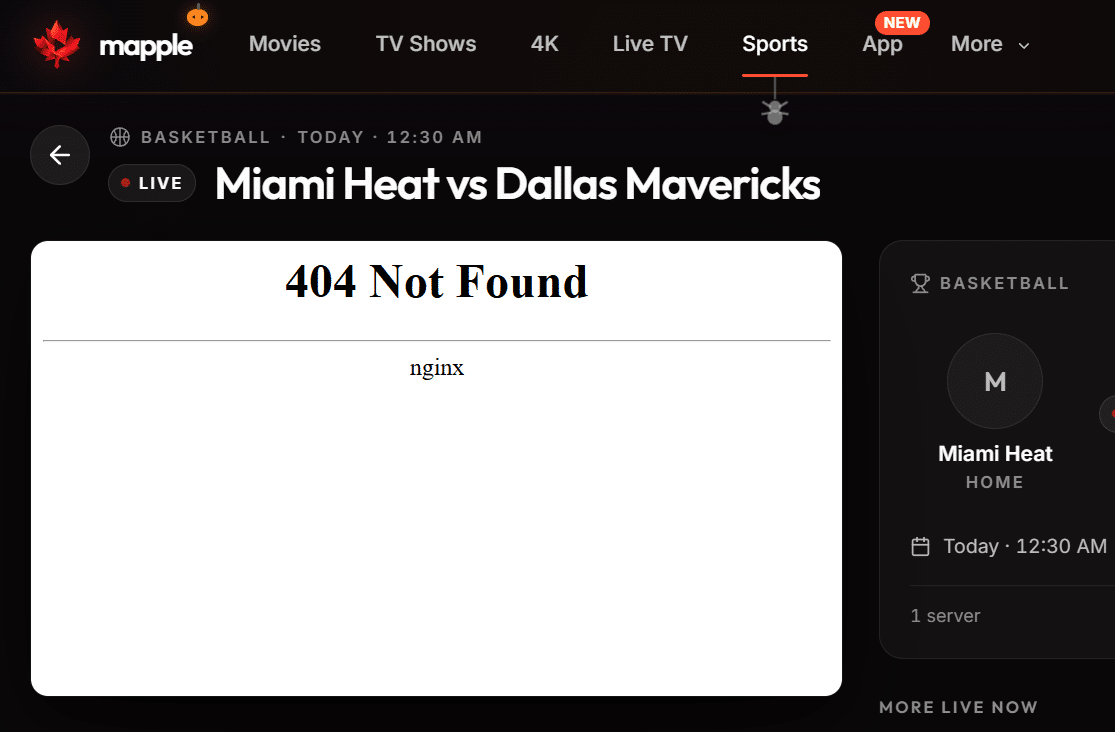
The immediate ripple effects of the closure were felt almost instantaneously across the web. Because Streamed acted as the underlying technical engine for dozens of portal sites—frequently referred to by anti-piracy investigators as "hydra sites" or one-stop piracy aggregators—its disappearance instantly broke the live feeds of numerous dependent platforms. For instance, Mapple, a prominent streaming portal that relied heavily on Streamed’s infrastructure, began returning 404 errors on many of its sports streams shortly after the announcement.
A Growing Threat on the Industry’s Radar
The timing of the shutdown is particularly notable given the escalating international scrutiny Streamed was facing from major entertainment and sports rights holders. Earlier this month, the Motion Picture Association (MPA) highlighted Streamed as an increasingly severe and rapidly expanding threat in its annual overview of notorious piracy markets submitted to the Office of the U.S. Trade Representative.
In its official filing, the MPA explicitly characterized Streamed as a dominant "Piracy-as-a-Service" provider. Citing traffic analytics from Similarweb, the industry group detailed the staggering scale of the network’s operations. According to the MPA’s data, approximately 30 distinct pirate sites were utilizing Streamed’s embedded video players in July, pulling in a combined total of 463 million visits. This represented a substantial escalation compared to data from the previous year, which had recorded 29 relying sites drawing 134 million visits.
The MPA’s submission underscored how these hydra sites—including platforms like HydraHD, Rivestream, StreamEX, Mapple, and the previously shuttered Cineby—relied entirely on Streamed’s proprietary infrastructure to deliver live content without hosting any streams themselves. All traffic and heavy lifting flowed directly through Streamed’s servers.
Aside from its business-to-business infrastructure role, the consumer-facing domain streamed.pk also enjoyed massive direct traffic. Similarweb figures indicated that the domain alone attracted 19.76 million visits in September, marking a 56 percent surge compared to the preceding month. The vast majority of this direct audience originated in the United States, followed closely by users in Canada and the United Kingdom.
Questions Remain Over the Cause of the Shutdown
Despite the intense pressure from anti-piracy organizations and the glowing spotlight cast upon it by the MPA, Streamed’s farewell message contains no explicit mention of legal enforcement, copyright infringement notices, or police raids. Visitors will find no official seizure banner of the kind typically deployed by law enforcement agencies or anti-piracy coalitions such as the Alliance for Creativity and Entertainment (ACE). Furthermore, neither the MPA nor ACE has publicly claimed responsibility for the shutdown as of publication.
Nevertheless, industry observers note that the absence of a seizure banner does not automatically rule out external pressure or legal coercion. In its recent submission to trade officials, the MPA notably took credit for the sudden disappearances of other high-profile piracy giants, such as Cineby and AnimeFLV. In those cases, the targeted sites also went dark without displaying traditional anti-piracy warning notices, and no enforcement agency immediately claimed credit, pointing to a pattern where operators may choose to bow out quietly under pressure rather than face protracted legal battles.
At the same time, the fact that Streamed’s closure page openly promotes competing pirate platforms complicates the theory that the shutdown was the result of a formal legal settlement, a court-ordered injunction, or a cooperative agreement with rights holders. As the digital piracy landscape continues to evolve, the sudden exit of such a massive infrastructure provider demonstrates the fragile nature of web-based streaming networks, even those operating at a massive global scale.
Representatives for the Motion Picture Association and the Alliance for Creativity and Entertainment were reached for comment regarding the circumstances of the shutdown, but had not responded by the time of publication.