
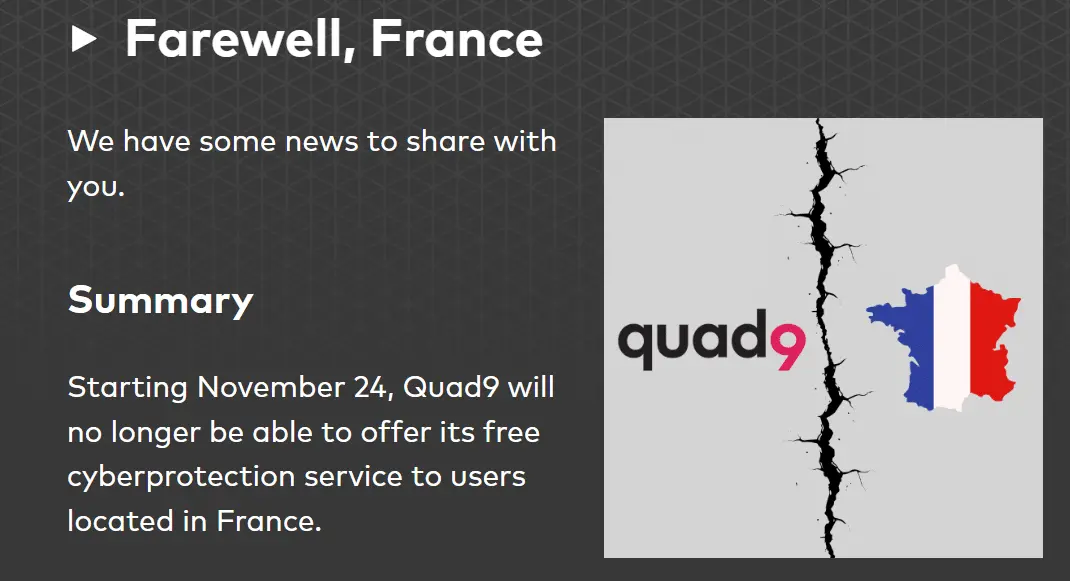
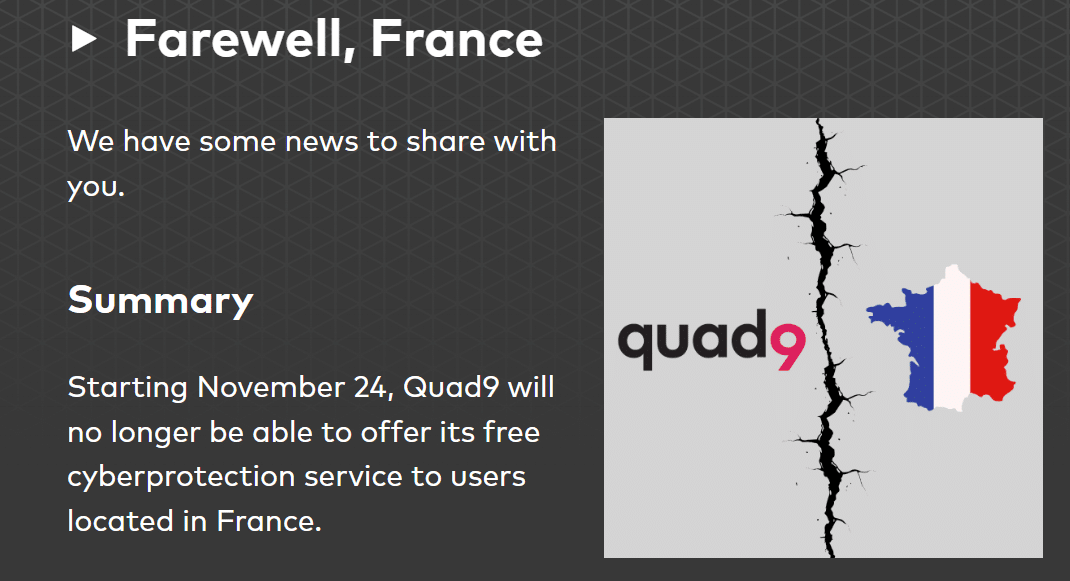
Public DNS resolver Quad9 has announced it will pull its services out of France following a contentious legal battle with sports broadcaster beIN Sports over website blocking orders. The Swiss-based non-profit foundation will officially stop serving users in the country on November 24, making it the second major DNS provider to abandon the French market due to escalating anti-piracy enforcement measures.
The decision comes in the wake of a ruling handed down by the Paris Judicial Court, which penalized the organization for refusing to block unauthorized streams of tennis matches. While beIN Sports had initially petitioned the court for financial penalties reaching up to €580,000 per day for non-compliance, the court ultimately established a more modest daily fine of €1,000. Although significantly lower than what the broadcaster requested, Quad9 calculates that the cumulative penalties tied to the specific compliance period, alongside the weight of approximately 20 other pending cases in French courts, present an existential threat that the organization cannot bear.
Earlier this month, representatives for the Swiss foundation informed legal analysts and media outlets that it was actively weighing its future in France, explicitly highlighting the possibility of a complete market withdrawal. The immediate catalyst for the departure centered on an ongoing dispute regarding 58 domain names associated with pirate sports streams. Quad9 steadfastly chose not to implement the requested blocks, triggering the legal penalties and forcing the organization to reevaluate its operational footprint in the country.

€1,000 a Day and the "Reasonable Effort" Standard
In its formal ruling, the Paris court ordered Quad9 to implement a May blocking directive that encompasses 58 distinct domain names. The court determined that failure to comply would result in a penalty of €1,000 per day. While this figure stands as a fraction of the €10,000 per domain requested by beIN Sports—which would have totaled hundreds of thousands of euros daily—it nonetheless imposes a concrete financial liability. Quad9 calculates that the penalty period running until the blocking measures officially conclude on November 14 amounts to €24,000, excluding the organization’s own mounting legal expenses.
The court’s decision hinged largely on Quad9’s explicit admissions during the proceedings. Judges pointed out that the organization was legally required to make reasonable efforts to block the designated domain names, yet deliberately chose to take no action at all. This stance contrasted sharply with recent rulings involving other internet infrastructure providers. Earlier in the month, the same Paris court rejected penalty requests brought by beIN Sports against Cloudflare and several virtual private network (VPN) providers. In those instances, the court concluded that the companies had made reasonable efforts because they had successfully blocked at least some of the contested domains. A similar ruling protected Cloudflare from Canal+ penalty requests in September.
Quad9, however, openly admitted in court submissions that it had not blocked a single domain on the list. The foundation maintains that its operational philosophy and technical architecture are fundamentally incompatible with targeted domain name filtering of this nature, leaving it uniquely exposed under French jurisprudence.

A Matter of Principle and Technical Limitations
For the Swiss non-profit, the conflict in France transcends financial calculations. Quad9 operates on the principle that recursive DNS resolution must remain a neutral utility rather than a tool for content policing or censorship. The foundation views its core mission as providing fast, secure, and unmodified domain name resolution to internet users globally.
In official statements, the organization emphasized its absolute refusal to alter or misrepresent DNS responses in ways that conflict with user expectations. Furthermore, Quad9 highlighted technical hurdles that complicate compliance. Because its public service is free and does not require user registration or account creation, the foundation asserts that it lacks a reliable method to isolate and target users located exclusively within France.
While applying a blanket block across its entire global infrastructure would technically satisfy the French court order, Quad9 refuses to enforce local judicial mandates on internet users worldwide. The foundation also questions the practical efficacy of such measures, pointing out that determined individuals can easily bypass DNS-level blocks by switching to any of the thousands of other open resolvers available on the internet. Comparing the directive to an exercise in futility, the organization argued that attempting to stop piracy through isolated DNS blocking is akin to holding a piece of newspaper in front of a stadium full of people to block their view of a concert.
Piling Pressure From Pending Cases
The decision to withdraw from France was ultimately accelerated by the broader legal landscape. Beyond the immediate dispute with beIN Sports, Quad9 faces approximately 20 parallel blocking cases working their way through the French legal system. The foundation anticipates that these pending matters would inevitably culminate in similar demands, mounting legal costs, and devastating financial penalties.
According to leadership, the organization simply cannot absorb the cumulative financial burden of penalties across dozens of active proceedings, nor can it sustain the ongoing expenditure required to fight similar future claims. This retreat marks a growing trend among public resolvers facing aggressive enforcement in the region. In 2024, OpenDNS similarly suspended its services in France following a Canal+ piracy blocking order, illustrating the severe friction between strict national intellectual property enforcement and the operational models of global internet infrastructure providers.
Beyond practical and financial considerations, Quad9 expressed deep concern over the broader philosophical implications of court-mandated censorship. The foundation warned that mechanisms established under the banner of combating copyright infringement risk expanding into broader forms of digital control, noting that once tools of censorship are built, they are rarely used sparingly or justly.

Despite its impending exit, Quad9 confirmed that an appeal remains pending and that it intends to continue contesting the legality of court-ordered DNS blocking in higher jurisdictions. In the meantime, French users relying on the service have until November 24 to transition to alternative DNS resolvers before the infrastructure is officially deactivated in the region. A copy of the Paris Judicial Court’s ruling, designated under case reference RG 26/11882, has been made publicly available by legal monitors for review.

Leave a Reply