
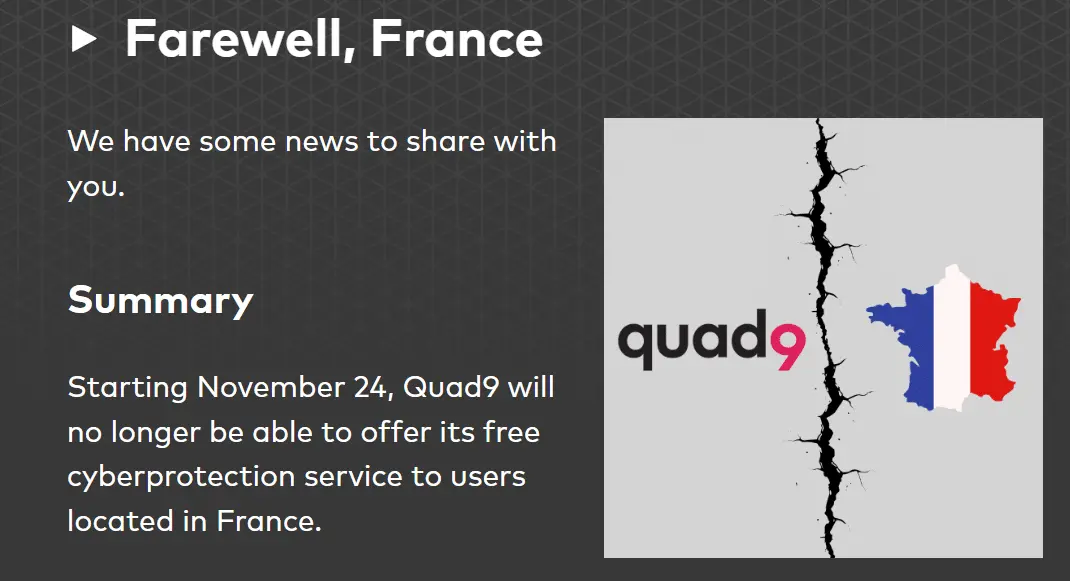
Swiss non-profit DNS resolver Quad9 has announced it is pulling out of France entirely after a Paris court ordered financial penalties against the organization for refusing to comply with website-blocking mandates targeting pirate tennis streams. The decision makes Quad9 the second major public DNS service to abandon the French market in recent years over escalating legal pressure regarding copyright enforcement.
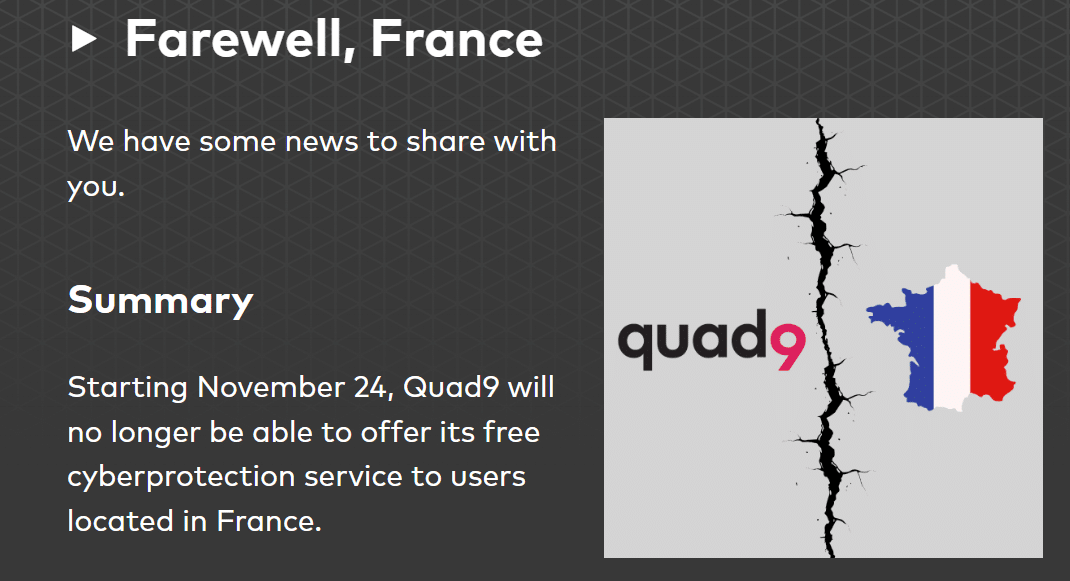
Starting November 24, Quad9 will formally cease serving users in France. The drastic measure comes in the wake of a legal battle initiated by sports broadcaster beIN Sports, which demanded massive daily fines against the foundation for failing to restrict access to a growing list of unauthorized streaming domains. Faced with this ruling and roughly 20 other pending intellectual property cases across French courts, Quad9 leadership concluded that continuing operations in the country is no longer tenable.
The confrontation began earlier this month when the Swiss foundation informed legal analysts and media outlets that its future in France was hanging in the balance. beIN Sports had petitioned the Paris Judicial Court to impose daily penalties of up to €580,000 against Quad9, arguing that the resolver should face severe financial repercussions for refusing to implement blocking measures for pirate sports broadcasts.

When the Paris court delivered its verdict, it ruled against the foundation. Rather than granting beIN Sports’ extreme financial demands, the court ordered Quad9 to implement a May blocking order—which has since expanded to encompass 58 distinct domain names—or face a daily penalty of €1,000.
While significantly lower than the broadcaster’s request of €10,000 per day for every individual accessible domain, the court-mandated fine still accumulated financial liabilities. beIN had originally sought penalties running through November 14. According to Quad9’s internal calculations, the assessed fine totals approximately €24,000, excluding the foundation’s independent legal expenses.
In its official judgment, the court emphasized Quad9’s own admissions regarding its complete lack of action. The judicial authority noted that while service providers are expected to make reasonable efforts to block listed domain names, Quad9 deliberately chose to take no action whatsoever, openly detailing its rationale to the court.

This outcome stands in stark contrast to earlier rulings handed down by Paris courts involving other digital infrastructure providers. Earlier this month, the same court rejected beIN Sports’ penalty requests against Cloudflare and several virtual private network providers. In those instances, the court ruled that because those companies had taken steps to block at least a portion of the targeted domains, they had demonstrated a reasonable effort to comply. Canal+ experienced a similar defeat in September when a Paris court refused its penalty requests against Cloudflare for similar reasons. Quad9, by contrast, explicitly confirmed in court submissions that it had not blocked a single domain on the list.
A Matter of Neutrality and Principle
For Quad9, the dispute transcends financial calculations. The Swiss foundation views recursive DNS resolution as a fundamentally neutral utility that should remain untampered with by third-party mandates.
In a public statement regarding the controversy, Quad9 articulated its philosophical stance, explaining that it categorically refuses to alter or misrepresent domain name system responses in a manner that contradicts user expectations. Furthermore, the organization noted technical limitations inherent in its architecture. Because its free public service operates without user registration or account sign-ups, the foundation maintains that there is no reliable, privacy-respecting mechanism to isolate and identify users based specifically in France.
While complying with the court order through a global block would have satisfied the legal requirements in France, Quad9 firmly rejected the prospect of applying a localized French court order to internet users worldwide. Discussing the technical futility of localized filtering under these conditions, the foundation compared the effort to holding a single piece of newspaper in front of a stadium crowd to obstruct the view of a concert. Moreover, the organization noted that blocking domains on its resolvers accomplishes little in practice, as users seeking unauthorized content can readily switch to any of the thousands of other open DNS providers operating globally.
Accumulating Legal Pressure and Broader Industry Fallout
The decision to withdraw from France is not isolated to the immediate dispute with beIN Sports. Quad9 faces approximately 20 similar blocking cases currently pending in French courts, with management anticipating that the majority would result in mounting pressure and catastrophic cumulative fines.
The foundation stated that it cannot financially or operationally survive the accumulation of penalties stemming from these active proceedings, nor can it absorb the expected liabilities from future lawsuits of a similar nature.

Quad9 is not the sole public resolver to retreat from the French jurisdiction under such pressures. In 2024, OpenDNS suspended its services in France after receiving a comparable piracy-blocking order requested by media giant Canal+.
Beyond operational challenges, Quad9’s leadership expressed deep concern over the broader implications of judicial web-censorship. The foundation warned that mechanisms introduced under the guise of sports piracy enforcement risk setting a dangerous precedent, noting that tools of censorship, once established, are rarely deployed with restraint or justice.
An appeal regarding the Paris court’s ruling remains pending, and the foundation has indicated it will continue fighting court-ordered DNS mandates where feasible. In the interim, French users relying on the service have until November 24 to transition to alternative DNS resolvers.

Leave a Reply