
A federal magistrate judge has ordered tech giant Meta to explicitly identify the employees and decision-makers who authorized the use of BitTorrent networks to download pirated books and data collections from notorious shadow libraries. The ruling marks the latest development in ongoing copyright litigation and punctures Meta’s defense that its data acquisition was merely the result of decentralized, collective team choices rather than top-down corporate decisions.
The order, issued by Magistrate Judge Thomas Hixson, addresses a persistent discovery dispute between Meta and publisher Entrepreneur Media, which publishes Entrepreneur magazine. Entrepreneur Media is one of several plaintiffs locked in legal battles with the social media conglomerate over its use of unauthorized datasets to train artificial intelligence models, specifically Meta’s Llama language models. While separate class-action lawsuits involving authors like Richard Kadrey and Sarah Silverman have seen rulings that training AI models on copyrighted books constitutes fair use under certain conditions, the BitTorrent distribution and contributory infringement claims remain stubbornly alive.
Uncovering the Command Histories and Decision-Makers
Last month, Magistrate Judge Hixson ordered Meta to turn over the command histories of the servers it utilized to torrent pirated books. These server logs are expected to shed light on how Meta’s torrent clients were configured, including whether upload or seeding settings were intentionally modified during the downloads.
While those technical logs aim to reveal what actually transpired on Meta’s machines, Entrepreneur Media pressed further by demanding to know who within the organization was responsible. The publisher formally asked Meta to identify every individual who "made, authorized, or approved" the decisions to acquire shadow library datasets using BitTorrent protocols.

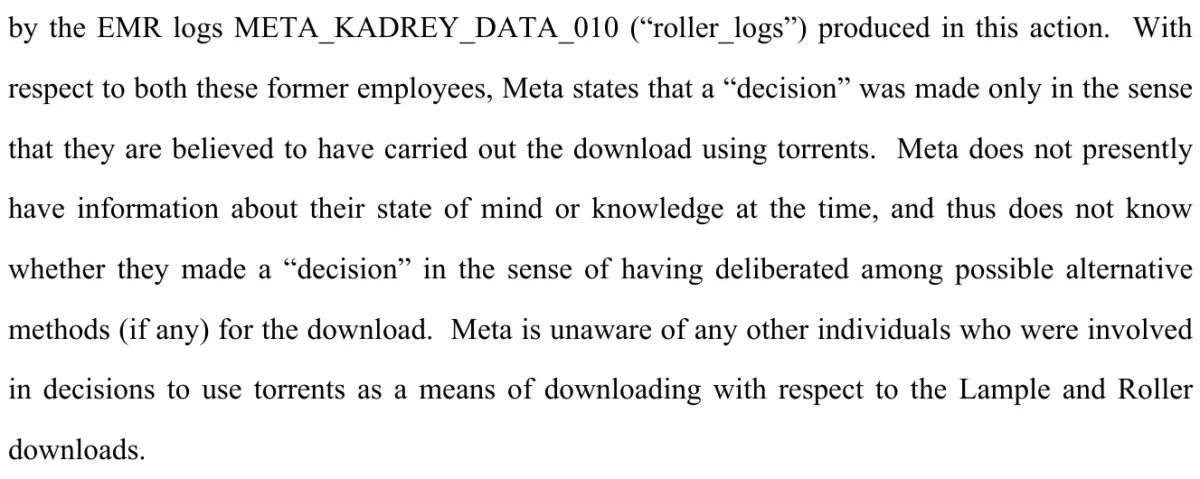
Meta responded by naming several individuals involved in general data-related decisions, but drew a sharp line regarding formal accountability. The company argued it could not identify anyone who "formally" made or approved the decision to acquire or use books for its first two Llama models, characterizing those milestones as the product of organic team consensus. When questioned about the BitTorrent downloads themselves, Meta pointed to the engineers who executed the downloads, describing their actions strictly as technical choices. Furthermore, Meta noted that its acquisition of data from Anna’s Archive underwent an internal legal review by in-house counsel in early 2024, stopping short of naming any senior executive who greenlit the use of peer-to-peer torrenting networks.
Entrepreneur Media quickly challenged this framing. "On that construction no one at Meta decided to torrent anything, yet Meta torrented shadow libraries repeatedly from 2022-2024," the publisher countered in court filings.
"Legally Not Okay"
The question of corporate awareness and willful infringement takes on added weight when examining internal company communications regarding copyright compliance. Internal documentation surfaced by plaintiffs reveals that Meta employees were well aware of the legal risks associated with peer-to-peer file sharing.
According to testimony from an engineer who handled LibGen data, the issue of seeding—the process of uploading data to other peers on the network while downloading—was actively discussed internally, prompting staff to implement measures intended to limit outbound sharing.

An internal Meta logbook, reviewed by an employee prior to initiating a download from Anna’s Archive, explicitly weighed the risks of utilizing torrent technology. "Decided to go with direct file uploads without using torrents for the following reasons: Using torrents would entail seeding the file such as sharing content outside. This would be legally not okay," the logbook stated, as highlighted in Entrepreneur Media’s legal filings.
Despite such internal red flags, Meta acknowledges that it did utilize BitTorrent to pull the Scientific Articles (Scimag) collection from Library Genesis (LibGen) and data collections from Anna’s Archive. However, the company maintains it has no record of anyone who formally "made, authorized, or approved" a decision to distribute or upload that material. Meta’s legal representatives have emphasized that technical safeguards were put in place to mitigate seeding activities.
The exact volume of material shared externally remains a point of contention. Last year, an expert retained by Meta estimated that uploads from its Amazon Web Services (AWS) servers accounted for roughly 30 percent of the total data volume downloaded during torrent operations between April and July 2024.
Judge Hixson’s Ruling: "Everyone in the Group"
Magistrate Judge Hixson’s recent ruling dismantled Meta’s resistance to naming names. Noting that Meta had previously informed the court it possessed no further information regarding the torrenting decisions, the judge found the company’s responses unsatisfactory.
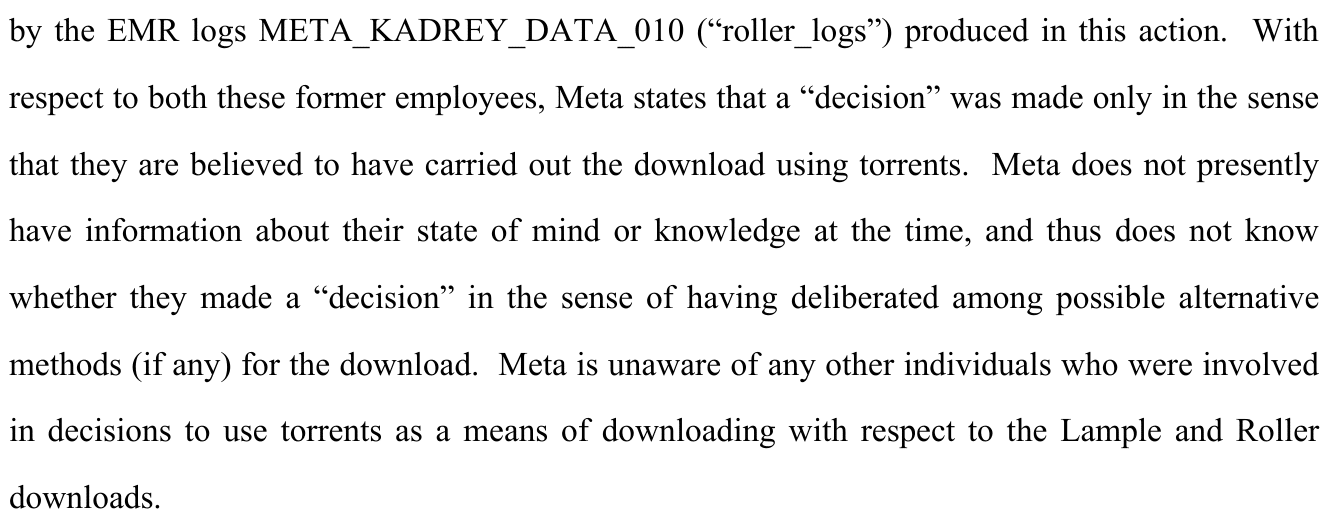
Judge Hixson emphasized that the plaintiffs’ interrogatory was not restricted solely to formal decisions, and observed that Meta’s previous answers focused primarily on how the acquired data was used rather than how it was obtained. Crucially, the judge dismissed the argument that collaborative team dynamics absolve the company from naming specific individuals. He ruled that because the interrogatory asked for all decision-makers, if a choice was made by a committee or a team, every person involved must be explicitly identified.
Under the new order, Meta must disclose the identities of everyone who participated in the internal discussions preceding the 2023 LibGen torrent download, those who approved the pivot to BitTorrent, and the individuals who greenlit the April 2024 data acquisition from Anna’s Archive.
The mandate extends even further, requiring Meta to name every person who contributed to decisions concerning "whether or how to seed, or to mitigate seeding," when downloading copyrighted materials from LibGen and Anna’s Archive.
For Entrepreneur Media, securing these identities is a critical step in building its case. The publisher argues that the names of the individuals involved bear directly on the legal concepts of willfulness, contributory copyright infringement, and unauthorized distribution.

While this phase of the discovery battle centers on corporate accountability and personnel, the broader legal questions—including whether Meta’s torrenting operations constitute fair use and whether the company illegally distributed pirated books to outside parties—remain to be decided.


Leave a Reply