
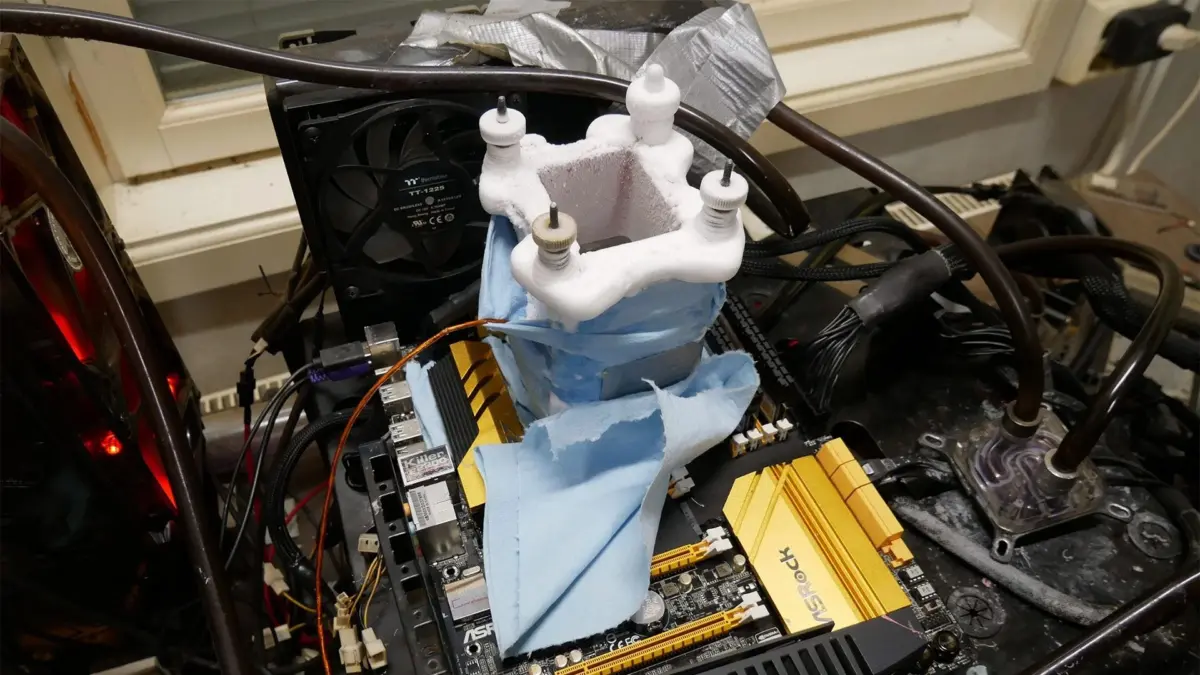
You don’t need the latest and greatest PC hardware to have fun or even break overclocking world records. Overclocking expert Luumi has demonstrated this very capably by achieving a new HWBot world record using an ancient Intel Core i5-4670K processor, a modest amount of DDR3 memory, and, inevitably, a flask or two of liquid nitrogen (LN2). Luumi recently knocked the four-core Intel Core i5-4670K Cinebench R11.5 record holder off their perch after an incredible 12 years, achieving a staggering multicore score of 10.8 cb.
The HWBot-crowned system is built around Haswell-era Intel silicon, the Core i5-4670K to be precise. This is an unlocked four-core, four-thread CPU with a stock base and boost frequency of 3.4 GHz and 3.8 GHz respectively, an 84-watt thermal design power, a 6MB cache, and integrated Intel HD 4600 graphics, all built on Intel’s 22-nanometer manufacturing process. To put the vintage of the hardware into perspective for modern PC enthusiasts, consumers during this era had to step up and purchase a more expensive Core i7 chip just to get four cores and eight threads, making the i5-4670K a strictly quad-core, quad-thread mainstream gaming and productivity processor of its day.
The achievement highlights the enduring appeal of competitive benchmarking among hardware enthusiasts who revisit legacy platforms to push them far beyond their original design specifications. Overclocking exploits like this require a deep understanding of thermal dynamics, voltage regulation, and silicon lottery luck, especially when dealing with silicon that is more than a decade old. While modern hardware routinely smashes performance ceilings with dozens of cores and advanced architectural efficiencies, there is a distinct community of veteran overclockers who find specialized joy in wringing every last drop of performance out of classic components that once defined mid-range PC builds.
Cinebench R11.5, the benchmark used to secure this historic record, serves as a classic stress test for rendering performance, scaling heavily across available CPU cores and threads. Although it has long since been succeeded by newer iterations of Maxon’s benchmarking suite, it remains a heavily utilized standard within the historical HWBot database for retro and legacy overclocking categories. Securing the top spot in a category that has stood stagnant for 12 years demonstrates not only the tenacity of modern overclocking techniques and refined hardware knowledge, but also the fact that older architectures still hold hidden reserves of potential when paired with extreme cooling methodologies.
By plunging the vintage Haswell processor into sub-zero temperatures using liquid nitrogen, Luumi was able to bypass the thermal and electrical limitations that constrained the chip during its commercial heyday back in 2013 and 2014. Extreme overclocking of this nature turns standard desktop hardware into a high-stakes physics experiment, where micro-adjustments to voltages and frequencies can mean the difference between a successful benchmark run and a system crash. For the Haswell generation, maintaining stability at extreme frequencies under LN2 requires specialized motherboards with robust power delivery systems, careful condensation management, and precise BIOS tuning.
The successful run adds another notable entry to Luumi’s impressive portfolio of competitive hardware feats, showcasing that the pursuit of computing performance is not exclusively tied to purchasing the newest generation of silicon rolling off the assembly lines. As semiconductor manufacturing faces physical limitations and new hardware becomes increasingly expensive, the retro overclocking scene continues to thrive as a creative outlet for enthusiasts who appreciate the history of personal computing architecture. Breaking a record that stood untouched for over a decade proves that while hardware may age, the passion and ingenuity of the overclocking community only grow stronger with time.

Leave a Reply