
For millions of women navigating midlife, the disruption of nighttime rest carries a distinct, exhausting signature. Menopause sleep problems rarely manifest as a simple inability to wind down; instead, they show up at both ends of the night, making it progressively harder to fall asleep and nearly impossible to stay asleep. Longitudinal research, such as the landmark Study of Women’s Health Across the Nation (SWAN) which enrolled 3,045 women aged 42 to 52, indicates that the odds of experiencing both types of sleep trouble escalate steadily across the menopausal transition. When nights repeat themselves in an identical pattern while waking life remains unchanged, the telltale nature of the transition becomes unmistakable—and it explains why generic sleep advice so frequently fails to provide relief.
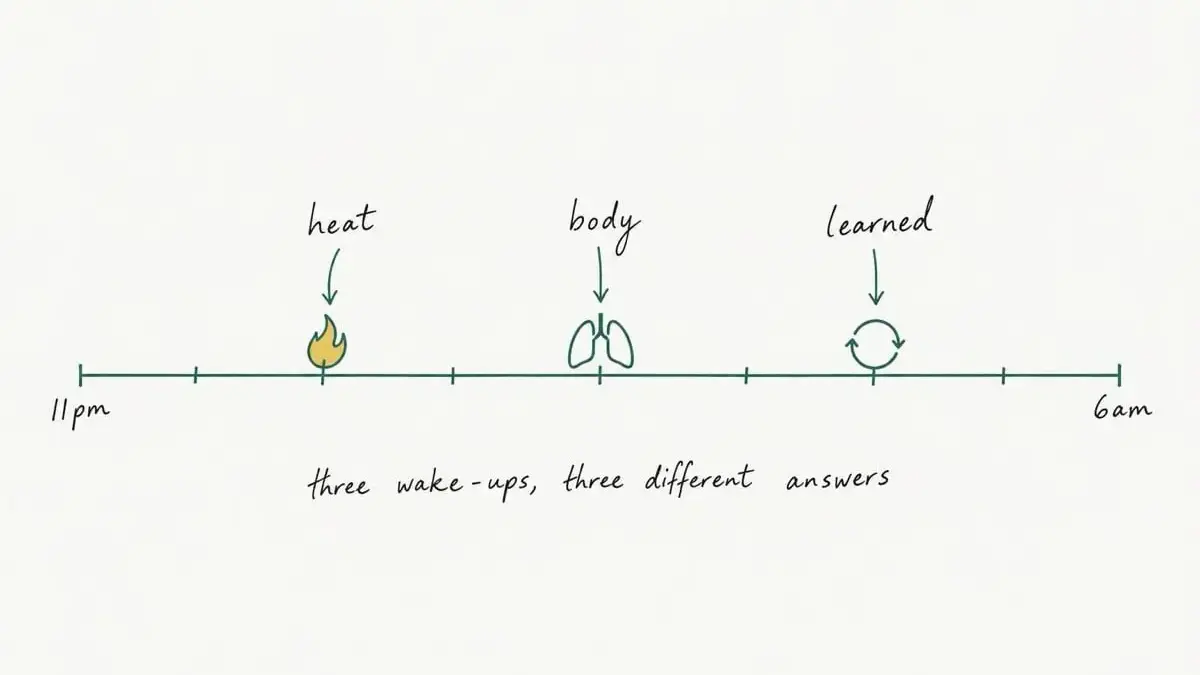
For a significant number of women, the second half of the night presents the most pronounced disruption. A typical night often begins innocently enough: sleep arrives by 11:00 p.m. without excessive difficulty. Then, the internal alarm goes off around 2:40 a.m.—often accompanied by damp sheets, kicking off heavy covers, and subsequently pulling them back on. Another awakening follows at 4:15 a.m., leading directly into an inevitable rise at 6:00 a.m., driven by professional and personal obligations that offer no leeway for fatigue.
By Thursday, the accumulated exhaustion manifests as uncharacteristic shortness with loved ones and the cognitive friction of rereading a single work email four times. Secondary analyses tracking the SWAN cohort over a decade reveal that insomnia symptoms—defined as self-reported issues occurring at least three times a week rather than a formal clinical diagnosis—are remarkably prevalent. These symptoms appeared in 31 percent of women during early perimenopause in the first year, climbing to 39 percent by year ten, while affecting 32 percent of women in late perimenopause and rising to 48 percent over time. While these figures fluctuate across stages and years, they underscore a broader reality: experiencing these struggles at 3:00 a.m. does not make an individual an isolated outlier, even if it feels that way in the quiet dark. Over time, this recurring cycle breeds a new and insidious psychological burden—a developing dread of the bed itself, which ultimately matters far more than any over-the-counter supplement sitting on a bathroom shelf.
Why the Usual Natural Remedies Keep Failing You
The persistent failure of natural remedies for broken midlife sleep largely stems from how they are presented: typically as an uncurated list of options lacking clear hierarchy, underlying mechanism, or an honest grading of supporting evidence. Melatonin serves as a prime example of this disconnect. When pooled across four randomized clinical trials involving menopausal women, its observed effect on overall sleep quality failed to reach statistical significance. In scientific terms, this indicates uncertainty rather than absolute disproven efficacy, but that nuance is rarely reflected on commercial product labels.
Valerian root fares little better under scientific scrutiny. An umbrella review published in 2024 synthesized eight systematic reviews examining valerian for sleep disturbances, ultimately judging the available evidence to be weak or inconclusive, with no demonstrable efficacy specifically for insomnia. Consequently, when an individual tries one of these remedies, dedicates two weeks to the regimen, notices no tangible change, and quietly concludes that personal failure is the root cause, they are mistaken. The core issue lies in being handed an unvetted shelf of products and told to guess—an ineffective approach for addressing menopause-related insomnia, which actually stems from multiple distinct physiological drivers.
Menopause Sleep Problems Are a Wake-Up Pattern, Not One Problem
Clinical observations suggest that menopause-related sleep disruptions are not a monolith, but rather at least three separate wake-up patterns masquerading under a single set of symptoms: heat-driven awakenings, body-driven awakenings linked to physiological factors like disordered breathing, and learned awakenings that persist long after hot flashes have subsided. A remedy tailored exclusively to one pattern will invariably yield disappointing results for the other two. Identifying which specific pattern dominates a person’s nights transforms an overwhelming list of unproven remedies into a clear decision-making framework.
Heat-driven awakenings are the most widely recognized manifestation, and their physiological basis is well-documented. Actigraphy monitoring in 168 midlife women revealed that 78 percent of objectively recorded nocturnal hot flashes coincided with a wake episode, with women demonstrating a significantly higher probability of being awake in the five minutes immediately following a flash than in the preceding minutes. While simultaneous occurrence does not definitively prove that every awakening initiates with a vasomotor event, the correlation remains difficult to dismiss.
Body-driven awakenings, by contrast, frequently go unrecognized in routine clinical settings. Data from the Sleep in Midlife Women Study demonstrated that the adjusted apnea-hypopnea index was roughly 31 percent higher post-menopause than in the premenopausal period. This metric tracks breathing events rather than formal apnea diagnoses, yet its clinical presentation is critical: women suffering from obstructive sleep apnea often present to primary care physicians reporting insomnia, persistent fatigue, and low mood rather than the classic symptom of loud snoring, contributing to widespread underdiagnosis in this demographic.

Learned awakenings explain why many women find themselves wide awake at 3:00 a.m. years after their hot flashes have completely faded. Through conditioning, the bed transforms from a place of rest into an environment associated with rumination and mental arithmetic regarding the demands of the following day. This pattern is no longer driven by fluctuating hormones, yet it represents the specific category backed by the most robust non-pharmacological treatments available.
Natural Remedies, Ranked by the Evidence Behind Them
When evaluated strictly through the lens of empirical evidence, natural and non-pharmacological interventions for menopause-related sleep disturbances establish a clear hierarchy: cognitive behavioral therapy for insomnia (CBT-I) ranks first, regular physical activity ranks second, and dietary supplements occupy a distant third. In a randomized clinical trial tracking 106 midlife women experiencing frequent hot flashes and insomnia, telephone-delivered CBT-I reduced insomnia severity scores by an average of 5.2 points more than a menopause-education control group at eight weeks, with those gains successfully maintained at the 24-week mark. No commercial supplement currently boasts clinical evidence approaching that magnitude.
As a structured behavioral treatment typically delivered across four to eight sessions by a trained clinician, specialized therapist, or guided digital program, CBT-I targets the foundational mechanics of sleep. It establishes a consistent wake time, aligns time spent in bed with actual sleep duration, discourages lying awake in bed, and dismantles nighttime thought loops. Professional medical bodies increasingly prioritize this approach; the American College of Physicians recommends CBT-I as the initial, primary treatment for all adults suffering from chronic insomnia, backed by moderate-quality evidence, while reserving medication as a secondary consideration. While this broader guideline applies to chronic insomnia generally rather than menopause specifically, targeted trials of midlife women yield remarkably consistent conclusions.
However, health authorities emphasize that the full multicomponent protocol of CBT-I must be implemented, explicitly advising against relying on generic sleep hygiene tips as a standalone cure. The familiar checklist of keeping a dark room, avoiding late screens, and eliminating evening caffeine represents a baseline floor rather than an active treatment.
Physical activity claims the second tier of the evidence hierarchy. Pooled individual-participant data across four trials conducted by the Menopause Strategies: Finding Lasting Answers for Symptoms and Health (MsFLASH) research network demonstrated that structured exercise reduced Insomnia Severity Index scores by an average of 2.1 points relative to control groups. While a two-point reduction represents a modest, genuine improvement rather than a total solution, incorporating movement provides meaningful support even if it cannot carry the entire therapeutic load alone.
Supplements occupy the third tier, with their modest and often inconclusive evidence clearly separated from marketing claims. Because botanicals and compounds can interact unpredictably with prescription medications and with each other, clinical consultation with a physician or pharmacist remains essential before introducing any such product. Furthermore, while conventional wisdom universally prescribes lowering bedroom ambient temperatures, controlled clinical trials specifically isolating room temperature as a treatment for menopausal insomnia remain scarce. Laboratory studies examining skin-warming in healthy adults indicate minor physiological effects on sleep-onset latency, suggesting that maintaining a cool, breathable bedroom serves primarily as a measure of comfort during night sweats rather than a biological cure for chronic sleep architecture disruptions.
When This Needs a Clinician, Not a Remedy
Certain nighttime symptoms signal that sleep disruption has moved beyond the scope of lifestyle adjustments or over-the-counter remedies. Loud snoring, breathing pauses, gasping or choking sensations during the night, and chronic daytime fatigue are primary indicators of sleep-disordered breathing, prompting health organizations like the UK’s National Health Service to recommend formal medical evaluation. Similarly, sleep difficulties persisting at least three times a week for three months or more meet established clinical thresholds for chronic insomnia, requiring professional assessment rather than trial-and-error experimentation.
Dismissing these persistent issues with the assumption that "it’s just menopause" frequently delays proper diagnosis and treatment. Because conditions like obstructive sleep apnea commonly present in women as insomnia, fatigue, and depressive symptoms rather than overt nocturnal disruption, clinical investigation is vital. For appropriate candidates, hormone therapy remains an option worthy of discussion with a healthcare provider; the North American Menopause Society identifies hormone therapy as the most effective FDA-approved treatment for moderate to severe hot flashes and night sweats, noting subsequent improvements in sleep quality when disturbances are directly tied to vasomotor symptoms. Ultimately, systematic tracking of sleep patterns over a single week—noting wake times, the presence of thermal disruption, and respiratory symptoms—provides the essential data needed to guide an informed conversation with a clinician.



Leave a Reply