
For millions of women navigating the midlife transition, sleep disturbances do not arrive as a gentle drift into tiredness. Instead, they manifest at both ends of the night with a stubborn predictability: making it harder to fall asleep, and even harder to stay asleep. Longitudinal research from the Study of Women’s Health Across the Nation, which tracked 3,045 women enrolled between the ages of 42 and 52, demonstrates that the odds of experiencing both types of sleep trouble rise steadily across the menopausal transition. When the nights repeat in this exact manner, and nothing else in a person’s daily life or external routine has shifted, the telltale pattern emerges. It is this unique disruption that explains why generic sleep advice so frequently bounces off women experiencing midlife insomnia.
For a significant number of women, the staying-asleep portion of the night is the loudest and most disruptive element, typically following a remarkably familiar trajectory. A woman might fall asleep by eleven o’clock without much trouble, only to jolt awake at 2:40 a.m.—damp from perspiration, kicking the covers off, and then hastily pulling them back on as a chill sets in. She may drift off again briefly, only to wake once more at 4:15 a.m., before finally rising for the day at six o’clock because professional responsibilities and work schedules do not care about a broken night.
By the time Thursday arrives, the cumulative deficit takes its toll. Women find themselves uncharacteristically short-tempered with the people they love and struggling through basic cognitive tasks, such as rereading the exact same work email four separate times. Secondary analyses examining ten years of data from that same landmark cohort reveal striking figures: self-reported insomnia symptoms appeared in 31 percent of women in early perimenopause during their first year, climbing to 39 percent by year ten. Among women in late perimenopause, the prevalence started at 32 percent and rose sharply to 48 percent over the same timeframe.
It is crucial to note that these statistics reflect self-reported symptoms occurring at least three times a week rather than formal, clinical diagnoses of chronic insomnia, and they fluctuate depending on the specific menopausal stage and year. Nevertheless, understanding these numbers provides profound reassurance to individuals who feel entirely isolated at 3 a.m. More importantly, many women in this situation begin to develop a psychological dread of the bed itself—a novel development that clinical experts note is often far more consequential than any supplement sitting on a kitchen counter.
Why the Usual Natural Remedies Keep Failing You
Natural remedies for broken midlife sleep routinely fail because they are typically encountered as an unstructured list of half a dozen options devoid of clear ordering, underlying mechanisms, or graded evidence. Melatonin serves as the clearest example of this disconnect. When pooled across four distinct randomized trials focusing specifically on menopausal women, the actual effect of melatonin on overall sleep quality was found to be statistically non-significant. In scientific terms, this indicates uncertainty regarding its efficacy rather than a definitive disproving of its benefits, yet this nuanced reality is rarely reflected on the labels of bottles found on retail shelves.
Herbal alternatives like valerian fare no better under scientific scrutiny. An umbrella review published in 2024 synthesized eight separate systematic reviews evaluating valerian for sleep disturbances and judged the existing evidence to be weak or inconclusive, finding no solid proof of efficacy for insomnia. Consequently, a struggling woman typically selects one remedy, gives it a trial period of two weeks, feels absolutely no relief, and quietly internalizes the failure, deciding that the underlying problem must somehow lie within her own biology. In truth, the problem lies in the delivery system: she was handed a crowded retail shelf and told to guess, which represents a fundamentally flawed approach to treating menopause insomnia—a complex condition driven by at least three entirely separate physiological causes.
Menopause Sleep Problems Are a Wake-Up Pattern, Not One Problem
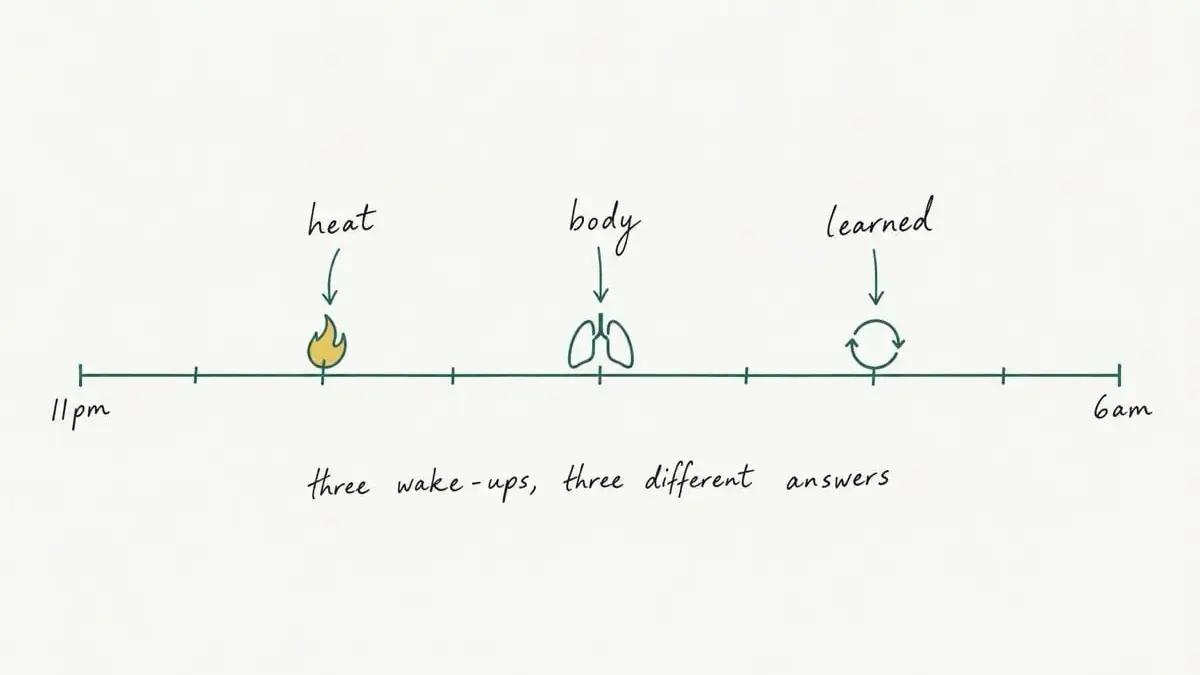
Menopause sleep problems cannot be accurately understood as a single, uniform issue. Instead, they represent at least three distinct wake-up patterns wearing the exact same outward symptom: heat-driven waking, body-driven waking stemming from physiological disruptions such as disordered breathing, and learned waking that persists long after the physiological hot flashes have finally faded. A remedy aimed squarely at one of these patterns will inevitably do very little to resolve the other two. Determining which specific pattern dominates a person’s nights is what transforms a random list of internet remedies into a coherent clinical decision.
Heat-driven waking is the phenomenon that nearly everyone pictures when they think of menopausal sleep disruptions, and its impact is entirely real. In an observational study monitoring 168 midlife women using actigraphy, 78 percent of objectively recorded nocturnal hot flashes coincided directly with a waking episode. Furthermore, women were significantly more likely to be awake in the five-minute window immediately following a flash than in the minutes leading up to it. While mere concurrence does not constitute absolute proof that every single awakening originates with a flash, the underlying biological link is remarkably robust.
Body-driven waking, on the other hand, is the pattern that is most frequently missed by primary care providers and patients alike. Data from the Sleep in Midlife Women Study revealed that the adjusted apnea-hypopnea index—a standard measure of respiratory events during sleep—was approximately 31 percent higher after the menopausal transition than it was before. This metric measures breathing disruptions rather than a simple count of formal apnea diagnoses. What makes this finding vital to recognize is how the condition presents clinically: women suffering from obstructive sleep apnea frequently present to primary care complaining of insomnia, persistent fatigue, and low mood rather than classic symptoms like loud snoring, which is a primary reason the condition remains severely underdiagnosed among women.
Learned waking explains why numerous women remain wide awake at 3 a.m. two full years after their hot flashes have completely subsided. Over time, the bed has psychologically transformed into a frustrating arena where the individual lies awake performing mental arithmetic and worrying about the impending demands of the next day. This is no longer driven by fluctuating hormones, yet it represents the specific pattern backed by the most rigorous non-pharmacological evidence available. While sorting individual nights into these three distinct groups serves as an organizing framework rather than a rigid clinical classification—and real-world weeks frequently blend them together—the categorization remains immensely useful because each distinct group points toward an entirely different next step.
Natural Remedies, Ranked by the Evidence Behind Them
When evaluated strictly by the strength of the clinical evidence supporting them, natural remedies for menopause sleep problems fall into a clear hierarchy: cognitive behavioral therapy for insomnia ranks first, regular exercise places second, and nutritional or herbal supplements trail as a distant third. In a randomized controlled trial involving 106 midlife women experiencing frequent hot flashes alongside insomnia, a telephone-delivered course of cognitive behavioral therapy for insomnia improved insomnia severity scores by an impressive 5.2 points more than a menopause-education control group at eight weeks, with those significant gains successfully maintained at the 24-week follow-up mark. To date, no dietary supplement has produced clinical evidence in that range.
First: CBT-I, Which Is a Treatment, Not a Tip
Cognitive behavioral therapy for insomnia is a short, highly structured course of behavioral modification—typically lasting between four and eight sessions—delivered by a qualified clinician, a trained therapist, or a guided digital platform. It focuses directly on the underlying mechanics of sleep: establishing a single, rigid wake time that is maintained every single day of the week, restricting the total time spent in bed to closely match the amount of sleep the individual is actually achieving, getting out of bed immediately rather than lying awake in frustration, and systematically dismantling the anxious thought loops that typically activate at 3 a.m.
This approach aligns directly with professional medical guidelines. The American College of Physicians formally recommends cognitive behavioral therapy for insomnia as the initial, frontline treatment for all adult patients suffering from chronic insomnia, issuing a strong recommendation based on moderate-quality evidence, while positioning medication as a secondary option for shared decision-making if behavioral therapy alone proves insufficient. While that particular guideline encompasses adults with chronic insomnia in general rather than exclusively focusing on menopause, the aforementioned clinical trial bridges that gap by demonstrating efficacy specifically in midlife women battling hot flashes and insomnia.

A vital distinction must be made regarding standard sleep hygiene advice. The American Academy of Sleep Medicine formally recommends the comprehensive, multicomponent version of cognitive behavioral therapy for insomnia while explicitly advising against relying on basic sleep hygiene tips as a stand-alone treatment. Therefore, keeping a dark room, eliminating late-night screen time, and cutting off afternoon coffee—habits many women have already meticulously adopted—do not constitute the actual treatment. They merely represent the foundational floor upon which true therapeutic interventions must be built.
Second: Exercise, With an Honest Effect Size
Pooled individual-participant data gathered across four clinical trials conducted by the Menopausal Strategies: Finding Lasting Answers for Symptoms and Health research network revealed that regular physical activity reduced Insomnia Severity Index scores by an average of 2.1 points relative to control groups. While cognitive behavioral therapy for insomnia produced the largest observed effect at 5.2 points, a two-point reduction represents a genuine, albeit modest, clinical improvement. It is a worthwhile practice to maintain, though patients should not realistically expect physical exercise alone to carry the entire burden of restoring a broken sleep schedule.
Third: Supplements, With Their Evidence Attached
When examining the landscape of supplements, medical professionals emphasize the necessity of reviewing available evidence rather than marketing claims, while keeping in mind that botanical and dietary compounds can interact unpredictably with prescription medications and with each other. Consulting a primary care physician or a licensed pharmacist prior to introducing any new supplement is universally advised. While lifestyle adjustments and environmental factors often dominate discussions, researchers note that basic comfort measures—such as utilizing portable fans and breathable bedding—can mitigate the physical misery of night sweats, even if a bedroom thermostat cannot fundamentally resolve a deep-seated neurological thought loop.
What One Week of This Actually Looks Like
In practical terms, adopting an evidence-based approach to midlife sleep disruption is remarkably straightforward, though rarely glamorous. A person begins by selecting a single, consistent wake time and holding it firmly every day of the week, including Saturday and Sunday. Each morning involves recording three simple data points on a piece of paper: the specific hour of waking, whether thermal discomfort or heat was involved, and whether any respiratory issues—ranging from partner-reported snoring to profound daytime exhaustion—occurred. This deliberate process halts the frantic cycle of adding endless new interventions. By day five, the personal sleep log, rather than a hopeful supplement label, clearly reveals which specific wake-up pattern is dominating the night.
To illustrate how this functions in daily life, consider two hypothetical profiles. Tricia is 49 years old and in the early stages of perimenopause. Her nightly log reveals four distinct awakenings across seven nights, three of which required changing damp sheets and turning on a bedside fan, with zero abnormalities noted in her breathing column. Her pattern is clearly heat-driven. Rather than overhauling her entire lifestyle with eight radical changes, her targeted strategy consists of holding a fixed wake time at 6:15 a.m., taking a daily walk, utilizing breathable bedding, and preparing a concise note for her upcoming physician appointment detailing the exact frequency of her night sweats. She does not purchase any speculative remedies.
Simultaneously, Tricia’s detailed log accomplishes something quieter yet profoundly valuable: it translates the sweeping, emotional sentiment of "I never sleep anymore" into precise clinical data that a physician can readily evaluate—specifically, four nights out of seven, featuring night sweats, persisting across eleven weeks.
Marlene, by contrast, is 54 years old and two years past her final menstrual period. Her vasomotor hot flashes have largely subsided, yet she continues to wake consistently at 3:10 a.m. Her log demonstrates a complete absence of heat-related disturbances, accompanied by a distinct behavioral habit of lying awake in bed for ninety minutes composing mental to-do lists for the following day. However, her breathing column is not entirely empty; her husband has mentioned audible snoring on two occasions, and she has noticed herself routinely dozing off in front of the television by 8 p.m. Consequently, her log yields two distinct clinical next steps: discussing cognitive behavioral therapy for insomnia with her doctor to address the learned behavioral pattern, and raising the persistent snoring and daytime sleepiness during that same medical appointment rather than dismissing them as ordinary fatigue. In the interim, she resolves to get out of bed whenever she finds herself awake for more than twenty minutes, actively unlearning the mental association between her bed and anxious rumination.
Both individuals maintain their logs for a full week before implementing any external changes. This single discipline prevents the common pitfall of simultaneously adopting magnesium supplements, blackout curtains, expensive pillows, and sleep-tracking applications within the span of a single week, a chaotic approach that ultimately obscures which intervention, if any, provided actual relief. Furthermore, neither woman treats her sleep disruption as a personal failure of willpower or discipline, recognizing instead that midlife sleep fragmentation frequently intersects with broader physiological and psychological shifts.
When This Needs a Clinician, Not a Remedy
Certain nocturnal disturbances clearly transcend the scope of home remedies. Pronounced snoring, breathing that repeatedly stops and starts, audible gasping or choking noises during sleep, and persistent, overwhelming daytime fatigue are primary clinical indicators of obstructive sleep apnea. Major health organizations advise scheduling a medical evaluation for any of these symptoms rather than continuing to experiment with over-the-counter sleep aids. The same professional evaluation is warranted for sleep difficulties that persist at least three times a week for a duration of three months or more—the established threshold defining chronic insomnia.
Medical specialists emphasize that attributing nocturnal struggles entirely to the dismissal of "it’s just menopause" is the assumption most likely to delay proper diagnosis and cost a patient months or years of restorative rest. Because sleep-disordered breathing in women frequently presents with atypical symptoms such as insomnia, chronic fatigue, and low mood rather than classic heavy snoring, overlooking these signs can leave underlying medical conditions unaddressed.
For women experiencing severe vasomotor symptoms, hormone therapy remains a clinical option worthy of direct discussion with a healthcare provider. Position statements from professional organizations like The North American Menopause Society identify hormone therapy as the most effective pharmacological treatment available for moderate to severe hot flashes and night sweats, noting subsequent improvements in sleep quality when the underlying disturbance is directly tied to those vasomotor symptoms. However, experts stress that hormone therapy is not designed to function as a stand-alone treatment for chronic insomnia, and its suitability depends entirely on an individualized risk-benefit assessment conducted by a qualified clinician.
Start With One Night, Not Eight Changes
Establishing a path toward restorative sleep begins with a simple, foundational action: selecting a consistent wake time before purchasing a single remedy. Placing a notebook by the bed to track the hour of waking, the presence of thermal discomfort, and any signs of respiratory disruption for seven consecutive days provides an invaluable diagnostic tool. Holding a single wake time without stacking additional unproven routines creates clarity. That simple weekly log replaces a shelf of speculative guesses with actionable data, providing both the individual and their clinician with the precise information needed to address the root causes of midlife sleep disruption.
Leave a Reply