
Elon Musk promised a flying car, and during a high-octane demonstration in Waco, Texas, the next-generation Tesla Roadster did precisely that. The electric supercar drove upside down, briefly took flight, and shattered conventional automotive performance expectations by accelerating from zero to 60 miles per hour in under a second.
The spectacle, lasting less than 30 minutes, functioned far more like a high-production stunt show than a traditional corporate product reveal. Mundane automotive metrics like pricing, delivery configurations, and concrete production timelines took a backseat to theatrical displays of engineering. While Musk casually suggested that the hypercar would finally enter production in 2028—prompting knowing skepticism after nearly a decade of waiting—the gathered audience was entirely captivated by the live demonstration of flight and physics-defying maneuvers.
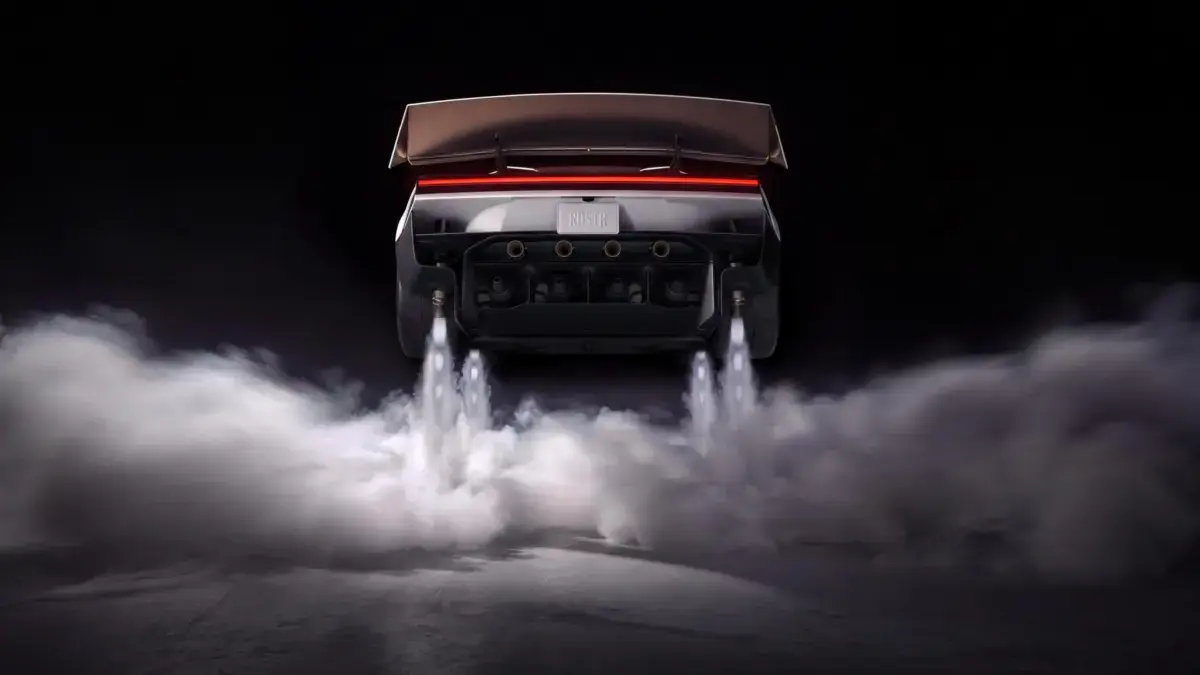
The event opened with the Roadster driving up an imposing, multi-story vertical ramp, utilizing extreme downforce to cling securely to the roadway as it ascended. Upon reaching the apex, the vehicle deployed its specialized cold-gas thrusters to flip itself and descend gently back to the ground. This capability relies on an advanced fan-based suction system mounted underneath the car and supplied by aerospace partner SpaceX, which is capable of generating up to two Gs of suction force to anchor the vehicle to surfaces.
Immediately following the vertical ramp demonstration, the Roadster took to the air, soaring gracefully over the rest of Tesla’s current vehicle lineup, including the Model 3, Model Y, Cybertruck, Semi, and Cybercab. During the flight, Tesla Vice President for Engineering Lars Moravy noted that the vehicle performed what he described as a "kick flip." Musk elaborated on the underlying technology, highlighting that the supercar features a combination of attitude-control thrusters and primary rear thrusters, giving the chassis performance capabilities traditionally reserved for rockets.
"So it can basically fly like a rocket," Musk told the cheering audience. "And it could do rolls. It could do, like, crazy gymnastics. Whatever you want, really. Now, I should say that this is not necessarily a safety-optimized car. But it takes the fun meter to 11 out of 10."
Underpinning these aerial acrobatics is a sophisticated pneumatic system. The Roadster is equipped with two ultra-high-pressure air tanks boasting a combined volume of 600 liters and containing approximately 250 kilograms of compressed air. This reservoir feeds 10 dedicated nozzles to execute precise maneuvers, and the vehicle is even capable of recharging its own tanks without the need for specialized chemical propellants.
While Musk initially claimed that the vehicle would be an actual car driven on public roads, Tesla representatives later clarified that the production model would not be road legal. Given the overlapping regulatory hurdles imposed by both the Federal Aviation Administration and the National Highway Traffic Safety Administration, the lack of street legality comes as little surprise. Whether the Roadster finally makes its targeted 2028 production window or slips into yet another decade of missed deadlines, the overarching sentiment among attendees remained steadfast: the car flew.
Describing the Roadster itself, Musk hailed it as "the last best driver’s car." Moravy explained that the engineering team drew heavy inspiration from legendary aerospace designs, specifically citing the SR-71 reconnaissance aircraft. The interior is a minimalist two-seater configuration featuring seats molded directly into the carbon-fiber chassis. All primary driving controls—including the yoke, braking system, and throttle—utilize advanced steer-by-wire technology. The rear of the vehicle houses the aforementioned thrusters and fans integrated into the aerodynamic diffuser area, complemented by a retractable rear wing designed to maximize downforce during high-speed track driving.
Tesla’s engineering claims regarding acceleration were put to the test during the Waco demonstration, where the company recorded a zero-to-60-mph time of just 0.81 seconds. Musk attributed this staggering performance to a combination of increased applied force and reduced vehicle mass. Looking ahead, Musk suggested that the final production Roadster could potentially improve upon even these figures, though he acknowledged the immense physical challenges of protecting vehicle occupants from such extreme G-forces.
"You’ve got to crack halfway to the speed of sound, I think," Musk teased, floating performance targets around "Mach 0.5. Maybe a little higher."
Following the conclusion of the event, Tesla updated its official website to reflect three distinct performance tiers for the next-generation Roadster, outlining how its controversial cold-gas thruster systems will scale across the planned lineup.
The next-gen Roadster has traversed a remarkably long and circuitous path to reach this milestone. A prototype version was originally introduced as a surprise "one more thing" announcement during the unveiling of the Tesla Semi in November 2017. Even by the standards of the time, the preliminary specifications were staggering: a zero-to-60-mph time of 1.9 seconds, a top speed exceeding 250 miles per hour, a massive 200 kWh battery pack delivering up to 620 miles of driving range, and a projected starting price of $200,000. Musk initially projected that customer deliveries would commence by 2020.
Early adopters quickly committed substantial capital, putting down $50,000 deposits—or a full $250,000 for the limited Founders Series—providing Tesla with effectively interest-free loans to help fund its broader manufacturing scaling ambitions. However, as Tesla shifted its primary focus toward high-volume mass-market vehicles like the Model Y and grappled with the complex engineering challenges of the Cybertruck, the Roadster program languished, earning a reputation in the automotive world as the ultimate vaporware. Periodically, whenever the project re-entered the public spotlight, Musk would elevate the promised capabilities even further, ultimately culminating in the conceptual "SpaceX package" featuring cold-gas thrusters, hover capabilities, and sub-second acceleration.
In recent commentary, Musk has occasionally sought to downplay the commercial significance of the Roadster, describing it as a "small potato situation" that will not substantially alter the company’s financial bottom line. Instead, he has framed the supercar primarily as a joint engineering exercise between Tesla and SpaceX, even questioning publicly whether the experimental machine can still be classified strictly as an automobile. Meanwhile, industry analysts have theorized that the high-profile resurgence of the Roadster is designed to lay the groundwork for a rumored corporate merger between Tesla and SpaceX.
During the prolonged delay of the Roadster, rival automakers rapidly closed the performance gap, introducing ultra-powerful electric hypercars of their own. Croatian manufacturer Rimac shattered global performance benchmarks with the Nevera, Porsche successfully refined high-performance electric track capability with the Taycan, and major Chinese automotive giants like BYD began producing track-ready supercars at a fraction of the cost. Consequently, the Roadster no longer stands alone as an impossible technological marvel; rather, it enters a mature market of high-performance electric vehicles.
Yet, as the dust settled in Waco after a car drove on walls, spun in mid-air, and redefined acceleration, industry observers and enthusiasts alike were reminded of a simple differentiator: none of the competition could fly.


Leave a Reply