
For millions of women entering midlife, sleep disruption does not arrive as a gradual nuisance; it strikes with a distinct rhythm that confounds ordinary remedies. Menopause sleep problems typically manifest at both ends of the night—making it harder to fall asleep and far more difficult to stay asleep. Data from the landmark Study of Women’s Health Across the Nation (SWAN), which followed 3,045 women aged 42 to 52 at enrollment, reveals that the odds of encountering both types of sleep trouble escalate steadily across the menopausal transition.
The nights repeat in a relentless loop. Because nothing else in life has ostensibly changed, this distinct pattern becomes the primary tell, explaining why generic sleep advice repeatedly bounces off midlife women seeking relief. For many, the staying-asleep half of the night is the loudest and most familiar disruption. A woman might fall asleep easily by eleven, only to jolt awake at 2:40 a.m. feeling damp, kicking the covers off, and then hastily pulling them back on moments later. She might wake again at 4:15 a.m. and finally rise for the day at six, driven by professional obligations that offer no quarter for exhaustion.
By Thursday, the cumulative toll surfaces as a short temper with loved ones and the cognitive fatigue of rereading the same work email four separate times. Secondary analyses tracking ten years of the same SWAN cohort underscore the prevalence of these issues. Insomnia symptoms were reported by 31 percent of women in early perimenopause during their first year, climbing to 39 percent by year ten. Among women in late perimenopause, 32 percent reported symptoms initially, rising to 48 percent over the decade. These figures reflect self-reported symptoms occurring at least three times a week rather than clinical diagnoses, fluctuating by stage and year, yet they confirm that women experiencing these disruptions are far from the isolated outliers they often feel like at 3:00 a.m. Over time, many women develop a quiet dread of the bed itself—a psychological shift that ultimately matters far more than any supplement sitting on a kitchen counter.
Why the Usual Natural Remedies Keep Failing You
Natural remedies for broken midlife sleep frequently fail because they arrive as an unorganized menu of options devoid of clear sequencing, underlying mechanisms, or graded evidence. Melatonin serves as a prime example of this disconnect. When pooled across four randomized clinical trials involving menopausal women, its overall effect on sleep quality did not reach statistical significance. In scientific terms, this indicates uncertainty rather than definitive disproof, a nuance rarely captured on a product label.
Herbal alternatives like valerian fare no better upon close inspection. An umbrella review published in 2024 synthesized eight systematic reviews examining valerian for sleep disturbances, ultimately judging the evidence to be weak, inconclusive, and entirely lacking proof of efficacy for insomnia. Consequently, a woman might try one remedy, give it a fair two-week trial, feel no discernible difference, and quietly conclude that the failure rests with her own biology. In reality, she was handed an unstructured retail shelf and told to guess—an ineffective approach for treating menopause insomnia, a complex condition driven by at least three distinct underlying causes.
Menopause Sleep Problems Are a Wake-Up Pattern, Not One Problem
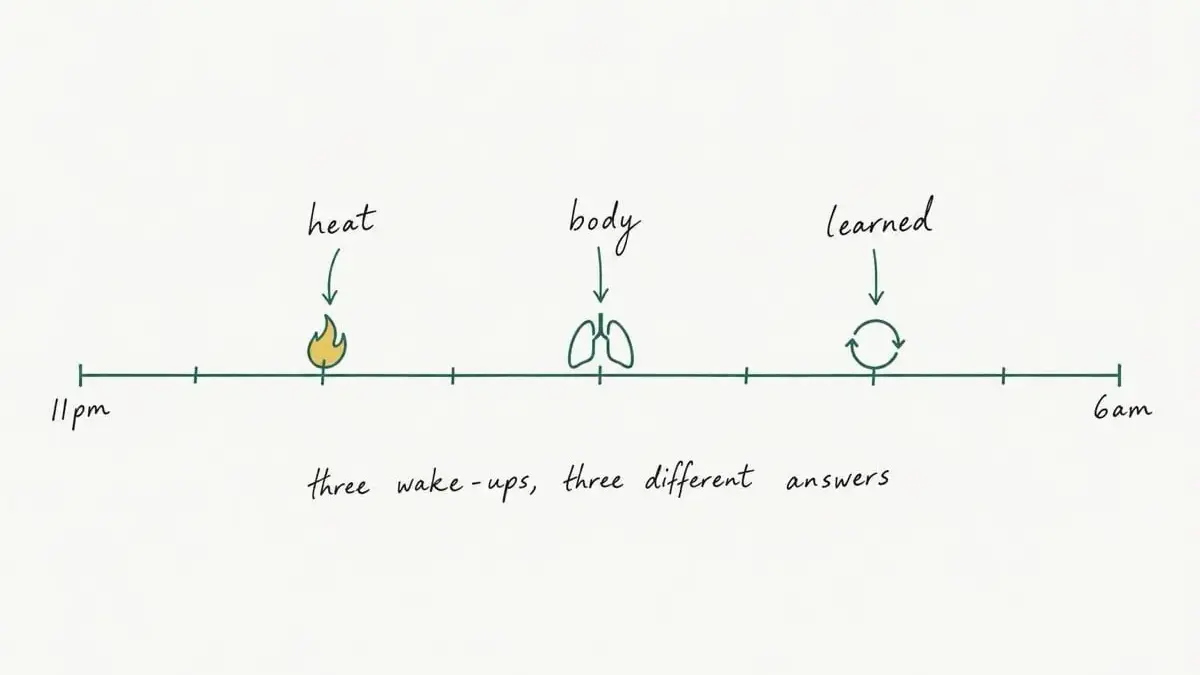
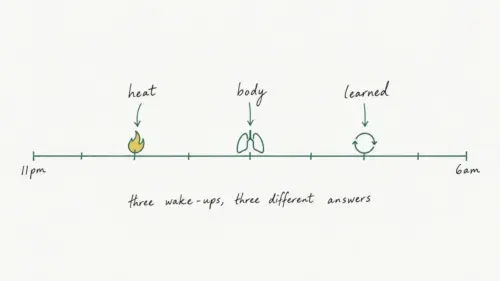
Menopause-related sleep disruptions are not a monolith; they represent at least three separate wake-up patterns wearing the same outward symptom: heat-driven waking, body-driven waking stemming from issues such as disordered breathing, and learned waking that persists long after hot flashes have subsided. A remedy tailored exclusively to one pattern will inevitably do little for the other two. Identifying which specific pattern dominates a person’s nights transforms an overwhelming list of random remedies into a coherent decision-making process.
Heat-driven waking is the most widely recognized pattern, and its physical reality is well-documented. In an actigraphy-monitored study of 168 midlife women, 78 percent of objectively recorded nocturnal hot flashes coincided with an actual waking episode. Furthermore, women were significantly more likely to be awake during the five minutes immediately following a flash than in the preceding minutes. While concurrence does not strictly prove every awakening originates with a flash, the physiological link is undeniable.
Body-driven waking, by contrast, is frequently missed in clinical settings. Data from the Sleep in Midlife Women Study indicate that the adjusted apnea-hypopnea index was roughly 31 percent higher after the menopausal transition than before it. This metric tracks breathing events rather than counting new clinical apnea diagnoses. Its clinical significance lies in how it presents: women suffering from obstructive sleep apnea often visit primary care physicians complaining of insomnia, fatigue, and low mood rather than loud snoring, which remains a primary reason the condition frequently goes undiagnosed in women.
Learned waking explains why some women remain wide awake at 3:00 a.m. years after their hot flashes have completely faded. Over time, the bed transforms from a place of rest into an arena for mental arithmetic and fretting over tomorrow’s schedule. This phase is no longer driven by fluctuating hormones, yet it represents the pattern backed by the most robust non-pharmacological treatments available. While sorting nights into these three categories serves as an organizational framework rather than a strict clinical classification—since real-world weeks often blend them—each group points directly toward a distinct next step.
Natural Remedies, Ranked by the Evidence Behind Them
When evaluated strictly by the strength of supporting evidence, natural and non-pharmacological interventions for menopause sleep problems fall into a clear hierarchy: cognitive behavioral therapy for insomnia ranks first, regular exercise places second, and dietary supplements trail as a distant third. In a randomized trial involving 106 midlife women experiencing frequent hot flashes and insomnia, telephone-delivered CBT-I improved insomnia severity scores by roughly 5.2 points more than a menopause-education control group at eight weeks, with those gains successfully maintained at 24 weeks. No supplement currently boasts clinical evidence matching that magnitude.
CBT-I functions as a structured behavioral treatment rather than a collection of casual tips. Typically spanning four to eight sessions delivered by a trained clinician, therapist, or guided digital platform, it targets core sleep mechanics. This includes establishing a single, unyielding wake time every day, restricting time in bed to match actual sleep duration, breaking the habit of lying awake by getting out of bed, and dismantling nocturnal thought loops. Professional medical bodies endorse this approach; the American College of Physicians recommends CBT-I as the initial treatment for all adults suffering from chronic insomnia, backed by moderate-quality evidence, with medication considered only as a secondary option.
Exercise offers a more modest, yet honest, effect size. Pooled individual-participant data across four MsFLASH trials demonstrated that structured exercise reduced Insomnia Severity Index scores by an average of 2.1 points relative to controls, compared to CBT-I’s larger 5.2-point reduction. While a two-point improvement is genuine and worthwhile, it is not robust enough to carry the full burden of sleep recovery on its own.
Supplements occupy the third tier, largely because their supporting evidence remains thin or inconclusive. Because supplements can interact negatively with prescription medications and with one another, medical professionals advise reviewing any potential regimen with a clinician or pharmacist. Meanwhile, popular advice regarding cool bedrooms lacks controlled clinical evidence specifically proving it treats menopausal insomnia. While lowering room temperature or using breathable bedding offers tangible comfort—making a night sweat far less miserable when not trapped in heavy flannel—maintaining a cool room should be viewed as comfort management rather than a standalone cure for chronic sleep disruption.
What One Week of This Actually Looks Like
In practice, addressing midlife sleep issues begins with structured observation rather than immediate interventions. A typical week starts by selecting a single, consistent wake time and holding it firmly every day of the week, including weekends. Each morning involves noting three basic details: the time of waking, whether heat played a role, and whether any breathing irregularities or lingering daytime fatigue occurred. By the fifth day, this personal log provides clear data identifying which specific wake-up pattern is disrupting the night.
Consider two hypothetical midlife profiles illustrating this approach. Tricia, aged 49 in early perimenopause, logs four wakings across seven nights, three involving soaked sheets and the activation of a bedroom fan, with no breathing issues noted. Her pattern is clearly heat-driven. Rather than buying an array of supplements, her strategy centers on a fixed 6:15 a.m. wake time, regular daily walks, breathable bedding, and a concise note for her physician detailing the frequency of her night sweats.
Marlene, aged 54 and two years past her final menstrual period, experiences no hot flashes, yet consistently wakes at 3:10 a.m. Her log reveals a habit of lying awake for 90 minutes planning the next day, alongside reported snoring noted by her spouse and daytime fatigue. Her log points toward two distinct paths: discussing CBT-I with her doctor for her learned waking pattern, and addressing potential sleep-disordered breathing regarding her snoring, rather than attributing exhaustion solely to general midlife tiredness. Both women maintain their logs for a full week before altering routines, avoiding the common pitfall of trying multiple interventions simultaneously and learning nothing from the process.
When This Needs a Clinician, Not a Remedy
Certain nocturnal symptoms signal underlying medical conditions that extend far beyond lifestyle adjustments or natural remedies. Loud snoring, breathing interruptions, gasping or choking sounds, and persistent daytime exhaustion are recognized by health authorities as primary indicators of sleep apnea, warranting professional medical evaluation rather than experimentation with over-the-counter supplements. Similarly, sleep difficulties persisting at least three times a week for three months or more meet the clinical threshold for chronic insomnia established by the American Academy of Sleep Medicine.
Dismissing these symptoms with the assumption that it is "just menopause" risks delaying proper diagnosis and treatment. Because sleep-disordered breathing in women frequently presents as insomnia, fatigue, and low mood rather than classic snoring, clinical oversight is essential. Furthermore, hormone therapy remains an option worth discussing with a healthcare provider; the North American Menopause Society identifies hormone therapy as the most effective treatment for hot flashes and night sweats, noting subsequent improvements in sleep quality when disturbances stem directly from those vasomotor symptoms. Ultimately, systematic tracking through a simple sleep log provides both the individual and the clinician with actionable data to restore restorative rest.
Leave a Reply