
For millions of women navigating midlife, sleep disruption does not arrive as a mild inconvenience or a temporary bout of fatigue. It exhibits a distinct, punishing rhythm that targets both ends of the night. Women frequently find it remarkably difficult to fall asleep initially, only to find themselves jolted awake hours later, caught in a repetitive loop that resists standard lifestyle adjustments.
Data from the landmark Study of Women’s Health Across the Nation (SWAN), which enrolled and followed 3,045 women aged 42 to 52, indicates that the odds of experiencing both sleep-onset and sleep-maintenance difficulties rise steadily throughout the menopausal transition. When nights repeat themselves with identical disruptions and no external changes in routine, the pattern becomes unmistakable. This specific signature is why generic sleep hygiene advice routinely fails to resolve the issue.
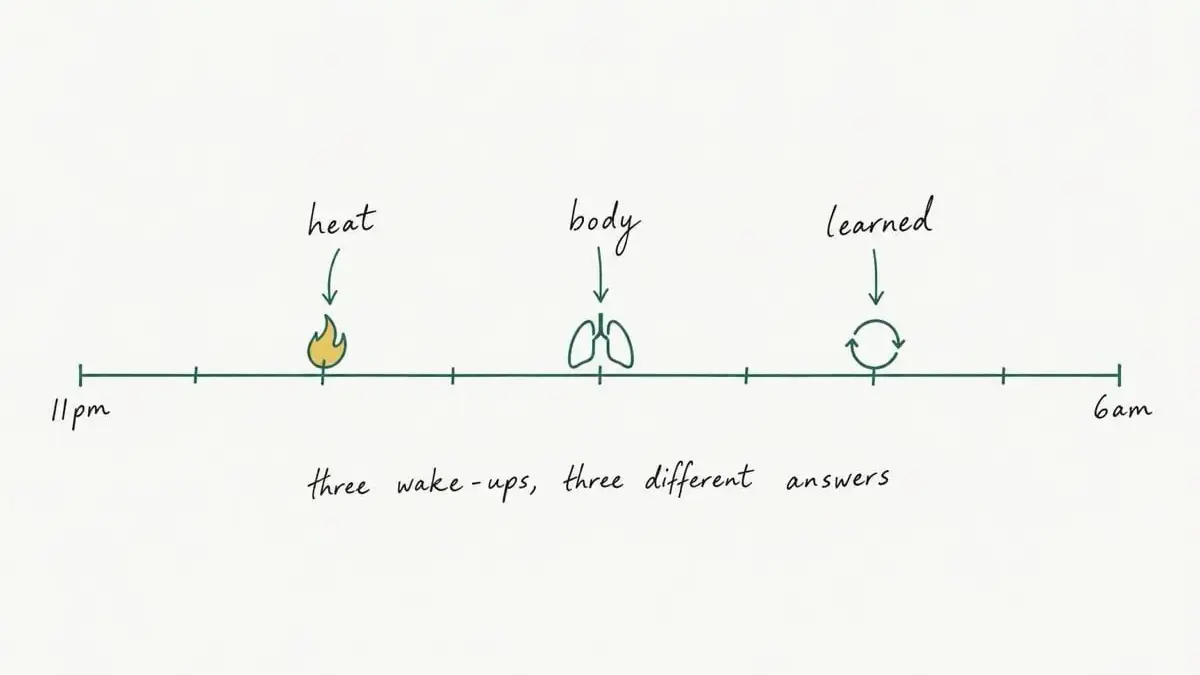
For many individuals, the inability to stay asleep is the most prominent feature, following a familiar and exhausting trajectory. A woman may fall asleep effortlessly by eleven o’clock, only to wake abruptly at 2:40 a.m. feeling damp, kicking off the covers, and then pulling them back up shortly after. Another waking often follows around 4:15 a.m., leading directly into a six o’clock alarm because professional responsibilities demand adherence to a rigid schedule.
By the time Thursday arrives, the cumulative toll manifests as frayed patience with loved ones and the cognitive fatigue of reading the exact same work email four times over. Secondary analyses spanning ten years of the same SWAN cohort revealed that self-reported insomnia symptoms affected 31 percent of women in early perimenopause during their first year, climbing to 39 percent by the tenth year. Among women in late perimenopause, the prevalence started at 32 percent and rose to 48 percent over a decade. These figures represent self-reported symptoms occurring at least three times a week rather than clinical diagnoses of insomnia, fluctuating across different stages and years. Nevertheless, experiencing these disruptions offers little comfort at 3 a.m., when the psychological weight of isolation makes the sufferer feel like an outlier.
Over time, this cycle fosters a profound psychological shift: the individual begins to genuinely dread the bed itself. This development is entirely new, deeply disruptive, and ultimately far more consequential than any over-the-counter supplement resting on a bathroom counter.
Why the Usual Natural Remedies Keep Failing You
Standard natural remedies for midlife sleep disruption typically fail because they are presented as an undifferentiated list of options devoid of sequential order, underlying mechanism, or rigorous evidence grading. Melatonin serves as a primary example of this phenomenon. When pooled across four randomized clinical trials involving menopausal women, its observed effect on overall sleep quality failed to reach statistical significance. In scientific terms, this indicates uncertainty rather than definitive disproof, a nuance rarely communicated on commercial product labels.
Valerian root fares little better under scientific scrutiny. An umbrella review published in 2024 synthesized eight systematic reviews examining valerian for sleep disturbances, ultimately judging the available evidence to be weak or inconclusive, with no demonstrable efficacy for insomnia.
Faced with these options, a woman might select a remedy, adhere to it for two weeks, observe no discernible change, and quietly conclude that the underlying failure rests with her own biology. In reality, she was handed a commercial shelf and instructed to guess. This approach is fundamentally flawed when applied to menopause-related insomnia, a complex physiological challenge driven by at least three distinct underlying causes.
Menopause Sleep Problems Are a Wake-Up Pattern, Not One Problem
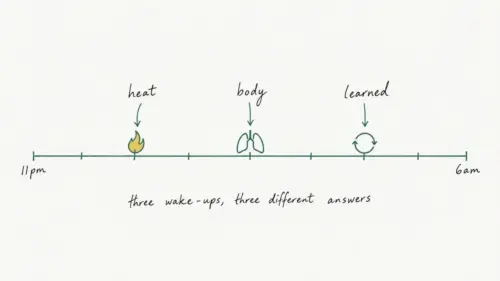
Menopause-related sleep difficulties do not stem from a single, uniform source. Instead, they represent at least three separate wake-up patterns masquerading behind identical symptoms: heat-driven awakenings, body-driven awakenings originating from physiological events such as disordered breathing, and learned awakenings that persist long after vasomotor symptoms have subsided. Applying a remedy designed for one specific pattern yields little benefit for the remaining two. Identifying which pattern dominates a person’s nights transforms a chaotic list of potential remedies into an actionable decision-making framework.
Heat-driven waking is the phenomenon most commonly associated with menopause, and its impact is thoroughly documented. In a study monitoring 168 midlife women using actigraphy, 78 percent of objectively recorded nocturnal hot flashes coincided with an actual awakening episode. Furthermore, participants demonstrated a significantly higher probability of being awake in the five minutes immediately following a flash than in the minutes preceding it. While temporal concurrence does not definitively prove that every awakening is initiated by a flash, the underlying correlation is difficult to dismiss.
Body-driven waking represents a pattern that is frequently overlooked by both patients and clinicians. Data from the Sleep in Midlife Women Study demonstrated that the adjusted apnea-hypopnea index—a standardized measure of breathing events during sleep—was approximately 31 percent higher postmenopause than it was premenopause. This metric measures specific respiratory disruptions rather than an absolute count of new clinical apnea diagnoses. The clinical relevance lies in how these events present: women suffering from obstructive sleep apnea often seek primary care reporting primary complaints of insomnia, fatigue, and low mood rather than classic symptoms like loud snoring. This atypical presentation remains a primary reason sleep-disordered breathing frequently goes undiagnosed in female patients.
Learned waking explains why some women remain wide awake at 3 a.m. years after their hot flashes have completely faded. Over time, the bed transforms from a place of rest into an environment associated with nocturnal arithmetic, anxiety, and mental calculations regarding the following day. At this stage, the disruption is no longer driven primarily by fluctuating hormones, making it the specific pattern backed by the most robust non-pharmacological treatments available.
While these three categories serve as a practical organizational framework rather than a rigid clinical classification—and real-world sleep weeks frequently blend elements of all three—categorizing nightly experiences remains valuable because each distinct group points toward a fundamentally different next step.
Natural Remedies, Ranked by the Evidence Behind Them
When evaluated strictly by the strength of supporting clinical evidence, natural and non-pharmacological interventions for menopause-related sleep disturbances establish a clear hierarchy: cognitive behavioral therapy for insomnia ranks first, regular exercise places second, and nutritional supplements lag distantly behind. In a randomized controlled trial involving 106 midlife women suffering from frequent hot flashes and insomnia, a structured program of telephone-delivered cognitive behavioral therapy for insomnia improved insomnia severity scores by roughly 5.2 points more than a menopause-education control group at eight weeks, with those therapeutic gains successfully maintained at the 24-week mark. No dietary supplement possesses clinical evidence matching that magnitude of improvement.
First: Cognitive Behavioral Therapy for Insomnia as a Treatment
Cognitive behavioral therapy for insomnia functions as a structured, short-term course of behavioral modification, typically spanning four to eight sessions delivered by a qualified clinician, trained therapist, or validated digital platform. The treatment targets the core behavioral mechanics of sleep: maintaining a single, fixed wake time every single day; restricting time spent in bed to closely match actual sleep duration; getting out of bed rather than lying awake during night-time hours; and systematically dismantling the cognitive thought loops that paralyze sleep at 3 a.m.
Professional medical guidelines consistently prioritize this intervention. The American College of Physicians recommends cognitive behavioral therapy for insomnia as the initial, frontline treatment for all adult patients suffering from chronic insomnia, issuing a strong recommendation based on moderate-quality evidence, while positioning medication as a secondary, shared decision if behavioral therapy alone proves insufficient. While those broader guidelines encompass adult populations with chronic insomnia generally rather than focusing exclusively on menopause, clinical trials specifically involving midlife women experiencing hot flashes and insomnia validate the same therapeutic approach.
A critical distinction emphasized by the American Academy of Sleep Medicine involves utilizing the full, multicomponent version of cognitive behavioral therapy for insomnia while explicitly advising against relying on basic sleep hygiene measures as a standalone treatment. Consequently, maintaining a tidy list of dark-room protocols, screen-free hours, and afternoon caffeine limits does not constitute the therapeutic intervention itself; it merely establishes the baseline environment.
Second: Exercise and Its Measured Impact
Pooled individual-participant data across four trials conducted by the Menopausal Strategies: Finding Another Link (MsFLASH) research network revealed that structured physical exercise reduced Insomnia Severity Index scores by an average of 2.1 points relative to control groups. While cognitive behavioral therapy for insomnia produced the largest observed effect size at 5.2 points, a two-point reduction represents a genuine, albeit modest, clinical improvement. It remains a worthwhile pursuit, though expectations should be managed regarding its capacity to independently resolve severe sleep deficits.
Third: Supplements Evaluated Through Evidence
When examining nutritional supplements, clinical data reveals significant limitations that are frequently omitted from commercial marketing materials. These compounds interact directly with conventional medications and with one another, necessitating professional guidance from a clinician or pharmacist prior to use. The existing body of research indicates that commonly recommended botanical and hormonal aids lack the robust, menopause-specific trial data required to support widespread clinical endorsement for chronic insomnia.
Context Regarding Bedroom Temperature
Standard advice for sleep disruption invariably suggests cooling the bedroom environment, yet controlled clinical evidence directly demonstrating that lowered ambient room temperature treats menopausal insomnia remains sparse. Research examining thermal regulation in healthy adult subjects indicates that warming the skin of the torso and upper legs by less than one degree Celsius shortened sleep-onset latency by approximately three minutes. That specific investigation did not focus on menopause or ambient room cooling, meaning it neither validates nor refutes standard thermal advice. The absence of definitive trial data, however, does not constitute evidence against personal comfort measures. Utilizing a fan and breathable bedding remains practical because experiencing a night sweat is demonstrably less distressing when trapped in light fabrics rather than heavy blankets. Ultimately, these measures provide comfort rather than acting as a biological treatment, and adjusting a room thermostat cannot dismantle a deeply entrenched 3.00 a.m. cognitive thought loop.
What One Week of This Actually Looks Like
In practical terms, adopting an evidence-based approach to midlife sleep disruption is systematic rather than glamorous. The process begins by selecting a single, consistent wake time and holding it rigidly across all seven days of the week, including weekends. Each morning requires recording three simple data points: the specific hour of waking, whether a vasomotor heat event was involved, and whether any respiratory issues or daytime fatigue surfaced. Ceasing the addition of random commercial interventions allows the nightly log, rather than a supplement product label, to clarify which specific wake-up pattern dominates the sleeping hours.
Consider two hypothetical midlife profiles illustrating how this diagnostic process operates in practice. Tricia, aged 49 and navigating early perimenopause, maintains a log revealing four nighttime awakenings over seven days, three of which necessitated changing damp sheets and turning on a bedside fan, with no reported breathing abnormalities. Her pattern is distinctly heat-driven. Her management strategy avoids purchasing a cascade of products; instead, she establishes a fixed wake time of 6:15 a.m., incorporates regular daily walks, utilizes breathable bedding, and logs the precise frequency of her hot flashes to discuss at her next clinical appointment.
Tricia’s structured log translates the subjective distress of feeling as though she never sleeps into precise clinical data: four nights out of seven, featuring three instances of night sweats, persisting over eleven weeks.
Marlene, aged 54 and two years postmenopausal, experiences minimal hot flashes, yet she consistently wakes at 3:10 a.m. Her log demonstrates an absence of heat symptoms alongside a persistent habit of lying awake for 90 minutes mentally drafting tomorrow’s to-do list. However, her breathing column is not blank; her partner has noted nocturnal snoring on multiple occasions, and she frequently falls asleep on the sofa by 8:00 p.m. Consequently, her situation yields two distinct next steps: consulting a physician regarding cognitive behavioral therapy for her learned nocturnal habits, and addressing the reported snoring and daytime somnolence during the same medical visit rather than dismissing them as general aging fatigue. In the interim, she leaves her bed whenever wakefulness extends beyond 20 minutes, preventing her brain from reinforcing the association between the bed and mental rumination.
Both individuals maintain their logs for a full week before altering their daily routines, avoiding the common pitfall of initiating magnesium supplements, blackout curtains, weighted blankets, and sleep tracking applications simultaneously, which obscures which intervention, if any, is effective.
When This Needs a Clinician, Not a Remedy
Certain nocturnal symptoms signal underlying medical conditions that extend far beyond lifestyle adjustments or natural remedies. Loud, disruptive snoring, witnessed breathing pauses, gasping or choking sensations during sleep, and persistent daytime exhaustion are designated by major health authorities as primary indicators of obstructive sleep apnea. Medical evaluation is strongly advised for these manifestations rather than experimentation down a retail supplement aisle. Similarly, sleep disturbances persisting at a frequency of at least three nights per week for three months or longer meet the established diagnostic threshold for chronic insomnia defined by the American Academy of Sleep Medicine.
Attributing these symptoms universally to the assumption that it is "just menopause" remains a primary factor delaying proper diagnosis and treatment. The elevated prevalence of sleep-disordered breathing during midlife underscores why atypical presentations in women—such as insomnia, chronic fatigue, and low mood—warrant comprehensive medical investigation.
Hormone therapy represents a critical therapeutic option worthy of discussion during a clinical consultation. Position statements issued by professional organizations, including the North American Menopause Society, identify hormone therapy as the single most effective intervention for managing moderate-to-severe hot flashes and night sweats, noting secondary improvements in sleep quality when sleep disruption is directly secondary to vasomotor symptoms. Hormone therapy is not classified as a standalone treatment for primary chronic insomnia, and its suitability depends entirely on an individualized risk-benefit assessment conducted by a qualified healthcare provider.
Start With One Night, Not Eight Changes
Establishing a clear path forward begins with defining a consistent wake time before selecting any therapeutic intervention. Placing a dedicated log book by the bedside to record the hour of waking, the presence of heat, and any respiratory symptoms or daytime fatigue for seven consecutive days provides an essential baseline. Holding a single wake time without introducing overlapping routines prevents the common cycle of trial-and-error exhaustion.
This observational log serves as an accessible diagnostic tool, bridging the gap between an overwhelming commercial marketplace of unverified remedies and a targeted, evidence-based discussion with a clinician.
Leave a Reply