
For millions of women navigating the menopausal transition, nighttime disturbances do not feel like ordinary bad sleep; they carry a distinct and repetitive signature. Menopause sleep problems typically manifest at both ends of the night, making it increasingly difficult both to fall asleep and to stay asleep. Data from the landmark Study of Women’s Health Across the Nation (SWAN), which meticulously followed 3,045 women aged 42 to 52 at enrollment, revealed that the odds of experiencing both types of sleep disruption steadily rise across the entire menopausal transition.
When nights repeat themselves with identical patterns while external life circumstances remain unchanged, it creates a psychological and physical tell. This unique predictability is precisely why generic sleep hygiene advice often fails to provide relief. For many women, the staying-asleep phase of the night is the loudest and most disruptive element, typically following a remarkably familiar trajectory. A woman might fall asleep effortlessly by eleven, only to jolt awake at 2:40 a.m. feeling damp, kicking off the covers, and then pulling them back up shortly after. Another waking often occurs around 4:15 a.m., leading inevitably to an early start at six because professional demands and daily obligations offer no reprieve.
By Thursday, the accumulated sleep deficit manifests as irritability with loved ones and the frustrating necessity of rereading a single work email four times. Secondary analyses spanning ten years of the SWAN cohort underscored the pervasive nature of these symptoms. Insomnia symptoms were reported by 31 percent of women in early perimenopause during the first year, escalating to 39 percent by year ten. Similarly, 32 percent of women in late perimenopause reported these symptoms, with that figure rising to 48 percent over time. These figures represent self-reported symptoms occurring at least three times a week rather than clinically diagnosed insomnia, shifting across stages and years. Yet, recognizing these patterns offers profound reassurance to women who otherwise feel entirely isolated during lonely hours of the night. Over time, the bedroom itself often transforms from a sanctuary into a source of dread, a psychological shift that ultimately matters far more than any over-the-counter supplement.
Why the Usual Natural Remedies Keep Failing You
The frustration experienced by midlife women is frequently compounded by the trial-and-error approach of natural remedies. Standard recommendations for broken midlife sleep usually arrive as a disorganized list of options devoid of clear ordering, underlying mechanisms, or empirical grading. Melatonin serves as the most prominent example of this disconnect. When data is pooled across four randomized trials involving menopausal women, the actual effect on sleep quality fails to reach statistical significance. In scientific terms, this indicates uncertainty rather than definitive disproof, a nuance rarely reflected on the labels of retail boxes.
Valerian root fares no better under rigorous scrutiny. A comprehensive 2024 umbrella review synthesized eight systematic reviews examining valerian for sleep disturbances, ultimately judging the evidence to be weak or inconclusive, with virtually no demonstrated efficacy against insomnia. Consequently, women frequently select a remedy, adhere to it for a fortnight, notice no discernible change, and quietly conclude that the fault lies within themselves. In reality, the problem stems from a fragmented wellness market that hands consumers an uncurated shelf of products and expects them to guess a solution for menopause-related insomnia—a complex condition driven by multiple distinct physiological mechanisms.
Menopause Sleep Problems Are a Wake-Up Pattern, Not One Problem
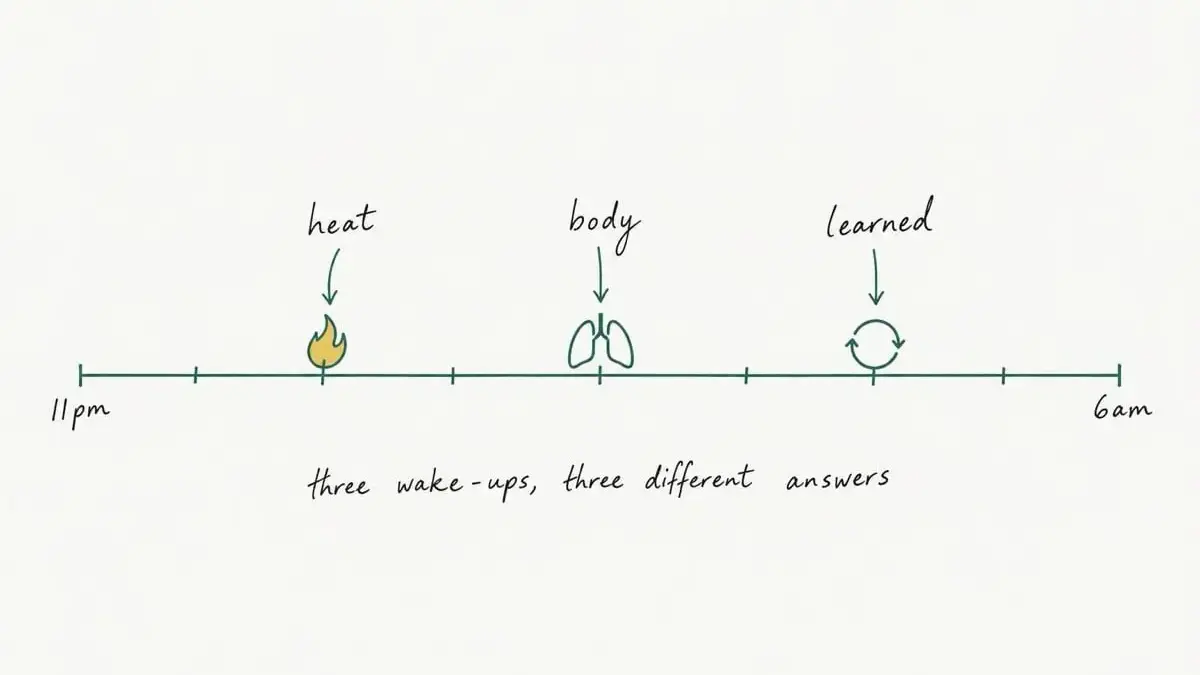
Clinical specialists emphasize that menopause-related sleep difficulties do not stem from a single, uniform origin. Instead, they represent at least three distinct wake-up patterns wearing the same outward symptom: heat-driven waking, body-driven waking rooted in issues such as disordered breathing, and learned waking that persists long after vasomotor symptoms have faded. Applying a remedy designed for one specific pattern yields little to no benefit for the other two. Determining which pattern dominates a woman’s nights is the critical step that transforms a random list of remedies into an effective clinical decision.
Heat-driven waking is the phenomenon most commonly associated with menopause, and its physiological reality is well-documented. In an observational study of 168 midlife women monitored using actigraphy, 78 percent of objectively recorded nocturnal hot flashes coincided directly with a waking episode. Furthermore, women demonstrated a significantly higher probability of being awake in the five minutes immediately following a flash compared to the minutes preceding it. While temporal concurrence does not definitively prove that every awakening originates from a thermal surge, the clinical link remains robust.
Body-driven waking, by contrast, frequently evades detection during routine medical consultations. Data from the Sleep in Midlife Women Study revealed that the adjusted apnea-hypopnea index was approximately 31 percent higher after the menopausal transition than before it. This metric measures breathing events rather than counting new clinical apnea diagnoses. The clinical challenge lies in how obstructive sleep apnea presents in women; rather than exhibiting traditional heavy snoring, female patients frequently visit primary care physicians reporting insomnia, persistent fatigue, and low mood, which frequently results in underdiagnosis.
Learned waking explains why many women remain wide awake at 3 a.m. years after their hot flashes have completely subsided. Over time, the bed becomes conditioned as a place of cognitive arousal—a space dedicated to calculating obligations for the following morning. This behavior is no longer driven by hormonal fluctuations, yet it represents the specific pattern backed by the most rigorous non-pharmacological evidence. While individual nights often blend these categories, sorting them out provides clarity for determining the appropriate next steps.

Natural Remedies, Ranked by the Evidence Behind Them
When evaluated strictly by the strength of empirical evidence, natural and non-pharmacological interventions for menopause sleep disturbances follow a clear hierarchy: cognitive behavioral therapy for insomnia ranks first, regular exercise places second, and dietary supplements occupy a distant third. In a randomized controlled trial involving 106 midlife women suffering from frequent hot flashes and insomnia, telephone-delivered cognitive behavioral therapy for insomnia (CBT-I) reduced insomnia severity scores by approximately 5.2 points more than a menopause-education control group at eight weeks, with these therapeutic gains successfully maintained at the 24-week mark. No supplement currently possesses clinical evidence matching that level of efficacy.
CBT-I functions as a structured behavioral treatment rather than a casual wellness tip. Typically delivered over four to eight sessions by a trained clinician, therapist, or guided digital program, it targets core sleep mechanics. Interventions include maintaining a fixed wake time every single day, restricting time in bed to match actual sleep duration, breaking the habit of lying awake in bed, and dismantling nocturnal thought loops. Professional guidelines strongly support this approach; the American College of Physicians recommends CBT-I as the initial intervention for all adults suffering from chronic insomnia, backed by moderate-quality evidence, with pharmacological treatments considered only if behavioral therapy proves insufficient.
Regular exercise offers a more modest yet reliable therapeutic effect. Pooled individual-participant data across four trials conducted by the MsFLASH research network demonstrated that structured exercise reduced Insomnia Severity Index scores by an average of 2.1 points relative to control groups. While a two-point improvement represents a genuine benefit, it is not substantial enough to carry the entire therapeutic burden alone. Supplements remain in third place, with variable evidence that must always be weighed against potential interactions with prescription medications.
What One Week of This Actually Looks Like
In practical terms, adopting an evidence-based approach to midlife sleep disruption is remarkably straightforward. Patients are encouraged to select a single wake time and maintain it rigidly, including on weekends. Each morning, keeping a simple log documenting the time of waking, the presence of heat, and any respiratory symptoms or daytime fatigue replaces the chaotic cycle of trying multiple interventions simultaneously. Within days, this observational log clarifies which specific wake-up pattern is disrupting rest.
For example, a woman in early perimenopause whose log reveals frequent wakings accompanied by night sweats and zero respiratory symptoms can clearly identify a heat-driven pattern. Her management strategy avoids unnecessary purchases, focusing instead on a fixed morning wake time, regular physical activity, breathable bedding, and documenting the frequency of her vasomotor symptoms for her next clinical evaluation. Conversely, another woman several years past her final menstrual period who experiences no heat but exhibits cognitive hyperarousal alongside partner-reported snoring benefits from recognizing both a learned waking pattern and potential sleep-disordered breathing. This insight directs her to discuss CBT-I and her respiratory symptoms with a physician rather than attributing her exhaustion solely to aging.
Maintaining this observational log for a single week prevents the common pitfall of introducing magnesium, blackout curtains, specialized pillows, and sleep tracking applications all at once, which obscures which intervention, if any, is actually working. Furthermore, approaching sleep disruption without viewing it as a personal failure regarding discipline helps contextualize the reality that midlife sleep changes frequently coincide with numerous overlapping physical and emotional transitions.
When This Needs a Clinician, Not a Remedy
Certain nocturnal symptoms signal the need for professional medical evaluation rather than self-directed remedies. Severe symptoms such as loud snoring, breathing interruptions, gasping or choking episodes, and persistent daytime exhaustion are hallmark indicators of sleep apnea, prompting major health authorities to advise consulting a physician. Similarly, sleep disturbances persisting at least three times a week for three months or longer meet diagnostic criteria for chronic insomnia, warranting formal medical guidance.
Dismissing these symptoms with the assumption that it is "just menopause" remains a primary barrier to timely care. Given that sleep-disordered breathing in women frequently presents as insomnia, fatigue, and low mood rather than classic heavy snoring, professional assessment is vital. Furthermore, for women whose sleep disruption is directly tied to vasomotor symptoms, hormone therapy is recognized by the North American Menopause Society as the most effective treatment for hot flashes and night sweats, with secondary benefits for sleep quality when disturbances stem from those underlying symptoms. A comprehensive clinical evaluation ensures that underlying conditions are properly identified and managed, moving past the guesswork of the supplement aisle toward sustainable relief.
Leave a Reply