
For millions of women undergoing the menopausal transition, nocturnal rest does not merely decline; it fractures in a distinct, repetitive rhythm. Menopause sleep problems typically manifest at both ends of the night—making it exceptionally difficult to both fall asleep and stay asleep. Data from the landmark Study of Women’s Health Across the Nation (SWAN), which meticulously followed 3,045 women aged 42 to 52 at enrollment, revealed that the odds of experiencing both types of sleep disturbances steadily rose across the entire menopausal transition.
The experience is often defined by its uncanny predictability. The nights repeat in a frustrating loop, often occurring even when nothing else in a woman’s external life has changed. That distinct combination is the hallmark of midlife sleep disruption, and it explains precisely why generic sleep advice repeatedly fails to hit the mark.
For many women, the waking-up half of the night is the loudest and most disruptive, possessing a depressingly familiar shape. Sleep arrives without much trouble around eleven o’clock, only to be violently interrupted at 2:40 a.m. The woman wakes up damp, instinctively kicking the covers off, only to pull them back up minutes later as chills set in. Sleep might return briefly, only to shatter again at 4:15 a.m., before the alarm forces an emergence at six o’clock because professional and personal obligations do not yield to exhaustion.
By Thursday, the cumulative toll becomes visible: an uncharacteristic shortness of temper with loved ones and the cognitive fatigue of having to reread the same work email four times just to grasp its meaning. Secondary analyses tracking ten years of the same SWAN cohort painted a stark numerical picture of this progression. Insomnia symptoms were reported by 31 percent of women in early perimenopause during the first year, rising to 39 percent by year ten. Meanwhile, among women in late perimenopause, the prevalence started at 32 percent and climbed to 48 percent.
These figures represent self-reported symptoms occurring at least three times a week rather than clinical diagnoses of chronic insomnia, and they naturally fluctuate by menopausal stage and year. Yet, for the individual experiencing them, knowing these figures provides a crucial anchor: a realization that she is not the isolated outlier she feels like when staring at the ceiling at 3:00 a.m. More importantly, many women find themselves developing a psychological dread of the bed itself—a new and pervasive development that clinical researchers argue matters far more to long-term recovery than any supplement sitting on a bathroom counter.
Why the Usual Natural Remedies Keep Failing You
Standard natural remedies for broken midlife sleep frequently fail because they are typically encountered as an unorganized list of options lacking clear mechanisms, prioritization, or graded scientific evidence. Melatonin serves as the most prominent example of this disconnect. When data is pooled across four separate randomized clinical trials involving menopausal women, the actual effect of melatonin on sleep quality fails to reach statistical significance. In scientific terms, this indicates uncertainty rather than outright disproving, but that nuance is entirely absent from the confident language printed on retail supplement boxes.
Valerian root fares no better under rigorous scientific scrutiny. An extensive umbrella review published in 2024 synthesized eight systematic reviews examining valerian for sleep disturbances and judged the overall evidence to be weak or inconclusive, finding no demonstrable evidence of efficacy specifically for insomnia.
Faced with these options, a woman typically tries one remedy, gives it a trial period of two weeks, feels no tangible difference, and quietly concludes that the failure rests with her own biology. In reality, the problem lies in the approach. Patients are routinely handed an unstructured retail shelf and told to guess—an ineffective strategy for managing a complex condition like menopause-related insomnia, which actually stems from at least three distinct biological and behavioral causes.
Menopause Sleep Problems Are a Wake-Up Pattern, Not One Problem
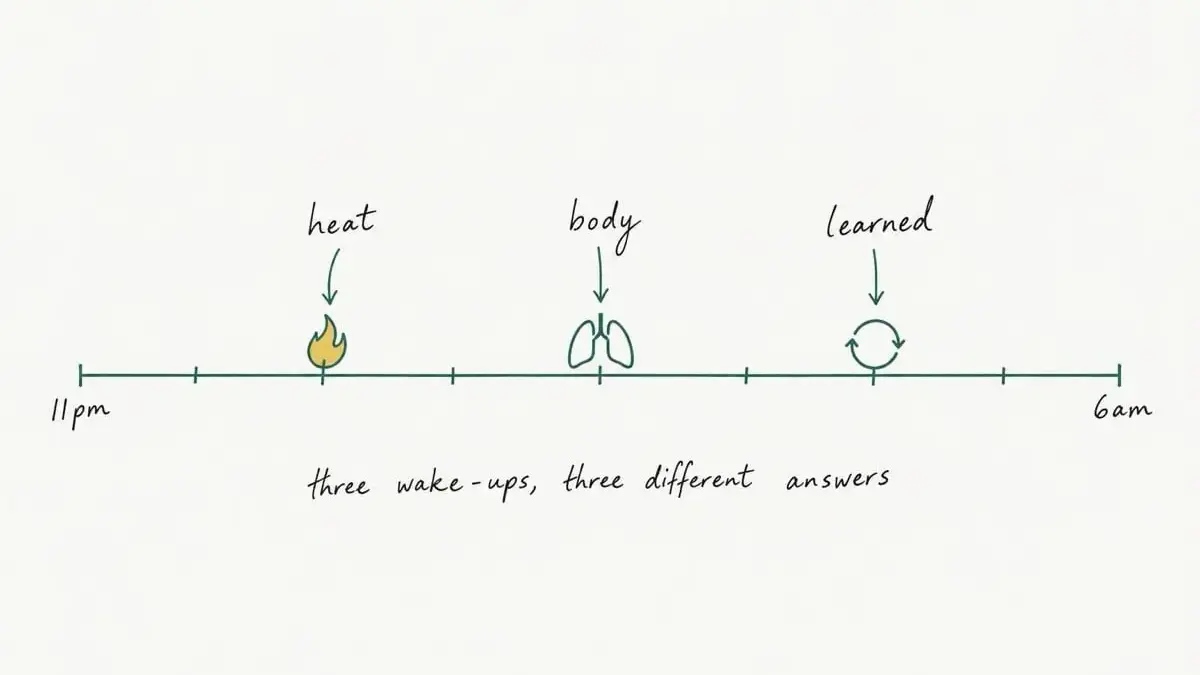
Clinical specialists emphasize that menopause sleep disruptions are not a single uniform issue. Instead, they represent at least three separate wake-up patterns wearing the same outward symptom: heat-driven awakenings, body-driven awakenings rooted in physiological issues such as disordered breathing, and learned awakenings that persist long after the biological hot flashes have faded. A remedy aimed at addressing only one of these patterns will inevitably do little for the other two. Identifying which specific pattern dominates a person’s nights is what transforms a random list of tips into a coherent medical strategy.
Heat-driven waking is the phenomenon most commonly associated with menopause, and its physiological reality is well-documented. In a study monitoring 168 midlife women using actigraphy, 78 percent of objectively recorded nocturnal hot flashes coincided directly with an awakening episode. Furthermore, women were significantly more likely to be awake during the five minutes immediately following a flash than in the minutes leading up to it. While mere concurrence does not mathematically prove that every single awakening initiates with a vasomotor flush, the underlying connection is robust.
Body-driven waking, by contrast, represents the pattern most frequently overlooked in primary care settings. Data from the Sleep in Midlife Women Study demonstrated that the adjusted apnea-hypopnea index—a standard measure of breathing events during sleep—was roughly 31 percent higher post-menopause than it was pre-menopause. This metric measures actual breathing disruptions rather than formal clinical diagnoses of sleep apnea. What makes this finding vital is how the condition clinically presents: women suffering from obstructive sleep apnea frequently visit their primary care physicians reporting chronic insomnia, persistent fatigue, and low mood rather than the stereotypical heavy snoring commonly associated with menopausal men, which remains a primary reason the condition so frequently goes undiagnosed in women.
Learned waking explains why a significant number of women remain wide awake at 3:00 a.m. years after their hot flashes have completely subsided. Over time, the bed has psychologically transformed from a place of rest into a stressful environment where the mind lies awake performing mental arithmetic about the upcoming day. This is no longer a hormone-driven problem; it is a conditioned behavioral response, and it happens to be the specific pattern backed by the most robust non-pharmaceutical treatment evidence available.
While sorting nights into these distinct categories serves as a conceptual framework rather than a rigid clinical classification—since real-world weeks frequently intermingle them—it remains immensely useful. Each distinct group points toward a fundamentally different next clinical step.
Natural Remedies, Ranked by the Evidence Behind Them
When evaluated strictly by the strength of empirical evidence supporting their effectiveness, natural remedies for menopause-related sleep problems fall into a clear hierarchy: cognitive behavioral therapy for insomnia ranks first, regular exercise places a distant second, and dietary supplements occupy a third tier far behind the others.
In a rigorous randomized trial involving 106 midlife women suffering from frequent hot flashes and co-occurring insomnia, telephone-delivered cognitive behavioral therapy for insomnia improved insomnia severity scores by approximately 5.2 points more than a menopause-education control group at the eight-week mark, with those therapeutic gains remaining stable at 24 weeks of follow-up. No herbal or dietary supplement possesses clinical trial evidence approaching that magnitude.
First: CBT-I, Which Is a Treatment, Not a Tip
Cognitive behavioral therapy for insomnia is not a casual lifestyle tip; it is a structured, short-term behavioral intervention typically lasting four to eight sessions, delivered either by a trained clinician, a specialized therapist, or a validated digital health program. The intervention targets the core mechanics of sleep: establishing a single, rigid wake-up time maintained every day of the week, restricting time spent in bed to closely match actual sleep duration, getting out of bed immediately rather than lying awake, and dismantling the midnight cognitive thought loops.

Professional medical guidelines consistently point to this modality as the primary intervention. The American College of Physicians recommends cognitive behavioral therapy for insomnia as the initial treatment for all adults suffering from chronic insomnia, issuing a strong recommendation backed by moderate-quality evidence, with pharmacological treatments reserved for shared decision-making if behavioral therapy alone proves insufficient. While that specific clinical guideline addresses chronic insomnia across the general adult population rather than menopause exclusively, the clinical trial cited earlier provides the direct match by focusing specifically on midlife women experiencing hot flashes and insomnia.
A critical distinction emphasized by sleep medicine experts involves the scope of the therapy. The American Academy of Sleep Medicine formally recommends the comprehensive, multicomponent version of cognitive behavioral therapy for insomnia while explicitly advising against relying on generic sleep hygiene tips as a stand-alone treatment. Consequently, the standard, tidy list of habits—keeping the room dark, eliminating screens, and avoiding late caffeine—does not constitute the treatment itself; it merely represents the foundational baseline.
Second: Exercise, With an Honest Effect Size
Pooled individual-participant data gathered across four separate MsFLASH clinical trials revealed that structured physical exercise reduced Insomnia Severity Index scores by an average of 2.1 points relative to control groups, compared to the 5.2-point reduction achieved by cognitive behavioral therapy for insomnia. A two-point reduction represents a genuine, measurable improvement, but it is a modest one—making exercise an intervention well worth performing, but not one capable of carrying the entire therapeutic load alone. Maintaining physical routines through weeks marked by profound fatigue remains a persistent challenge for midlife women navigating these transitions.
Third: Supplements, With Their Evidence Attached
When examining the role of dietary supplements, clinical evidence reveals significant limitations. Supplements routinely interact with conventional prescription medications and with one another, making professional medical or pharmacological consultation essential before ingestion. While various natural compounds have been studied, none carry the robust clinical backing required to displace behavioral interventions as the primary treatment standard.
A Note on the Cool-Bedroom Advice
Almost every piece of popular literature concerning menopausal sleep advises dropping the ambient temperature of the bedroom. However, researchers have found a distinct lack of controlled clinical evidence demonstrating that cooler room temperatures directly treat menopausal insomnia. Available physiological studies on temperature generally examine different demographics; for example, controlled research in healthy adults has shown that warming the skin of the trunk and upper legs by less than one degree Celsius can shorten sleep-onset latency by approximately three minutes.
That specific research did not focus on menopause nor did it test room cooling, meaning it neither validates nor refutes the popular advice. Nevertheless, maintaining a cool room with a fan and breathable bedding remains a sensible practice simply because managing acute night sweats is inherently less miserable when heavy, trapping blankets are removed. Experts advise treating room temperature as a matter of physical comfort rather than a biological treatment for insomnia, noting that a household thermostat cannot resolve a psychologically conditioned midnight thought loop.
What One Week of This Actually Looks Like
In practical application, an evidence-based approach to managing midlife sleep disruption is remarkably straightforward. A patient selects a single, immovable wake-up time and maintains it every day, including weekends. Each morning, the individual records three specific details: the hour they woke up, whether a hot flash or heat was involved, and whether any breathing-related symptoms—ranging from partner-observed snoring to profound daytime exhaustion—occurred. This systematic tracking replaces the impulse to constantly introduce new commercial interventions. By day five, the personal log rather than a supplement marketing label reveals which distinct wake-up pattern is dominating the night.
Consider the contrasting cases of two hypothetical midlife readers. Tricia is 49 and in early perimenopause. Her daily log reveals four nocturnal awakenings over seven nights, three of which necessitated changing damp sheets and turning on a bedside fan, with zero entries in the breathing column. Her pattern is distinctly heat-driven. Her management strategy avoids purchasing an array of unproven products; instead, she establishes a fixed 6:15 a.m. wake time, incorporates daily walks, switches to breathable bedding, and compiles a concise note for her upcoming physician appointment detailing the weekly frequency of her vasomotor flashes.
Tricia’s structured log accomplishes something vital: it translates the sweeping emotional declaration of "I never sleep anymore" into precise clinical data that a physician can readily evaluate—specifically, four nights out of seven, featuring three episodes of night sweats, sustained over eleven weeks.
Marlene is 54 and two years past her final menstrual period. Her vasomotor flashes have largely ceased, yet she continues to wake up reliably at 3:10 a.m. Her log demonstrates a complete absence of heat, accompanied by a consistent behavioral habit of lying awake in bed for ninety minutes mentally drafting the next day’s to-do list. However, her breathing column is not blank; her partner has noted heavy snoring on two occasions, and she frequently finds herself dozing off in front of the television by eight o’clock in the evening.
Consequently, Marlene’s log yields two distinct clinical next steps: consulting her physician about cognitive behavioral therapy for insomnia to address the learned behavioral waking pattern, and simultaneously raising the issue of nocturnal snoring and excessive daytime sleepiness during the same medical visit rather than dismissing them as ordinary fatigue. In the interim, she adopts the behavioral rule of getting out of bed if she remains awake for twenty minutes, preventing her brain from reinforcing the association between the bed and active cognitive work.
Both readers maintain their logs for a full week before altering any routines. That single procedural discipline prevents the common pitfall of simultaneously launching magnesium supplements, blackout curtains, a specialized pillow, and a sleep tracking application in the same week, which ultimately obscures which intervention, if any, provided relief.
When This Needs a Clinician, Not a Remedy
Certain nocturnal symptoms clearly signal the need for professional medical evaluation rather than self-directed remedy trials. NHS clinical guidelines indicate that loud snoring, breathing that repeatedly pauses and starts, audible gasping or choking noises during the night, and persistent, severe daytime fatigue are cardinal symptoms of obstructive sleep apnea, advising patients to consult a physician directly instead of browsing supplement aisles. The same recommendation applies to sleep disturbances that persist at least three nights a week for a duration of three months or longer—the established clinical threshold for chronic insomnia defined by the American Academy of Sleep Medicine.
Medical professionals caution that dismissing persistent sleep disruption with the assumption that "it’s just menopause" is the single factor most likely to delay proper diagnosis and treatment by a year or more. The elevated rates of sleep-disordered breathing observed in midlife women frequently manifest not as classic heavy snoring, but precisely through presenting symptoms of insomnia, profound fatigue, and depressed mood.
For women experiencing vasomotor symptoms, hormone therapy represents a clinical option worthy of discussion during a medical appointment. The position statement issued by The North American Menopause Society identifies hormone therapy as the single most effective systemic treatment for moderate to severe hot flashes and night sweats, noting subsequent improvements in sleep quality when the underlying sleep disturbance is directly secondary to those vasomotor symptoms. However, hormone therapy is not classified as a stand-alone treatment for primary chronic insomnia, and its suitability depends entirely on a personalized clinical benefit-risk assessment conducted by a qualified healthcare provider.
Leave a Reply