

Launched quietly in February, a novel torrent search engine named TorrentClaw is turning heads across the digital landscape by aggressively leveraging artificial intelligence to reshape how files are indexed, categorized, and verified. Built upon links harvested from its proprietary Distributed Hash Table (DHT) crawler alongside dozens of external torrent sites and aggregators, the platform has rapidly expanded. In just a few months of operation, TorrentClaw has ballooned into a massive index housing more than six million torrents, encompassing everything from niche releases to the latest Hollywood blockbusters and hit television series.
While traditional torrent sites often rely on clunky, retro interfaces, TorrentClaw immediately stands out with a sleek, modern homepage that bears unmistakable visual markers of AI-driven design. The platform makes no secret of this ancestry; rather, its creators embrace artificial intelligence as the foundational pillar powering every facet of the site’s ongoing development, operational scaling, and marketing outreach. According to the platform’s core developers—who collectively operate under the pseudonym Deivid Soto—the entire infrastructure is heavily automated through cutting-edge language models.
"Basically, the core framework is Claude Code combined with local LLMs for specific execution and ingestion tasks," Soto explains, shedding light on the technical engine driving the enterprise.
This heavy reliance on automated systems allows the platform to handle labor-intensive data organization effortlessly. For instance, advanced language models are deployed to accurately match raw torrent files to official film and television titles, ensuring that media is neatly categorized without requiring an army of human moderators. Beyond simple organization, this technological approach has enabled the development of novel tools designed to address longstanding security and authenticity issues that have plagued the peer-to-peer ecosystem for decades. Among these innovations is TrueSpec, a specialized verification system built to determine whether torrents actually contain the content advertised in their release titles, thereby helping users sidestep deceptive uploads and malicious software.
TrueSpec: Download and Verify
In the traditional peer-to-peer landscape, release names serve as the primary source of metadata for users seeking media. These strings of text typically detail resolution, video codecs, audio configurations, and the specific release group responsible for the file. However, these labels offer zero absolute guarantee of accuracy. While well-run, private torrent communities rely on vigilant manual moderation teams to police mislabeled or malicious content, the vast majority of automated public indexes operate entirely unmoderated. TrueSpec was designed to bridge this operational gap.
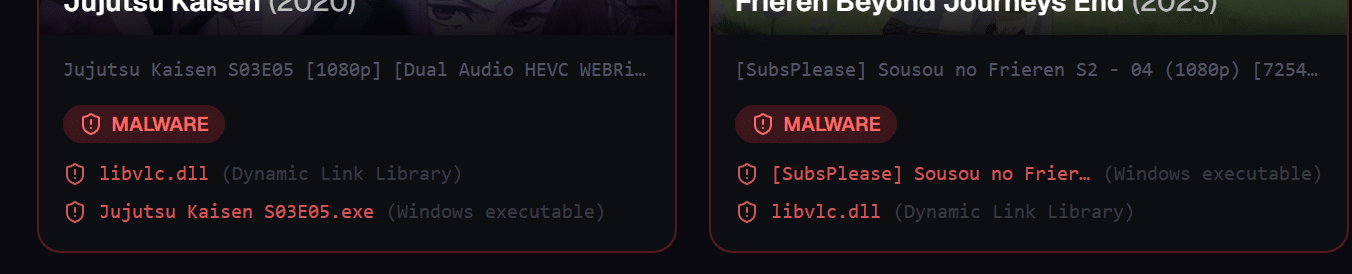
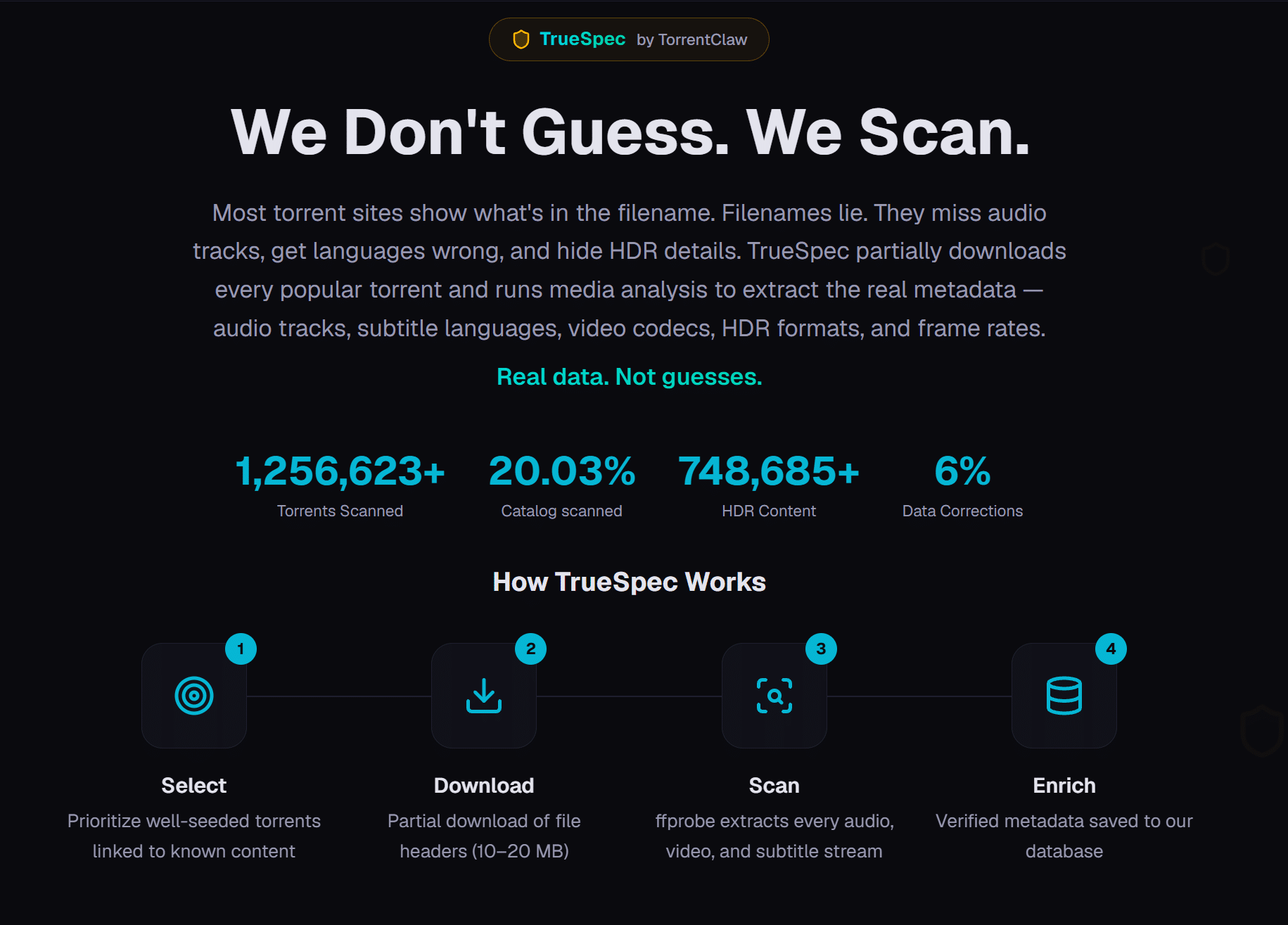
Operating in the background, the TrueSpec system actively joins individual torrent swarms to inspect file listings directly. Instead of downloading entire media files, the tool retrieves just enough pieces—typically ranging between 10 to 20 megabytes per torrent—to run a diagnostic check using the video analysis utility ffprobe. This allows the system to cross-reference the physical contents of the container against the claims made in the release title, flagging discrepancies, fake resolutions, and disguised programs.
In addition to validating media containers, TrueSpec incorporates a security screening protocol for suspicious files. When encountering executable files or unrecognized formats, the system looks up their cryptographic hashes on VirusTotal. If the file size permits, the tool uploads the binary directly for a comprehensive security scan. TorrentClaw does not operate its own proprietary antivirus engine; instead, all malware verdicts are derived directly from VirusTotal’s established threat intelligence database.
When TrueSpec successfully identifies a genuine malware threat, the affected torrent is not scrubbed from the index entirely. Instead, the platform retains the listing on the site but appends a clear "Malware detected" warning label while disabling the associated download button. Highlighting the persistence of these threats, one fake episode of the popular animated series Jujutsu Kaisen bearing this warning label still maintained 34 active seeders while remaining accessible on various external third-party sites.
Navigating False Positives and Limitations
Despite its innovative approach, the TrueSpec verification apparatus has encountered growing pains and technical hurdles. During an earlier testing phase in July, an initial dataset identified 6,450 suspected malware cases, though subsequent analysis revealed a high volume of false positives. Among the misidentified files were harmless legacy items such as the well-known RARBG maintenance executable file, specialized fansub scripts designed to switch audio languages on the fly, and benign scripts intended solely to open a web browser.
Refined data from late September presents a more accurate picture of the platform’s threat landscape. TorrentClaw now restricts its official malware classifications strictly to instances where VirusTotal explicitly confirms a threat, resulting in a significantly trimmed count of 34 verified malicious torrents. Spot-checks of the underlying data confirm that every flagged case links directly to a corresponding VirusTotal report.

Even with these improvements, security experts note that the current detection count is likely conservative. TrueSpec avoids downloading large executable packages, prioritizes ingestion toward well-seeded torrents, and is entirely incapable of scanning dead swarms with zero active peers. Furthermore, because TorrentClaw concentrates its indexing efforts primarily on films and television shows, pirated software applications and video games remain largely unmonitored by the system.
Malware represents only a fraction of the anomalies flagged by TrueSpec. Out of 687,057 total probed torrents, approximately 1,265 were flagged as deceptive, encompassing programs disguised as video files and intentionally falsified resolution claims. This deceptive category accounts for less than 0.2 percent of all checked files.
By contrast, the most frequent type of "mislabeling" identified by the system is entirely harmless. More than half of all probed torrents—roughly 55 percent—include auxiliary subtitle tracks that are omitted from the primary release names. While TorrentClaw flags these as missing labels, standard scene distribution rules do not mandate the inclusion of subtitle details in titles unless the text is hardcoded directly into the video stream.
Uncovering VLC Player Malware Vectors
A closer examination of the confirmed malware torrents reveals a distinct, recurring operational pattern. In 31 out of the 34 verified cases, the malicious torrent packages contain an executable file renamed to match a current television episode or film title, accompanied by a legitimate file named libvlc.dll and a playable video file housed within a subfolder.
The application bundled in these packages is a direct, unmodified copy of the genuine VLC media player originating from VideoLAN, retaining its authentic code signature. The vector for infection relies instead on the accompanying dynamic-link library file. When the user launches the media player, the application automatically loads the malicious DLL, which security engines on VirusTotal subsequently flag as a trojan.

The torrents carrying these payloads are brazenly disguised as popular, high-profile media releases, including episodes of hit series such as The Boys, Jujutsu Kaisen, and Frieren, alongside major cinematic features like Dune: Part Three and Zootopia 2. Many of these listings fraudulently appropriate the names of established release and distribution groups, including SubsPlease, ETHEL, and YTS, to foster a false sense of security among prospective downloaders.
This specific propagation method is well-documented within the cybersecurity community. Earlier in the year, security researchers detailed a coordinated campaign utilizing counterfeit SubsPlease releases distributed via alternative indexes like Nyaa to spread the Vidar infostealer, operations frequently executed through compromised user accounts. TorrentClaw cataloged its 31 identified malware torrents between February and August. The majority—22 entries—originated from its own DHT crawler, while the remainder were ingested from external platforms including Nyaa, The Pirate Bay, and TorrentDownload. Soto notes that all of these files possessed active seeders when initially indexed, and 15 remained actively circulating as of early October.
Built For AI, By AI
TrueSpec represents only one component distinguishing TorrentClaw from traditional torrent indexes. The platform also features a Model Context Protocol (MCP) server, allowing modern artificial intelligence assistants such as Claude and Cursor to directly query the site’s index and retrieve .torrent files autonomously.
Technically, this integration means users can direct an AI assistant to locate a specific media release and fetch the underlying torrent file entirely through natural language prompts, bypassing the need to visit the website’s front end. According to Soto, certain automated accounts execute approximately 10,000 API requests daily, indicating heavy utilization by external third-party sites or specialized services.
Remarkably, maintaining this infrastructure remains remarkably inexpensive. In July, Soto estimated that the core TrueSpec verification pipeline operated on just three server nodes costing a combined total well under $50 per month. Highlighting the economic viability of automated auditing, Soto noted the broader implication: if content verification can be executed this cheaply, any major indexer could theoretically implement it, yet none currently do.
Nevertheless, the practice of partially downloading content from hundreds of thousands of individual swarms carries potential legal complications. TorrentClaw’s official Digital Millennium Copyright Act (DMCA) policy states that the platform does not host, store, upload, or distribute files. However, copyright holders may interpret automated fragment retrieval differently.
Addressing these concerns, Soto describes TrueSpec as a passive, read-only client that strictly avoids uploading or seeding data to the swarm. The system retrieves only the initial segments of a video file—just enough data to read the container headers for verification purposes—and immediately purges the information.
"It deletes everything once the analysis is done. We don’t store or serve any content, and we process every valid takedown notice we receive," Soto states.
Demonstrating its commitment to automation, TorrentClaw even utilizes artificial intelligence to process copyright infringement notices. An AI-managed system introduced in late September has successfully handled 23 takedown requests, succeeding an earlier batch of just over 300 notices, the majority of which were duplicates.
To sustain operations, TorrentClaw has introduced tiered subscription models. A standard PRO tier is available for $3.99 per month, while a PRO+ package bundled with an integrated virtual private network service costs $6.99 monthly. Whether this commercialized approach can endure scrutiny remains to be seen, as monetized torrent services historically attract significantly sharper legal focus from rightsholders than their purely free counterparts.


Leave a Reply