
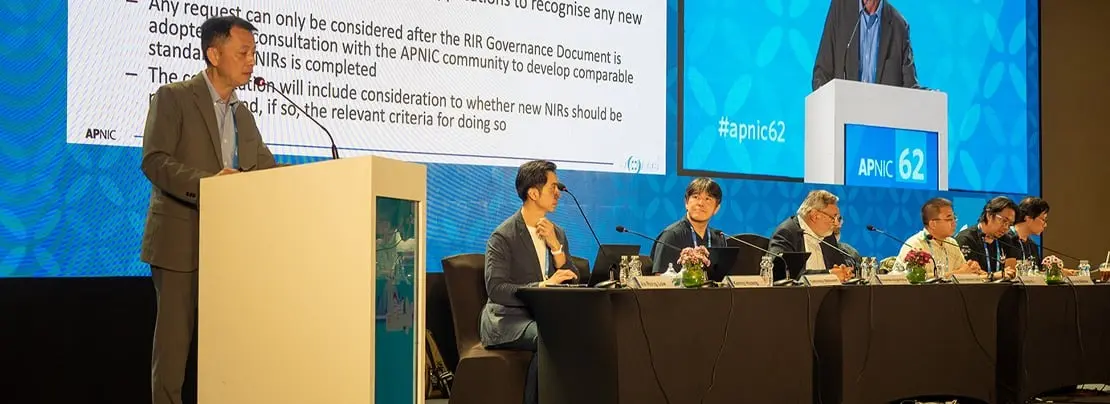
The recent APNIC Member Meeting (AMM) held during the APNIC 62 conference successfully brought together Internet community members, stakeholders, and organizational leaders from across the Asia-Pacific region to review performance metrics and deliberate on strategic priorities for the future.
The conference drew robust participation, welcoming 584 registered participants representing 54 distinct economies. Throughout the event, more than 50 community members actively contributed to open mic sessions, while the APNIC Executive Council (EC) engaged in direct dialogues with members, community representatives, and regional partners. This high level of active engagement underscored the commitment of the regional Internet community to shaping the trajectory of the organization and the broader global Internet Number Registry system.
Reflecting on the successful turnout, the APNIC Executive Council expressed gratitude to everyone who participated in APNIC 62 and the AMM, whether attending in person or joining virtually from around the globe. The diverse perspectives, constructive feedback, and insights gathered during these sessions hold significant weight, as they will directly inform the development of APNIC’s upcoming 2028-2032 Strategic Plan, which is scheduled to commence implementation next year.
Financial sustainability
Financial sustainability remained a central point of discussion and a key focus for the Executive Council throughout the meetings. During the AMM, members received a comprehensive update regarding the organization’s financial health, learning that APNIC’s first-half operational activities were delivered strictly in line with the 2026 Activity Plan, keeping overall financial performance firmly on track.
APNIC continues to operate within its authorized budget and currently forecasts a full-year operating deficit of AUD 209,000. This projected figure represents a notable improvement over the originally budgeted deficit of AUD 308,000. Looking further ahead, the organization remains firmly on track to return to a fully balanced budget by 2027.
Beyond the immediate budget cycle, discussions during the AMM addressed the broader, long-term challenge of maintaining financial sustainability past 2027, particularly as membership growth rates experience a natural stabilization. Addressing this future landscape will demand continued financial discipline and rigorous prioritization of organizational activities. This may include scaling back or sunsetting specific workstreams that no longer align directly with evolving member needs, while simultaneously identifying and implementing further improvements to operational efficiency.
Members were also briefed on several key asset and reserve management updates, including the status of APNIC’s investment portfolio, the financial transactions surrounding the sale of the 6 Cordelia Street office, and the organization’s overarching financial reserve strategy. These topics naturally generated substantial interest and engagement during the open mic session, leading to constructive dialogues and valuable feedback shared by the participants in attendance. Detailed documentation, including the official Executive Council report, the Treasurer’s report, and session recordings, remains accessible online via the conference program portal for those seeking a deeper dive into the financial data.
Enhancing governance through community participation
Community participation continues to serve as the bedrock of APNIC’s multistakeholder operational model, playing an indispensable role in the ongoing governance and evolution of both APNIC as an organization and the broader global Internet Number Registry system.
During the proceedings, the community formally recognized and thanked key community leaders—specifically Maemura Akinori, Nicole Chan, Dr Devesh Tyagi, Di Ma, and Gaurav Kansal—for their extensive contributions and leadership regarding the ICP-2 Review and the RIR Governance Document processes. Their dedicated efforts have helped guide critical regulatory and operational frameworks.
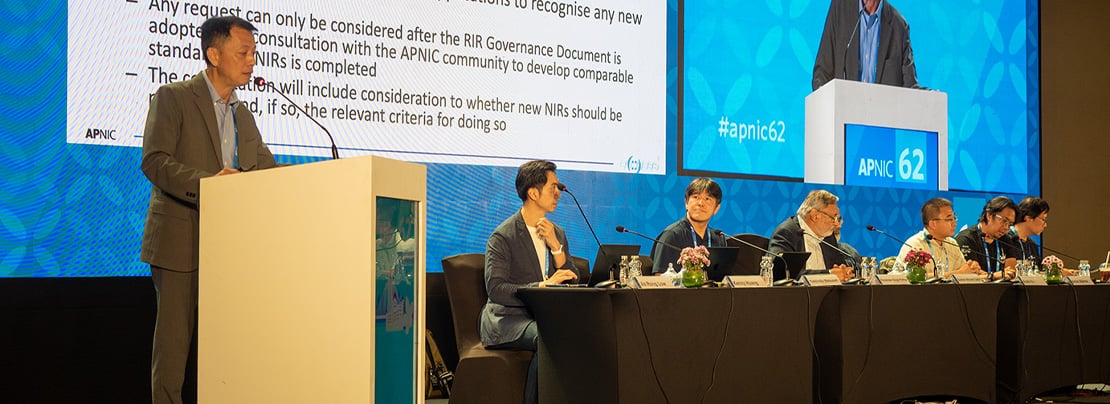
The APNIC Open Policy Meeting served as another focal point for governance, featuring robust discussions across seven distinct policy proposals. This represented the highest volume of policy proposals seen at an APNIC meeting in recent years, demonstrating the active intellectual engagement of the regional community. Notably, two of these proposals successfully achieved consensus among the participants.
Another vital discussion stream centered on cultivating the next generation of community leaders. The Community Consultation on Increasing Diversity in Community Leadership addressed both the structural challenges and the tangible opportunities present in the region. Key themes included finding effective ways to strengthen members’ sense of connection and belonging to the broader APNIC community, as well as establishing reliable, long-term development pathways to support emerging leaders as they step into governance and technical roles.
Furthermore, participants heavily emphasized the immense value of the APNIC Fellowship Program, highlighting its critical role in identifying, mentoring, and supporting future technology leaders hailing from developing economies across the Asia-Pacific. The APNIC Secretariat is currently in the process of consolidating the comprehensive findings from these consultations so that the Executive Council can carefully consider them when determining the organization’s next strategic steps.
APNIC’s future strategic direction
The APNIC 62 conference also provided the official platform for the release of the 2026 APNIC Survey findings. Commissioned by the Executive Council and independently administered by a professional research organization, the survey gathered comprehensive feedback from more than 1,300 individual members and community participants. The resulting dataset provides a statistically robust and reliable perspective on how the community perceives APNIC’s current operational performance, its responsiveness to future needs, and its overarching strategic priorities.
The survey results revealed consistently high levels of satisfaction across multiple core metrics, including organizational trust, service quality, the tangible value derived from membership, and overall institutional performance.
One of the most significant insights extracted from the survey data was the remarkable breadth of priorities identified by respondents. Rather than concentrating their focus narrowly on one or two isolated areas, survey participants emphasized the vital importance of maintaining a balanced portfolio of activities across the entire organization. These activities are seen as crucial not only for maintaining smooth registry operations, but also for actively contributing to the preservation of an open, stable, secure, and resilient Internet throughout the vast Asia-Pacific region.
In response to these comprehensive findings, the Executive Council announced plans to publish a formal organizational response later this year. This response will outline precisely how the community survey data and associated feedback will be integrated into the foundational framework of APNIC’s next Strategic Plan.
Stay involved
As the conference concluded, the organizers reiterated their appreciation to all participants, contributors, and volunteers who made APNIC 62 and the AMM a success. Members are strongly encouraged to maintain their active engagement by participating in ongoing policy consultations, contributing to governance activities, and utilizing communication channels such as the APNIC EC Contact Form. Ongoing community input remains essential for ensuring that the Executive Council accurately understands member priorities and continues to make well-informed, community-driven decisions for the future of APNIC.


Leave a Reply